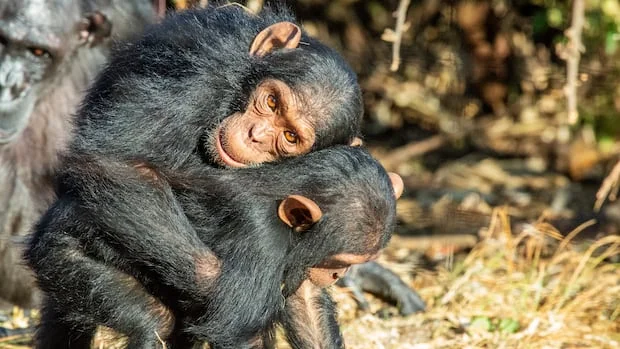
Great apes avoid conflict by hugging and kissing each other
Study shows chimpanzees and bonobos use affection to build 'social tolerance'
LISTEN | Interview with Jake Brooker:How do great apes keep the peace? A caress, a cuddle or even a little hanky-panky can go a long way.
A new study has found both chimpanzees and bonobos use physical affection to build "social tolerance" and avoid unnecessary conflict ahead of potentially stressful situations.
Their tools of diplomacy include hugs, kisses, pats, and even love bites.
"All of the above and more," lead author Jake Brooker told As It Happens host Nil Kӧksal. "They use a lot of genital touching as well."
The findings — published Wednesday in the journal Proceedings of the Royal Society B: Biological Sciences — shed new light on how humanity's closest relatives maintain strong social bonds in tough times.
Pre-snack snuggles
Brooker, a psychologist and great apes researcher at Durham University in England, says researchers already knew that great apes use positive touch to console each other after conflict.
"When somebody is really clearly distressed, then we notice that a lot of bystanders will approach and offer them comforting contact, like similar to the way that human beings will do," he said.
But he says researchers started to notice these same affectionate behaviours "happening in other contexts that were stressful for them."
They seemed to get particularly touch-feely when threatened by an outside group, Brooker said — or right before eating.
"Great apes deal with a lot of stress in their lives," he said. "In particular, they can have a lot of within-group tension and stress when it comes to competition and their own resources."
To study this behaviour, the researchers looked at five groups of semi-wild bonobos and chimpanzees living in great ape sanctuaries in the Democratic Republic of Congo and Zambia.
They began feeding the primates peanuts at regularly scheduled intervals, so they knew when the food was coming, then observed their interactions in the five minutes leading up to snacktime.
"We saw that they were doing a lot of these behaviours right up into the anticipation of feeding," Brooker said. "And what we found was that the ones who were exchanging the most contact were also the ones who were able to share in the feeding of that food afterwards."
By building trust ahead of time, the apes avoid fighting over the food, the study concludes. That, in turn, allows them to eat more and longer.
- Chimps are sticking grass and sticks in their butts, seemingly as a fashion trend
- Great apes get a kick out of 'playfully teasing' each other, study finds
But, just like with humans, social dynamics aren't always cut and dried.
One group of chimpanzees bucked the trend and showed no such correlation between pre-snack cuddling and peaceful feeding. The study's authors say this suggests specific group histories and past conflicts may impact how positive touch is used within a group.
Chimps beat a bad rep
University of Toronto primatologist Julie Teichroeb says it's particularly interesting that both chimpanzees and bonobos displayed this positive touching behaviour.
That's because chimps, she says, have a reputation for being much more aggressive than their bonobo cousins.
Bonobos, for example, have been known to collaborate with outside groups, whereas chimps tend to break into violent rivalries between factions, even to the point of civil war.
"These two species are often contrasted because they differ greatly in their levels of aggression to out-group individuals, so it is interesting that they both use touch in the same way to increase within-group tolerance," Teichroeb, who was not involved in the study, told CBC in an email.
"This strengthens the likelihood that our shared ancestors also used the same mechanisms to decrease social conflict."
In fact, the study found chimps tended to canoodle more widely than the bonobos, and engage in higher-risk behaviours, like gentle bites or placing their fingers in each other's mouths. That was especially common between males.
"This suggests that species that are more aggressive may need to display greater levels of reassurance to allow social tolerance to carry over," Teichroeb said.
The lesson? Hug your bros
Brooker says there's a lesson here for people.
"I remember at school that it was really frowned upon for boys to offer any kind of touching contact to their friends. It was really vilified, almost," he said.
"If it was between friends and between people who have a really deep understanding, it can be something that really helps with communication and bonding. And it's maybe something that people could be missing out on."
Interview with Jake Brooker produced by Kevin Robertson