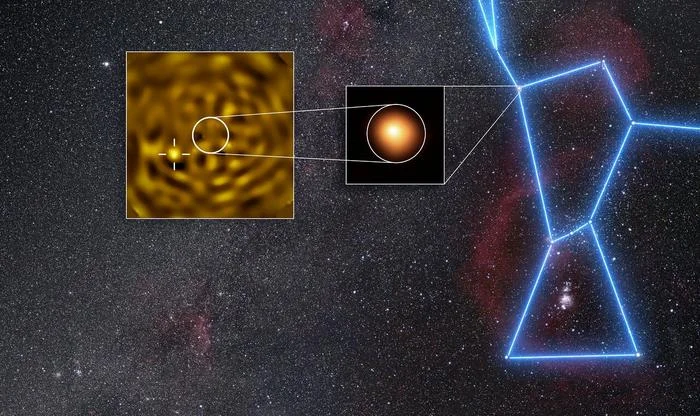
Astronomers have found the best evidence yet for a companion star to Betelgeuse, the brightest star in the constellation Orion. Based on data obtained by the SPHERE instrument on the European Southern Observatory’s Very Large Telescope (VLT) in Chile, they say this companion may be responsible for the red supergiant star’s periodic changes in brightness, which have puzzled scientists for decades.
Betelgeuse is a red supergiant star located about 548 light-years away. As the 10th brightest star in the night sky, it is generally visible even in locations with substantial light pollution. However, its brightness varies over a period of roughly 420 days, superimposed on a longer 2200-day modulation.
For decades, astronomers have suspected that some of these variations could be caused by a companion star that modifies the distribution of cosmic dust that Betelgeuse produces and expels. These changes in cosmic dust would, in turn, change the amount of its light that reaches us here on Earth.
A few years ago, two studies (published in The Astrophysical Journal in 2024 and 2025, but available as preprints beforehand) predicted that in December 2024, this companion star would be at its greatest distance (maximum elongation) from Betelgeuse, making it easier to detect. To take advantage of this opportunity, researchers led by Miguel Montargès of the Observatoire de Paris – PSL, France, requested observing time on the VLT. Although the same studies predicted that the companion would not be massive enough to be detectable with current instrumentation, Montargès and colleagues nevertheless hoped to place upper limits on its stellar parameters.
A difficult analysis
The astronomers used the SPHERE instrument on the VLT to image light from the region where the companion was expected to be, followed by advanced post-processing techniques originally developed to search for exoplanets. Betelgeuse’s brightness and large angular size made this analysis difficult, explains Montargès, but he and his colleagues were nevertheless able to gather enough data to identify a “Betelbuddy” with a confidence of 6σ. As Montargès points out, this is better than the previous upper limit of 1.5σ reported by astronomers at NOIRlab in 2025, and above the usual 5σ threshold that constitutes an “observation” or “discovery”.
Despite this, the astronomers say that before they can be certain that they have really detected a companion that it is indeed gravitationally bound to Betelgeuse, they will need to perform additional observations next year. At that point, they will attempt to confirm the companion’s presence by observing it half a period after the initial detection, on the other side of the red supergiant. “We will then continue observing it to get a precise characterization of its orbit (semi-major axis, eccentricity and inclination, among other parameters),” Montargès says. “These will be required to understand the past and future evolution of the system.”
What happens next
As a mature supergiant star, Betelgeuse is expected to undergo a supernova explosion at some point. The presence of a companion star could affect how this process plays out, and even dictate when the eventual explosion occurs. “It is clear to me that this companion detection will now trigger a wave of new studies on the evolutionary status of Betelgeuse,” Montargès says. “Depending on past, present and future interactions between the two stars, the supernova could possibly be advanced or delayed.
‘Buddy star’ could explain Betelgeuse’s varying brightness
“Betelgeuse is a star that has been observed throughout history,” Montargès continues. “It was even depicted in prehistoric paintings, yet we are discovering one of its fundamental characteristics only now.”
And that is not all: “30% of red supergiants in our galaxy show the type of light variations that led to the discovery of Betelgeuse’s companion,” he tells Physics World. “We may have opened a new avenue to find such binary systems, when the primary star is an evolved star like Betelgeuse.”
The new study is detailed in Astronomy and Astrophysics.