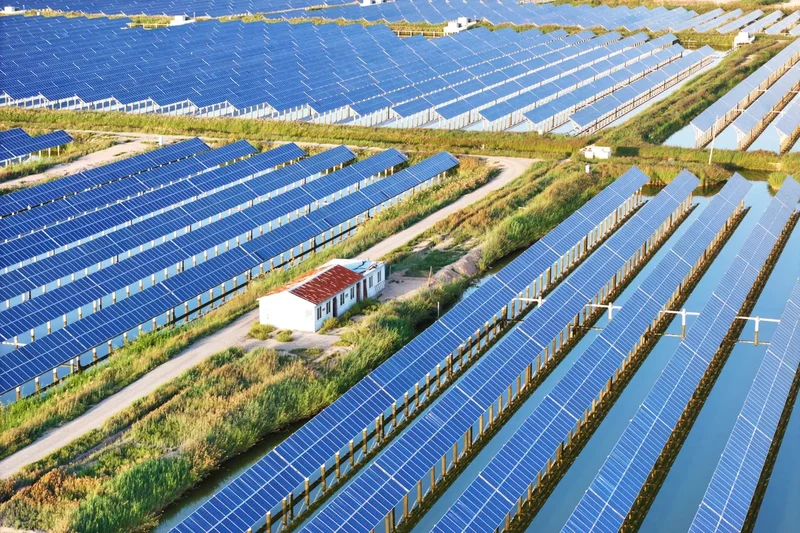
China's drive to build solar power at a record pace has come at a hidden cost to its birds, a new study has found.
Researchers tracked bird populations alongside government solar policy in more than 2,300 counties over a decade. They found that wherever local authorities pushed hardest for solar development, the diversity in bird population reduced.
Although the drop at any single site was small, the pattern repeated across thousands of counties rather than in just a handful, and the decline was sharper in wealthier regions and in places without desert terrain.
Both resident and migratory birds suffered, though species that live in the mountains, where solar farms rarely go up in the first place, were largely spared.
China has already installed more solar capacity than any other country. Its solar footprint covered an estimated 4,520sqkm by 2024, close to three times the size of Greater London.
The country plans to reach carbon neutrality before 2060. However, experts said the solar sites are being chosen not for optimum sunshine or spare land but to fit the government's five-year economic plans, according to the study.
Builders often plant vegetation around new solar sites to meet environmental rules, but the study found this rarely helped. The extra leafiness was "too homogeneous", the report said, and as a result "the ecological quality went down" even as the amount of greenery increased. The researchers called this pattern "inferior greening".
The researchers also had to rule out a simpler explanation, that solar developers were choosing land that was already poor for birdlife, rather than causing the decline themselves.
To test this, they built a statistical model using historical sunshine records and a measure of how uncertain climate policy had been in each area over time. Neither factor should affect bird numbers except through its influence on solar development.
The result held up, and it survived a battery of further checks, including tests that dropped outlying regions and controlled for other environmental policies running at the same time. The findings were published Thursday in the journal Science.
Huiming Zhang, an associate professor at Nanjing University of Information Science and Technology and the study's lead author, said the results should not be read as an argument against renewable energy.
"The main message is not to slow the renewable energy transition, but to make solar development more ecologically informed," he said. Clean energy development and biodiversity conservation did not have to come at each other's expense, Dr Zhang said, but "careful siting and biodiversity safeguards are essential."
"The average effect is modest, but it is meaningful when it occurs systematically across many counties," Dr Zhang and his co-authors wrote.
The study's authors want large solar projects steered towards land with less ecological value, along with more thorough checks on individual sites before building begins and tighter limits on converting productive, wildlife-rich land.
Yuanning Liang, an economist at Peking University, said birds are a useful gauge of biodiversity more broadly, since they are one of the few animal groups tracked closely over time and across large areas.
"The next step is to move from biodiversity measurement to valuation by linking changes in bird diversity to ecosystem services and conservation values.
"Without such valuation, policy analysis gives insufficient weight to conservation, and benefit-cost analysis can understate the social cost of development. Just as climate policy requires credible estimates of climate damages to inform the social cost of carbon, credible estimates of biodiversity values are needed when sustainable development policies alter ecosystems."