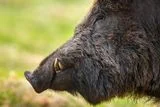
Killing a mature wild boar was dangerous enough that a 19th-century Belarusian saying advised hunters to send for a priest first. The boar behind one particular medieval trophy made that advice worth listening to. It was at least eight years old, weighed more than 100 kilograms (220 pounds), and had reached the full size and strength.
Archaeologists excavating the Troitsky XVI site in Veliky Novgorod, Russia, recovered one of that animal's tusks in 2020, fitted into an engraved metal mount designed to look like silver. Dated to the second half of the 12th or early 13th century, the find is described in The Volga River Region Archaeology as the first amulet of its kind ever recorded, a tooth or tusk set into a decorative mount.
Read More: Translation of Tiny Scroll Tucked Inside 1800-Year-Old Amulet
Medieval Boar Tusk Amulet From Novgorod Was Made to Resemble Silver
Animal tooth and claw amulets are common finds in Novgorod's medieval layers, and boar tusks are the second most frequent type, behind bear teeth and claws. Of the 61 boar amulets recorded so far, 45 came from male tusks. Nearly all were drilled through and strung on a cord, but someone paid a jeweler to encase this one in metal and engrave it with flowing plant motifs and spirals, decorative work never before documented on a Novgorod tin object.
Chemical analysis showed the mount was made from tin mixed with small amounts of lead and copper, a composition similar to what a 14th-century London jewelers’ guild classified as fine pewter. Its smooth, silvery surface likely made it an appealing substitute for the precious metal.
The mount was likely cast in a two-part clay mold, then engraved by hand once the metal cooled. A separate strip of wire, made from a slightly different, lower-melting alloy, was soldered around the wider end, showing the craftsman purposely chose different metals for different parts of the job.
Tin wasn't cheap or local either. Most of it reaching Novgorod's jewelers likely traveled from tin-mining regions in Britain, since usable tin deposits were scarcer across medieval Europe than copper or lead.
The Dangerous Hunt Behind an Elite Trophy
The tusk turned up on a wealthy estate alongside arrowheads, part of a saber's crosspiece, a chainmail fragment, birch bark documents, and seal fragments, the kind of assemblage researchers associate with families tied to Novgorod's warrior elite. Nearby, in the same layers, sat a fragment of an equally rare tin pin decorated with a peacock.
In medieval Rus, boar hunting was primarily a dangerous pursuit for princes, nobles, and warriors rather than a way to secure food or fur. A medieval chronicle records Prince Daniel of Galicia and his hunting party killing six boars during one outing, three of which the prince brought down himself with a spear.
An Older Amulet Tradition Takes On a New Meaning
Boar tusk amulets like this one were more common in Novgorod centuries earlier, peaking between the mid-900s and mid-1000s, a period researchers tentatively connect to close contact with Scandinavian culture and its boar mythology, including a golden boar sacred to the god Freyr and boar-crested helmets found in warriors’ graves across Northern Europe.
By the time this tusk was mounted, researchers believe that original meaning had faded roughly 150 years earlier. They argue that the tusk may instead have represented a hunter’s strength and courage transferred from animal to victor, while also serving as a charm for future good luck. A similar tusk found at another Rus town carries a scratched Christian inscription asking for divine help, suggesting that this old pagan practice had learned to coexist with newer prayers.
The mount has no loop for a cord, but the tusk’s broken end may once have carried another attachment. Whether worn, kept within the household, or passed down as an heirloom, its story may have remained worth telling for at least one more generation.
Read More: Iron Age Celtic Grave Reveals Gold, Weapons, and a Two-Wheeled Chariot
Article Sources
Our writers at Discovermagazine.com use peer-reviewed studies and high-quality sources for our articles, and our editors review for scientific accuracy and editorial standards. Review the sources used below for this article:
- This article references information from a study published in The Volga River Region Archaeology:A Wild Boar Tusk in a Metal Mount from the Troitsky XVI Excavation Area in Veliky Novgorod: a comprehensive study