For women experiencing violence, knowing where to find help can be difficult, especially for those who are new to Italy or do not speak Italian fluently.
Here are some of the resources available, from the national 1522 helpline to anti-violence centres, shelters and financial support.
Helpline
The official helpline for women experiencing violence is 1522, a free service run by the Ministry of Equal Opportunities that is available 24 hours a day across Italy and provides assistance in several languages.
Operators can provide information in Italian, English, French, Spanish, Arabic, German, and by appointment also in Albanian, Persian, Algerian, Syrian, Syrian-Lebanese, Moroccan, Egyptian, Berber and Chinese. They share essential information on available services, and calls are confidential.
The helpline can connect you with centri antiviolenza (anti-violence centres), which provide free practical and psychological support as well as legal guidance to women victims of violence and abuse. In cases of emergency, operators might activate a specific procedure with law enforcement authorities to help the callers.
If you are in immediate danger, call 112, Italy's emergency number, or go to the nearest police station or carabinieri station to report what happened.
When women file a complaint to the carabinieri or the police, the case might fall under codice rosso (red code), a fast-track procedure for certain offenses, including domestic and gender-based violence. It requires the police to inform the prosecutor’s office immediately and the prosecutor to hear the victim within three days.
If you are unable to make a phone call or go to a police station, you can also use YouPol, a free app from the state police to send real-time texts, photos and videos directly to local police officers to report domestic violence.
Shelters and anti-violence centres
Anti-violence centres (centri antiviolenza) designed to help women victims of male violence are available across Italy and offer free support to those at risk.
The association D.i.Re, a national anti-violence network run by women, lists 88 organisations that run anti-violence centres around the country, providing the phone number for each.
Anti-violence centres can provide different forms of assistance, including access to safe shelters for women and their children, legal assistance, psychological support, help with employment search or continuing education, support groups and more.
These centres are underfunded and oversubscribed. Yet, reaching out to these centres or other organisations in your region is the first essential step to learn about available resources and receive assistance.
The Ministry of Equal Opportunities also provides an updated map of accredited anti-violence centres and shelters. UNHCR also suggests Juma Map, as a resource for finding organisations supporting survivors or people at risk of gender-based violence.
Other major organisations supporting women experiencing violence include Differenza Donna and Telefono Rosa.
Support for international residents
D.i.RE also runs a project called Leaving violence Living safe dedicated to female refugees and asylum seekers who are victims of violence, helping them access shelters and other services in partnership with UNHCR, the United Nation Refugee Agency.
The organisation says it has supported 422 women refugees and asylum seekers and trained 64 language mediators.
Up to 27 percent of the women who access anti-violence centres are foreign, according to Mariangela Zanni, D.i.RE national councillor.
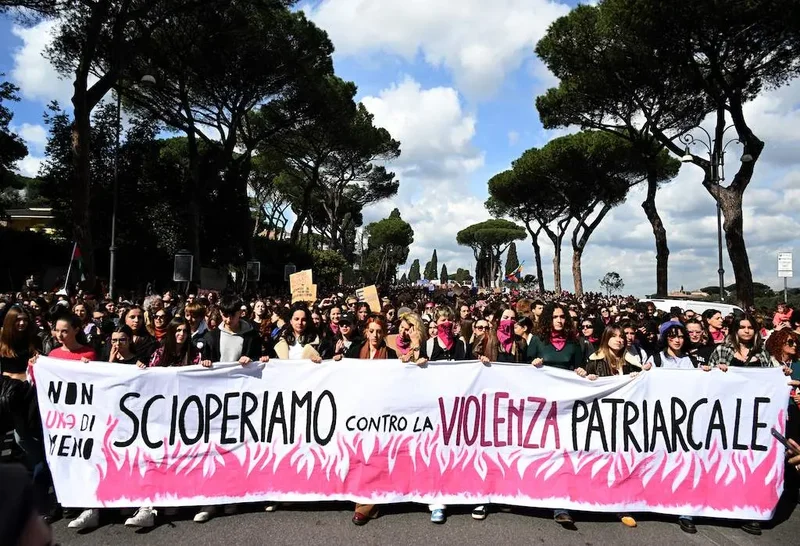
Violence against women, she said, was linked to the “patriarchal culture where men think they have the power to decide over the lives of women they had an intimate relationship with.”
“It is important to properly prevent the phenomenon, starting with emotional education programs in schools and continuing with mandatory training for all workers that answer women's requests for help: social health services, law enforcement, and the judicial system,” she said.
Foreign women without a valid residence permit who are victims of domestic violence might also be eligible for a special residence permit. The permit can be granted when local authorities establish that there is a concrete and current danger to the woman's safety as a result of violence. It aims to help women whose residence status is linked to their relationship with an abusive partner, as it can allow them to remain legally in Italy after leaving their abuser.
It can be requested in cases involving offences such as abuse, sexual violence, serious injuries, kidnapping and other crimes committed in the context of domestic violence. The procedure can also be triggered through the work of an anti-violence centre or specialised social services that report the situation to the authorities.
However, the permit is subject to specific legal requirements and is not automatically granted to every victim of domestic violence.
Women experiencing violence and living in a situation of financial hardship may also be eligible for Italy’s Reddito di Libertà (“Freedom Income”), a financial support measure designed to help women leave abusive situations and regain economic and personal independence.
The amount available is up to €530 per month for maximum 12 months, as reported by ANSA.
The funds are available to women living in Italy who are victims of violence, including eligible non-EU nationals with a valid residence permit, and who are being supported by a recognised anti-violence centre and social services.
The money can help cover housing and other expenses, such as school expenses for children, but funds are limited and not everyone who applies might be able to benefit from this initiative. Women need to fill a form and submit the application to their municipality with the help of representatives from an anti-violence centre or social services.
Violence against women remains a serious problem in Italy, with 100 or more women killed in the country each year, most by current or former partners, according to Interior Ministry figures.
According to Non Una di Meno, an organisation that tracks femicides in Italy, 40 femicides had been recorded between the beginning of the year and August 8th, with the number rising further following the spate of killings reported since Ferragosto (August 15th).
We have chosen to make this article free to all, but if you can please consider supporting The Local by becoming a member