Did Mexico create a blacklist of journalists and politicians? The president says no
- Click here to listen to this article
- Mexican President Claudia Sheinbaum is under fire after a top aide publicly named dozens of journalists, media outlets and opposition figures as part of a hostile ‘digital ecosystem’ attacking her government.
- Critics decry the lists as blacklists that stigmatize independent media in one of the world’s deadliest countries for reporters.
- The release of the lists comes as Sheinbaum’s administration prepares new ‘audience rights’ rules that would discourage television and radio outlets from broadcasting what the government calls ‘false’ information.
MEXICO CITY — In her previous job as mayor of Mexico City, Claudia Sheinbaum expressed outrage when a conservative critic proposed publicizing a list of prominent supporters of her leftist Morena political party.
“This is a fascist position,” then-Mayor Sheinbaum declared in 2021. “Who makes lists? McCarthyism. Nazism. Those are the ones who make lists.”
Now, Sheinbaum finds her government accused of creating its own blacklists — this time naming journalists, media outlets and others at odds with her administration.
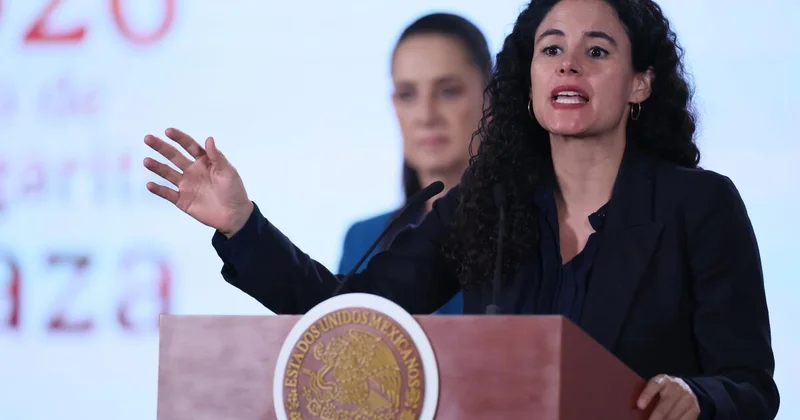
The president is facing a firestorm of criticism after her chief counsel, Luisa María Alcalde, unveiled the incendiary lists last week at the National Palace. She assailed a digital “ecosystem” of bots and trolls that, she contends, picks up on journalistic criticisms to amplify “false narratives” against Mexico’s leadership — or, as many critics call it, a “narco government.”
Alcalde released two lists containing the names of 54 news outlets and journalists, and another ledger of 32 opposition politicians and groups.
We journalists aren’t here to applaud the government
— Jorge Ramos, former Univision anchor
As journalists lined up to condemn the lists, Sheinbaum denied any attempt at censorship and came to the defense of her suddenly embattled chief counsel — who, the president said, never targeted anyone directly. The lists did not propose any official actions against those named.
“At no moment did she say ... ‘They are the bad journalists,’ or ‘the journalists who attack us,’ ” the president said.
According to Sheinbaum, the point was that social media used journalistic accounts “to generate a propaganda scheme against the government.”
The president’s efforts didn’t quiet a crescendo of scathing rebuke from many journalists, who called the lists a government-backed effort to muzzle Mexico’s press.
“It makes it seem like it’s something orchestrated, organized, that those of us mentioned here get together every night to generate messages, critiques, accusations [against] the government,” Carmen Aristegui, a leading Mexican journalist, said in a video response. “The history of humanity tells us that when a regime, when a government, decides to list names ... it has resulted in tragedies.”
Aristegui’s eponymous news outlet made a list.
Mexican President Claudia Sheinbaum let long-mounting frustrations with the Trump administration rise to the surface.
Many journalists were especially outraged because of the extreme dangers faced by Mexican reporters, editors, columnists and photographers. At least 14 have been killed since Sheinbaum took office almost two years ago, noted Jorge Ramos, the Mexican-born former Univision anchor whose name appears on a list.
“The list adds yet more pressure for a profession under attack,” Ramos wrote in the newspaper Reforma, which was also listed.
“The principal problem with this list is the total ignorance about the work of independent journalism,” wrote Ramos, who has clashed publicly with Sheinbaum and her predecessor and mentor, Andrés Manuel López Obrador. “We journalists aren’t here to applaud the government.”
Some journalists cheekily celebrated their inclusion — just as, in the 1970s, U.S. journalists and others named on President Nixon’s “enemies list” viewed their presence as a badge of honor.
“Thanks for including me,” wrote Denise Dresser, known for her acerbic anti-government columns. “To be there confirms that criticism still stings them, pluralism weighs on them, dissent keeps them awake, and freedom of speech is not your thing. We’ll see each other in the next ecosystem.”
The list of political figures includes two ex-presidents, Vicente Fox and Felipe Calderón, both conservative adversaries of Sheinbaum and López Obrador.
Sheinbaum vehemently denied any attempt to compile a blacklist.
“There was no list,” Sheinbaum told reporters Tuesday during a heated exchange at her regular morning news conference. “Names were presented. ... What was demonstrated was the use of digital platforms, of social media, to amplify and generate false news.”
The president rejected any suggestion of censorship.
“Nobody is censored,” Sheinbaum said. “Who has been censored here? Name one journalist whom we have censored? There isn’t one.”
Working for the sons of cartel leader ‘El Chapo,’ a pilot known as Jando rose from drug smuggler to become the commander of the Sinaloa cartel’s air force.
The president scoffed at the notion that anyone named may suffer consequences, even though Mexico is one of the world’s most hazardous countries for journalists.
“Don’t tell me some of the journalists who are there have suffered some damage because of this,” she said.
Sheinbaum regularly bemoans what she views as “fake news” maligning her leadership. In May she urged Mexicans not to watch TV Azteca, a private station that regularly assails the government. TV Azteca’s billionaire owner, Ricardo Salinas Pliego, made the lists.
The lists emerged as part of Sheinbaum’s controversial plan to protect “audience rights” by imposing new guidelines on television and radio outlets. Broadcasters, the government explained in a fact sheet, should not air “false” information and should distinguish between fact and opinion, publicity and news.
Under Sheinbaum’s blueprint, broadcasters would be required to develop codes of ethics, name ombudsmen to represent viewers and listeners, and establish mechanisms to receive and evaluate complaints. The plan does not cover print and digital media.
The proposed guidelines, Sheinbaum said, amount to “self-regulation.” But an official summary states that federal regulators may impose “sanctions and economic fines” against outlets that violate the new standards.
Many broadcasters view Sheinbaum’s “audience rights” initiative as a stealth infringement on the free press.
“It’s clear that the intention is not to protect the audience,” Alejandro Villalvazo, a TV Azteca anchor said on the air. “The idea is to place a dictatorial hand to decide what we can and can’t say.”
On Thursday Sheinbaum said the new guidelines for broadcasters could be finalized next week. They do not require congressional approval and could be enacted by her government.
“It’s an advance in our country’s democracy,” Sheinbaum said of the new rules. “It doesn’t have anything to do with censorship.”
*McDonnell is a staff writer, Sánchez Vidal is a special correspondent. *