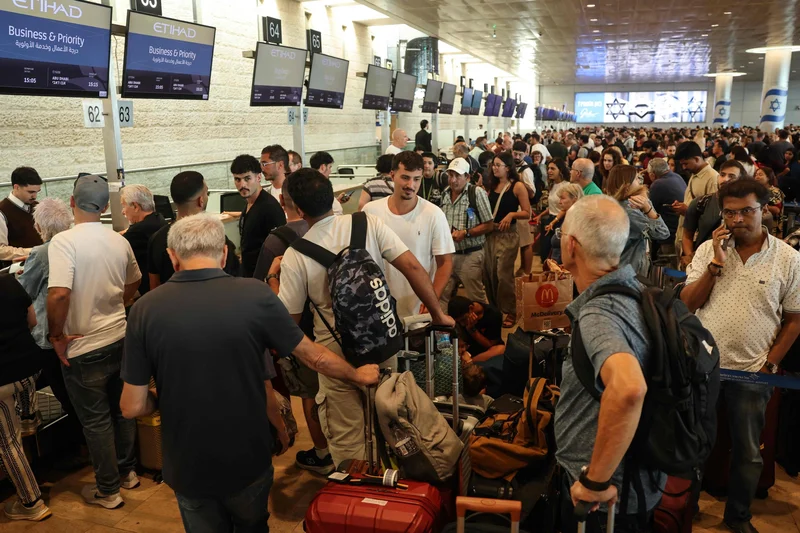
Israel is seeing a record wave of emigration increasingly driven by highly educated, high-earning professionals, research shows, as the country continues attacks across the region, including in Lebanon, Iran and Syria, amid mounting international criticism over violations of international law.
Nearly 270,000 Israeli citizens left the country for at least three consecutive months between 2023 and 2025, according to a Tel Aviv University study released this month, marking a sharp increase from comparable levels a decade earlier.
The trend has raised warnings of a potential brain drain, with studies showing doctors, engineers, academics and other skilled professionals leaving in high numbers.
Independent Israeli political commentator and former university professor Ori Goldberg told Anadolu Agency (AA) that the trend reflects a broader loss of stability in Israel.
"The country is falling apart. It lacks stability," Goldberg said.
He said many of those leaving expect "stability," functioning state services and guarantees that public institutions will operate at a satisfactory level, while also tending to hold relatively liberal views.
"The numbers are much larger than they usually are. The balance of people who are leaving against people who are coming is much larger than it usually is," he said.
A Tel Aviv University study based on Central Bureau of Statistics data found that 268,509 Israelis left the country for at least three consecutive months between 2023 and 2025, compared with 183,219 during the corresponding three-year period a decade earlier.
Departures totaled 86,509 in 2023, 91,499 in 2024 and 90,922 in 2025.
Because official 12-month emigration figures for 2025 will not be available until 2027, researchers used departures lasting at least three consecutive months as an early indicator. They estimated that 45,000 to 50,000 Israelis likely remained abroad for at least a year in 2025.
Separate data presented during a Knesset committee debate in June also showed a sharp deterioration in the migration balance.
Israel's migration balance for Israeli citizens was negative between 2022 and 2024, declining by approximately 140,000 people over the three years, according to statistics bureau figures cited by the Knesset.
The profile of those leaving has also shifted.
Israeli emigrants aged 25-64 in 2022 were considerably more educated than the general population: the proportion holding bachelor's degrees was 1.5 times higher, master's degrees twice as high and doctoral degrees 4.6 times higher, according to data presented to lawmakers.
In 2024 alone, 530 physicians left Israel, two-thirds of whom had studied in the country, while the number of doctors returning declined.
Research by the Israel Tax Authority cited by the Times of Israel found that emigration among affluent Israelis rose sharply in 2023 and 2024, with doctors, engineers and other highly educated professionals disproportionately represented.
The average annual income of emigrants in the year before departure rose in real terms from around 125,000 shekels ($39,000) in 2015-2019 to roughly 200,000 shekels in 2024.
Goldberg said the departure of professionals presents a "real risk," particularly as conditions in sectors such as healthcare, research and technology become more difficult.
"There is a bit of a risk of a brain drain," he said, noting that those leaving tend to be "highly educated professionals."
He pointed particularly to physicians and tech workers, saying doctors sent abroad for residencies are increasingly not returning, while tech professionals have greater flexibility to relocate.
"Practicing these professions in Israel will become more and more difficult. So people will simply leave, which is what I think is happening," he said.
Goldberg attributed much of the acceleration to developments since October 2023, when Israel launched a genocidal war on Gaza following an attack by Hamas, arguing that the security crisis and subsequent political and social changes cannot be separated.
"I think most of it is because of October 2023," he said.
"The political developments and the polarization and controversy and the social questions developed because of the collective trauma experienced since October 2023."
He said the period pushed Israeli society toward a more security-oriented outlook and reinforced political divisions already visible during the controversy over the government's judicial overhaul.
The Tel Aviv University researchers similarly noted that public concern over emigration increased after the November 2022 elections and the judicial overhaul dispute, before intensifying following October 2023.
- Temporary wave or long-term shift?
Researchers cautioned that current emigration levels do not by themselves threaten Israel's economic resilience, but warned that a sustained rise could have long-term consequences for an economy heavily dependent on a relatively small pool of skilled workers in technology, healthcare and academia.
They also raised the possibility of a feedback effect in which continued departures encourage further emigration, making the trend increasingly difficult to reverse.
Goldberg said he does not expect the current wave to simply disappear even if immediate conditions improve.
"I don't think it's such a temporary wave, and I don't think political and security conditions can be stabilized so easily," he said. "I'm not so sure Israel can simply go back to the way it was."
Research by immigration and demography scholar Lilach Lev Ari on Israelis living in the US also suggests that prolonged residence abroad can reshape migrants' relationship with their country of origin.
Her study found that while Israeli migrants maintained structural connections with Israel through family ties, digital communication and visits, longer-term migrants could simultaneously experience growing emotional distance - a phenomenon described as "transnational dissonance."
Goldberg said the current departures could therefore form part of a broader transformation rather than a short-lived response to a single crisis.
"I am assuming that Israel is entering a longer-term demographic and economic shift," he said.