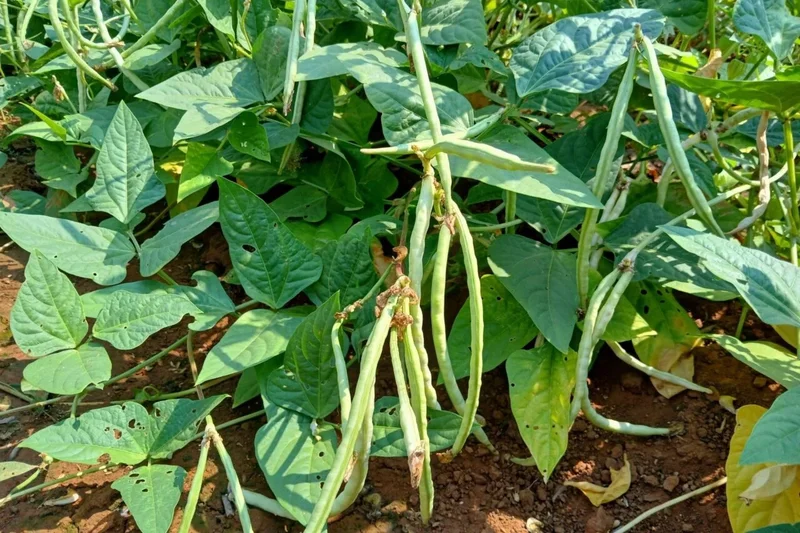
Plants are even craftier than we knew when it comes to self-defense, with one plant literally summoning parasitic wasps to kill off other insects eating its leaves.
Scientists in China studied how the cowpea plant (Vigna unguiculata) defends itself against a particular leaf-eating intruder. They found evidence the plant not only emits airborne chemicals that attracts a common parasite of the insect, it releases other chemicals into the soil through its roots that make it easier for future generations to use the same strategy. The team’s work showcases a previously unknown tactic of plant pest removal, the researchers say.
“Our findings reveal a fundamentally distinct layer of indirect defense in which [leaf-eating] leaves an imprint in the soil,” they wrote in their paper, published Friday in Cell Reports.
The crafty cowpea
The cowpea is a legume and one of the oldest known crops farmed by people. Today, people largely cultivate the plant for its black-eyed peas (also called southern peas), though its leaves and other parts are edible as well.
Though cowpeas are a hardy crop, they have their natural predators. One of these is the insect Liriomyza trifolii, more commonly known as the American serpentine leafminer. These tiny flies will bore holes in the cowpea’s leaves, both for food and to lay their eggs inside; their larva will similarly feed and create tunnels throughout the leaf. Heavy enough infestations can wipe out all of a plant’s leaves and reduce crop yields.
Leafminers have their own enemies, namely certain parasitic wasps. These wasps typically lay their eggs into the leafminer’s larvae, and upon hatching, the wasp’s offspring will munch on the latter. According to the authors, past research has shown that cowpeas can produce volatile compounds (chemicals that easily evaporate into the air) that seem to naturally attract these wasps when being attacked by leaf-eating insects like the leafminer. These chemicals only stick around for a short while, however, meaning it’s only a short-term defense mechanism.
The researchers were interested in figuring out whether the cowpea might have other tricks up its sleeve to defend against leafminers, or rather, up its roots. In a controlled setting, they studied cowpeas, leafminers, and the parasitic wasp species Neochrysocharis formosa.
As expected, leafminer-infested cowpeas released volatile chemicals that could attract the wasps. However, they also released other compounds through their roots that appeared to change the bacterial composition, or microbiome, of the surrounding soil. This tweaked microbiome, in turn, improved the cowpea’s ability to release its airborne wasp whistle, even in plants that had never been infested by leafminers in the first place.
“This multistep feedback loop transforms transient herbivore attack into a soil-borne defensive legacy,” the authors wrote.
Lessons to be learned
The authors note that their research was conducted under carefully controlled conditions. So important questions like how long the plant’s soil-changing strategy actually lasts in the real world are still unanswered. And who knows how many other plant species out there use a similar method.
For now, though, the team’s work further illuminates the complex interactions that plants have with their predators and alliesârelationships that humans might be able to leverage to keep our crops healthy without needing to rely too much on toxic pesticides, the researchers argue.
“These findings provide a mechanistic foundation for exploiting plant-microbe partnerships to enhance biological control, highlighting new opportunities for designing resilient and sustainable agroecosystems that harness the ecological process in soils,” they wrote.
Personally, I’m just glad that even plants have an exterminator they can call.