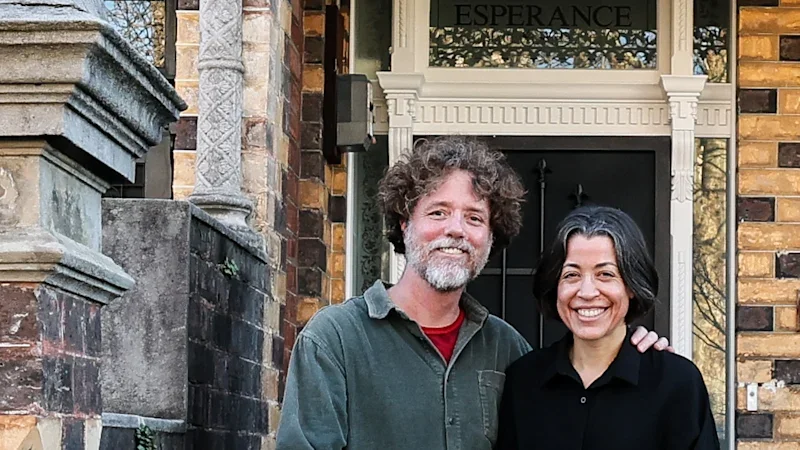
Shane McCullagh and his partner, Safia Desai, had worked in remote communities for years. Moving back to Melbourne, they wanted their kids to go to a good school, close to the city and work.
It was a two-year process to get into the coveted Princes Hill Secondary College school zone – the pair, both trained as teachers, had started renting nearby. Their two children attended Carlton North Primary, and they wanted to stay in the area for secondary school.
Many Melbourne home buyers consider school options when purchasing property, with analysis from Cotality revealing houses within select school zones can fetch premiums of hundreds of thousands dollars more than those outside the zone in the same suburb.
The median value for houses within the Princes Hill Secondary College and neighbouring University High catchment areas is about $204,000 more than those outside – a premium of 15.2 per cent. Of the areas analysed, only Glen Waverley Secondary College fetches a higher premium in Melbourne, at just under $267,000.
Princes Hill Secondary was within the top 20 government schools for VCE scores in 2025, with a median subject score of 32.
“It was just a challenge to find a house,” McCullagh, who now works as an infrastructure coordinator at the school, said. “And to be able to afford it, quite frankly.”
Princes Hill is one of Melbourne’s smallest suburbs, with a population of just 2005 in the 2021 Census, and there aren’t always enough sales to calculate a median value.
The school zone takes in small sections of Carlton North and Brunswick. The median home in the zone costs $1.54 million, or $1.34 million outside.
“Our data shows a distinct price premium for properties within these school zones,” Cotality quantitative analyst Irene Kang said, but noted that premium was often also tied to other amenities. “Families are typically paying for a broader lifestyle ... rather than purely the school itself.”
McCullagh agreed. “The attraction for us is the livability of the area – access to public transport, close to the CBD ... and obviously the parks nearby,” he said, noting the family had given up more space or a more modern home to stay in the area.
“We knew that houses here don’t come up very often ... we felt like we had to jump on it. The sheer number of people vying for one place was always a bit daunting.”
Kang said houses within coveted school zones tended to be more tightly held than those outside.
There were also “tangible” financial benefits, she said – mortgage payments for a home with access to a high-performing government school build equity over time, private school fees do not.
McCullagh’s agent, Nelson Alexander Fitzroy’s Nicholas West, said getting into a sought after school zone had become a bigger part of the buying discussion in the past decade.
“Parents have fewer children these days,” he said.
Like Kang, he stressed Princes Hill was an already tightly held suburb with many amenities.
“It’s a small area with relatively low turnover,” he said. “People just sit there and stay.”
Jellis Craig Mount Waverley agent Lily Chen said homes in the Glen Waverley Secondary College school zone ($1.95 million median) were more likely to sell than those outside ($1.68 million median).
“We definitely put it in the advertising, so a potential buyer knows right away,” she said. “If the price for a house outside the school zone is similar to one within the zone, [buyers] will raise the question of why it would be worth buying.”
Chen said the school zone wasn’t the only motivator for potential buyers.
“Some pockets in the school zone, like near The Glen shopping centre, are also expensive for other reasons,” she said.
School performance does not necessarily translate to a proportionally higher value for homes.
Balwyn High School – which had the equal highest median VCE study score of any non-selective government school in 2025 (33, with Glen Waverley) and the highest proportion of students with scores of 40 or more – fetched a premium of just 4.2 per cent within it and neighbouring Canterbury Girls’ school zones.
It’s already one of the most expensive suburbs in Melbourne – median house value $2,440,056 – and locals might afford to send their children to a nearby private school.
“It’s a back-up plan,” Marshall White Boroondara agent Suki Zhuang said.
She thought Balwyn High’s reputation helped boost prices even if buyers didn’t have school-aged kids.
“Having the school catchment helps with potential future value,” Zhuang said.
Kang said rising home values in coveted school zones risked entrenching inequality over time, squeezing out parents on lower incomes from high-performing government schools.
“Selective schools [could] help to support a more equal outcome, with entry based on academic performance rather than housing wealth,” she said.
More: