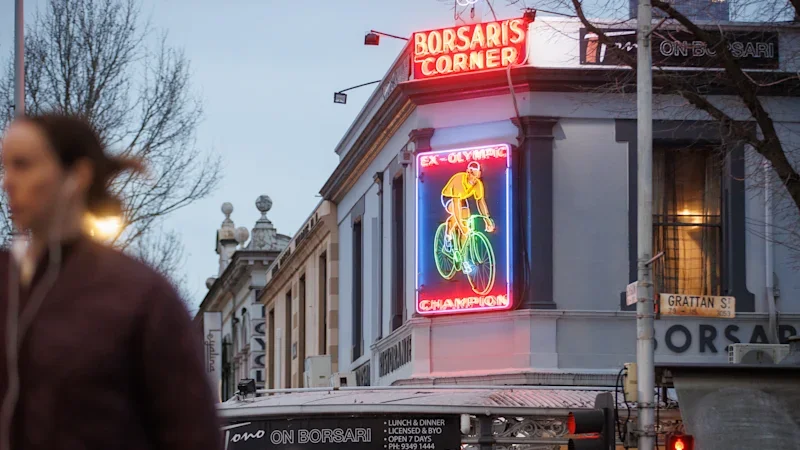
Lygon Street landmark Borsari’s Corner is on track to forever glow in the heart of Melbourne’s Little Italy, with the iconic neon sign and building recommended for heritage protection.
Olympic gold medallist and Italian community leader Nino Borsari installed the distinctive emblem bearing his likeness above the corner emporium he ran with wife, Fanny.
Described as the “King” of Italians in Carlton in The Argus newspaper in 1956, Borsari was heavily involved in promoting that year’s Olympic Games in Melbourne to Europe and was awarded an Italian knighthood for his work in Australia.
But he didn’t always intend to end up here. Achieving fame after winning a gold medal at the 1932 Los Angeles Olympics, Borsari raced in Victoria in the 1930s, returned to Italy and then came back to Melbourne in 1939 just before World War II broke out. He remained in Melbourne as an “enemy alien” and was banned from competitions but spared internment in regional Victoria during the war – a kindness he spent the rest of his life repaying.
“I said ‘why wouldn’t they arrest you, papa?’ And he said, ‘well, they like sportspeople’,” Borsari’s son, also named Nino, said with a grin.
“Mum and Dad were very much about paying back the hospitality that they had received here.”
He established a retail shop on the corner of Lygon and Grattan streets with help from other businessmen, which became known for high-quality bicycles, jewellery and hard-to-find Italian goods.
Nino and Fanny, an opera singer, grew the business together while raising their children Nino and Diana in a flat above the shop. The distinctive corner sign dates back to the 1940s, but it wasn’t until decades later that Borsari snr realised it included a small mistake, according to his son.
“It says ex-Olympic champion, and it took Dad 30 years to realise you’re never an ex-Olympic champion, you’re a champion and that’s it,” Borsari jnr said.
His sporting connections were deployed in an official charm offensive across Europe in the lead-up to the Melbourne Olympics, tasked by Australia with combatting overseas perceptions the city wasn’t modern enough to play host. It was later acknowledged as a roaring success and became known as the “Friendly Games”.
Nino and Fanny were known for their charity work and were among migrant founders of Brunswick-based Juventus Soccer Club, which dominated Victorian soccer from the 1950s and became an important hub for Italian-Australians.
Borsari snr was also patron of the Victorian Soccer Federation, a key figure in the League of Victorian Wheelmen and president of the Australian Boxing Federation.
But it was his support of recent migrants that earned him the prestigious Knight of the Order of Merit of the Italian Republic in 1968.
“I remember taxi drivers saying, ‘Oh, you’re Nino Borsari. I used to bring people straight off the ships when they were landing back in the ’40s and ‘50s, they didn’t speak any English and they’d say Italiano, Italiano, so I’d take them to Borsari’s Corner’,” Borsari jnr recalled.
Heritage Victoria described the corner as an evocative symbol of post-World War II Italian migration.
University of Melbourne Italian studies senior lecturer Elisabetta Ferrari likened the Borsaris’ willingness to help migrants from their corner shop to a welfare centre where recent arrivals could find help getting a job, obtain specialty products from home and seek advice on settling into Australia.
“Carlton especially has really been shaped by the Italian community and to recognise one of the valued members of the Italian community, I think, is very important and a way to remember that history,” Ferrari said.
Beverley Caprioli, matriarch of the family behind Lygon Street institution University Cafe for almost five decades, recalled the Borsaris as a deeply respected family known for their kindness.
“The Borsari family were leaders and helped a lot of young people who came to Australia,” she said.
“He [Nino] became a symbol of helping people and being able to give advice.”
While the Borsari name will forever be associated with Lygon Street, the family has since moved on.
The corner is now occupied by a restaurant run by another proprietor, and Borsari jnr has mixed feelings about the potential Victorian Heritage Register inclusion as he worries it could increase maintenance costs for the building.
But he is thrilled his parents’ achievements are being recognised in the 21st century.
“They were equally proud of being Australians as they were of being Italians, and sponsoring that community spirit,” he said.