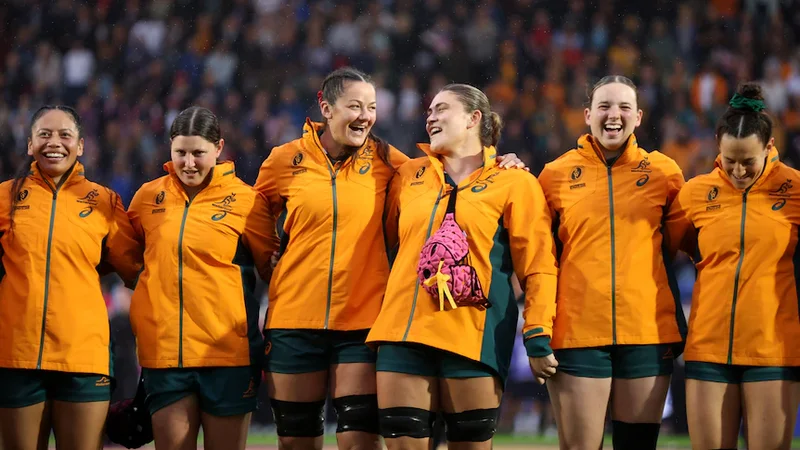
When you chat about the Wallaroos with Libby Andrew, one word frequently comes up in conversation.
Family.
It's the description Andrew uses to explain the close-knit relationship between players who have represented the national women's rugby union team, both past and present.
She knows, as well as anyone, how deep the connection runs, having played in the Wallaroos' first Test in 1994.
When Andrew was asked to present Wallaroos players with their jerseys last year, the strength of the bond was clear to see.
"I had never met any of them face to face," Andrew told ABC Sport this week.
"But when I walked into that room, there was a connection there.
"I guess it's probably a bit like being a grandparent. It feels like family."
The 2026 Wallaroos squad share Andrew's sentiment.
"There is just something that still ties you together, whether you're a Wallaroo of today's era or the past," Wallaroos captain Siokapesi Palu Sekona said.
"The experiences that you have on the field and off the field — they can only be felt by those who are Wallaroos."
Palu Sekona is preparing to lead the Wallaroos in Saturday afternoon's O'Reilly Cup Test against New Zealand in Auckland.
It will be the Wallaroos' 100th Test after a 32-year journey to reach the milestone.
When Palu Sekona and her teammates take the field against the Black Ferns, they'll be playing for more than themselves.
"There is definitely a responsibility to not only do the jersey justice, but to honour and show respect to the trailblazers of the game," said Palu Sekona, who will start at blindside flanker.
"I want to make sure I lead this team well and it will be a reflection of not only the 23 players who wear that jersey [against New Zealand], but more so for all the Wallaroos who are embedded in those green and gold jerseys."
Wallaroos' early days
Despite the fact history was made at North Sydney Oval on September 2, 1994, the Wallaroos' first Test was an understated occasion.
The squad to play New Zealand was picked following a national invitational club tournament held in Newcastle, as there was no official interstate competition — like Super Rugby Women's — in those days.
Andrew, who started in rugby league before switching codes, was one of several ACT players chosen.
The Test kicked off at 5pm as the first match of a double-header, with a Shute Shield semifinal between Randwick and Warringah considered the main attraction.
"We got stuck in peak-hour traffic on a Friday in Sydney and we were pushing shit uphill from the afternoon we left the hotel," said Andrew, who was a reserve flanker for the Test.
"At the time, I was so focused on the game that I had no idea we were creating history. It never occurred to me.
"I wasn't thinking about how other people were going to receive it or what it was going to feel like.
"We arrived late. There was no jersey presentation. It was like, 'We're late, the traffic was heavy, here's your jersey and chuck it on.'"
New Zealand won the Test 37-0, but the moment deserved to be remembered as a victory for Australian women's rugby.
The Australian Rugby Football Union (ARFU) — now known as Rugby Australia (RA) — had expressed lukewarm interest in establishing a national women's team.
ARFU staff member Joan Forno, who had been appointed Australian Women's Rugby Union president in 1993, took on the responsibility.
"She kept asking why aren't the girls playing and they kept ignoring her," Andrew said.
"We had missed the first two World Cups and I think because of the success of the Wallabies at the time, people were asking where the girls' team was.
"The ARFU kind of said, 'We're going to have to do this at some point'.
"They asked Joan if she would get it off the ground."
In Forno, Australian women's rugby had found one of its greatest advocates.
The players were juggling match and training commitments with full-time work or study, while some also had parenting duties.
Others quit their jobs so they could play for the national team.
Forno fought for funding, resourcing and — above all — greater recognition of the women's game.
"Joan Forno is like your mother," said Andrew, who worked as a police officer during her playing career.
"You don't say no to Joan Forno. Everyone was petrified of Joan, but Joan got shit done.
"I'm really hoping when the Women's Rugby World Cup comes to Australia in 2029, there will be credit given to Joan Forno."
Forno managed the Wallaroos when they made their Women's Rugby World Cup debut at the 1998 tournament, which was held in Amsterdam.
Under her management and the coaching of another devoted supporter of women's rugby, Bob Hitchcock, the Wallaroos reached the quarterfinals where they lost to England 30-13.
But the Wallaroos later defeated Scotland 25-15 to claim the Plate title.
"Joan and Bobby Hitchcock were like a pigeon pair," said Andrew, who played in the 1998 and 2002 Women's Rugby World Cups.
"Without Joan and Bob, there's no way we would be where we were."
'For the love of the game'
To mark the 30th anniversary of the Wallaroos' first Test, Andrew was inspired to self-publish a book in which she reflected on the team's history and the challenges they faced.
The book was titled Wallaroo 19 (Andrew is officially recognised as the 19th Wallaroos representative).
The fact the Wallabies were fully professional for much of Andrew's Test career, while Wallaroos players held down jobs, isn't lost on the 54-year-old.
"The women's rugby era I came from, we did things for our mates and for the love of the game," said Andrew, who played 12 Tests between 1994-2002.
"If it wasn't us, it may not have happened until 10 years later.
"The experience of a female athlete in this country was not the same experience as a man in the same sport."
Palu Sekona is in awe of the legacy forged by Andrew and her teammates.
"They've been the trailblazers," Palu Sekona said.
"They had to make those sacrifices at the beginning."
Positive steps
As Australia prepares to host the 2029 Women's Rugby World Cup, RA is increasing its support of the Wallaroos.
In a long overdue move, the Wallaroos' squad will soon go full-time and be aligned with the women's sevens program.
Overseeing this process will be successful Australian sevens coach Tim Walsh, who began work as RA's director of women's high-performance last month.
Walsh's knowledge of the rugby landscape is outstanding and he's ideally suited for this role, having been in charge of the women's sevens program when it went full-time in 2014.
He'll work closely with incoming Wallaroos head coach, Sione Fukofuka, who begins his tenure next year.
Walsh realises the Wallaroos are a "sleeping giant" in international rugby as their potential hasn't been properly harnessed.
Naysayers will point out the Wallaroos have lost more than 60 per cent of their Tests, remain winless against New Zealand after 30 attempts and finished no higher than third in their eight appearances at the Women's Rugby World Cup.
But these results create a false impression about Australia's talent pool and only highlight the hurdles women's rugby has faced, such as underfunding.
"The term sleeping giant is a really good analogy," Walsh said.
"We've seen glimpses of it (Wallaroos' potential). We've got the athletes, but we've got to provide the infrastructure for them to be able to excel.
"The runway to a home World Cup is long enough to wake up that giant."
Walsh added: "The physicality, the skill acquisition and the amount of times you get to play against and with each other is probably what's lacking.
"What we're looking to do is to maximise talent. There are some great players out there."
For Palu Sekona, who balances playing commitments alongside her job at Canberra's Erindale College, the Wallaroos just need "the opportunity to hone their rugby craft".
"Once we get our physicality right, our strength and conditioning right, imagine where our game can take us," said Palu Sekona, who plays her 28th Test on Saturday.
Andrew is elated the Wallaroos will get the support they lacked during her career.
"If those girls get full-time contracts, I can only say Hallelujah," she said.
"We do have the talent. We just need the coaching and we need the same opportunities the other countries have got."
Living in Canberra, Andrew will be with the Wallaroos in spirit once kick-off rolls around in Auckland at 1:05pm AEST.
When asked how proud she'll be watching the Wallaroos play their 100th Test, Andrew's sense of family came to the fore again.
"[I'll be] like a mother watching her child ride a bike for the first time," she said.