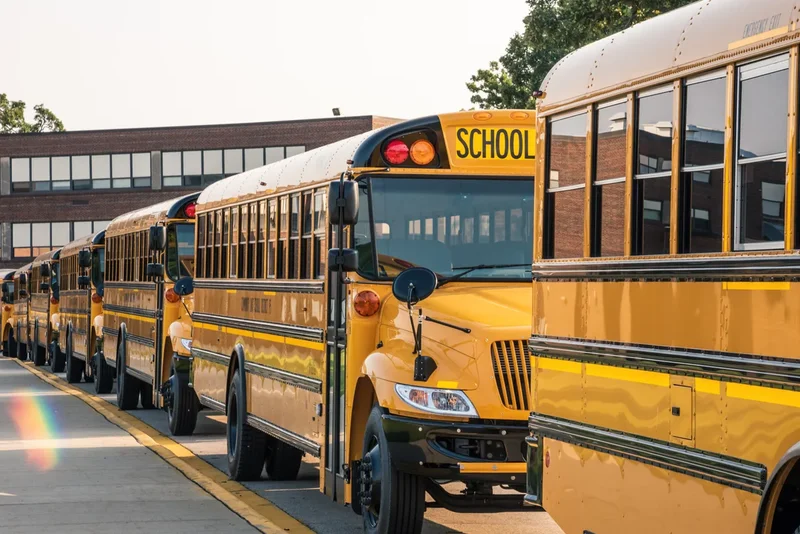
Though student transport once featured a kaleidoscope of colors, a single shade ultimately emerged victorious. Over many decades, the standard look of the American school bus has rendered "school bus yellow" a national shorthand for its deep, glossy hue.
No congressional act mandated the color, which carries a slight orange tint. Instead, a 1939 conference of transport officials from all 48 U.S. states selected the shade for its high visibility, establishing one of the earliest vehicle safety standards. At their peak during the 1980s, these yellow buses transported over 60 percent of American students to school.
The metal-bodied school bus originated in rural America through Georgia automobile dealer Albert Luce. Initially designed to transport cement laborers, Luce offered it to educational institutions after the industrial firm rejected his creation.
The timing proved ideal as local school districts began closing one-room neighborhood schoolhouses in favor of larger facilities situated much farther apart. This widespread consolidation spurred the growth of student busing.
"I don’t think you could’ve had one without the other," says Matt Anderson, head transportation curator at the Henry Ford Museum of American Innovation in Dearborn, Michigan, which displays Luce’s 1927 bus.
Decades later, buses served a key role in school desegregation, transporting Black and white children across racial divides. That controversial policy has largely ended, and schools across much of the United States have become increasingly segregated.
Carl Fisher operated a metal school bus for two-thirds of its nearly century-long existence. With 66 years behind the wheel, Fisher retired in 2012 as the longest-serving driver, according to the Guinness Book of World Records. His initial vehicle was a Dodge truck modified by his father’s friend, who added benches and small stools to transport 20 children in Pleasant Hope, Missouri.
"He put windows in it and everything, really made it nice," Fisher says.
Those foundational features became industry standards, with subsequent safety enhancements including cushioned seating and a flip-out stop sign.
"It’s the safest form of on-road transportation per passenger, per mile, bar none — without seat belts," says Brad Beauchamp, who works with the electric vehicles team at Blue Bird, the yellow school bus manufacturer Luce reportedly named after a bird his wife saw on a fence post.
Driver shortages and other challenges mean yellow school buses are no longer available for many pupils, putting pressure on families to manage daily transportation.
Jim Oppegard, who drove children for more than two decades in the Minneapolis suburb of Brooklyn Park, retired at age 94 as the oldest school bus driver on record. He describes it as fulfilling work.
"You’re helping the kids and helping the overall society," he says. "You’re doing an important job."