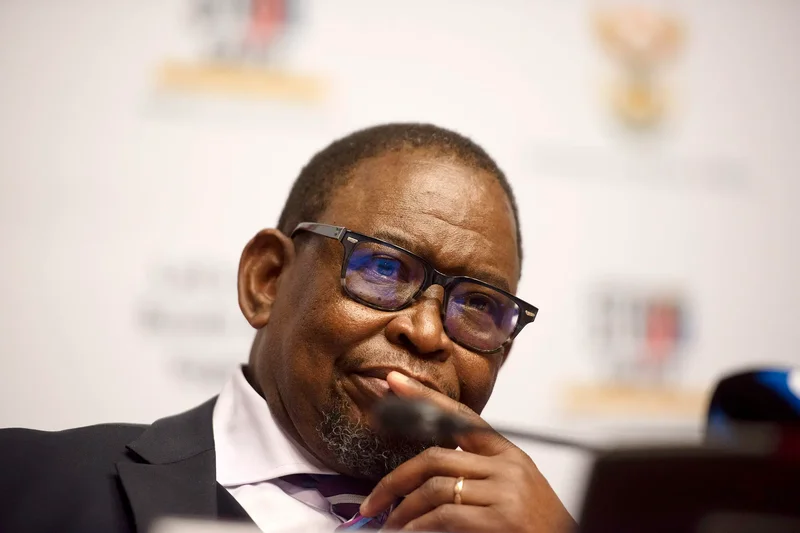
Public Investment Corporation (PIC) chairperson David Masondo has resigned as Finance Minister Enoch Godongwana prepares a sweeping overhaul of the board of Africa's largest asset manager.
The Mail & Guardian has learnt that Deputy Trade, Industry and Competition Minister Zuko Godlimpi has emerged as the preferred candidate to replace Masondo as chairperson, although the appointment has yet to be finalised.
Masondo's resignation follows months of governance turmoil at the PIC, marked by the precautionary suspension of chief executive Patrick Dlamini, the resignation of six non-executive directors, protected disclosures submitted to Parliament alleging political interference and a governance investigation by the Financial Sector Conduct Authority (FSCA).
In his resignation letter to Godongwana, Masondo said he was stepping down to help restore stability at the PIC after months of turmoil following the appointment of the new board eight months ago. He said he hoped his resignation would allow the institution to move forward with "renewed focus and confidence". Masondo also said the PIC's investment portfolio had increased by more than R1 trillion during his tenure and that governance reforms flowing from the Mpati Commission had been implemented where they fell within the board's control. He added that he would provide fuller reasons for his decision in due course.
The PIC manages more than R3 trillion on behalf of the Government Employees Pension Fund, the Unemployment Insurance Fund, the Compensation Fund and other public entities, making it Africa's largest asset manager and one of South Africa's most important financial institutions.
A senior figure familiar with the board's deliberations said the dispute was never simply about Dlamini's suspension.
"This is not a contest of personalities. The issue is the tension between legitimate shareholder oversight and the board's independence. The Minister's concern is fair. No Minister of Finance could sit on his hands."
According to the source, the board acted only after receiving a protected disclosure, obtaining legal advice and following the PIC's whistleblower policy before resolving to suspend Dlamini pending an independent investigation.
"A suspension is not a verdict, and none of these processes has made a finding against anyone. The chairperson reported to the shareholder, followed the policy, and took the uncomfortable decision rather than the convenient one."
Asked about allegations of political interference, Godongwana declined to comment.
"I know nothing about that. I can't comment," he said.
The allegations remain untested. However, the dispute has evolved beyond the suspension of the chief executive into a broader confrontation over the relationship between the shareholder, the board and executive management.
As the crisis deepened, the board itself began to fracture.
Thabi Nkosi and Nosiphiwo Balfour resigned. Days later, Lerato Makwetla, Lindy Bodewig, Mpumelo Maseko and Dorothy Kobe also resigned, bringing the number of departing non-executive directors to six.
The departures have stripped the board of most of its non-executive leadership at a time when regulators, Parliament and investors are scrutinising the institution.
The proposed overhaul has already drawn concern from the Public Servants Association (PSA), which represents public servants whose pensions are managed by the PIC through the Government Employees Pension Fund. The PSA has urged Godongwana not to dissolve the board, arguing that vacancies should instead be filled to preserve continuity while the various investigations into the corporation continue.
Deputy Trade, Industry and Competition Minister Zuko Godlimpi has emerged as the preferred candidate to chair the reconstituted board, according to sources familiar with the appointment process. His name is expected to proceed through the formal appointment process.
If confirmed, Godlimpi's appointment would implement a key recommendation of the 2020 Mpati Commission, which called for the PIC to be chaired by an independent non-executive director rather than the deputy finance minister.
The governance tensions had been building for months, with disagreements over executive appointments, the restructuring of the chief investment officer function and the handling of major investment decisions.
One of the principal flashpoints was the decision to commission a PricewaterhouseCoopers forensic investigation into the PIC's Lanseria International Airport investment after arbitration proceedings had concluded. Supporters argued the investigation was necessary to protect public funds, while critics questioned whether it should have proceeded after arbitration and whether the required governance processes had been followed.
The dispute later spilled into litigation, including a damages claim against Dlamini in his personal capacity, raising broader questions about board independence, executive authority and shareholder influence within the PIC.
The 2020 Mpati Commission concluded that the PIC required fundamental governance reform to restore confidence in the management of public funds. Among its recommendations was that the corporation should be chaired by an independent non-executive director rather than the deputy finance minister.
That recommendation was never implemented.
Professor Alex van den Heever, from the Wits School of Governance, said the latest crisis suggested the commission's central governance recommendations had not been fully implemented.
"The post-Mpati changes did not correct the fundamental concentration of power at the top. The current crisis is therefore evidence that the governance model itself remains flawed."
Van den Heever said that while the state owns the PIC as a corporate entity, it does not own the pension, unemployment insurance and other public funds entrusted to the corporation for investment.
"The State may own the shares in the PIC as a corporate entity, but it does not own the pension, unemployment insurance and other public funds entrusted to the PIC for investment. Those assets are held for the benefit of public servants, workers and other beneficiaries. The Minister is not their beneficial owner."
He said stronger safeguards should include an independent non-executive chairperson, a transparent appointments process involving depositors and beneficiaries, and a clearer separation between political oversight and executive management.
"The central purpose of the PIC's governance arrangements should therefore be to protect the funds under management from political direction, patronage, factional contests and malicious extraction."
"The answer is not to eliminate public accountability. It is to replace unilateral political control with multi-key accountability."
A senior figure familiar with the board's deliberations cautioned that replacing directors before the various investigations had been concluded risked undermining the independence of boards across the public sector.
"The challenge is sequencing. Reconstituting a board while the investigations cited as the reason are still under way teaches every state-owned entity director that fiduciary courage is fatal."
The source argued that accountability should follow due process.
"In particular, a fair hearing, findings before consequences; if the concerns survive that, accountability should follow. Pensions are protected by process, not speed."
Masondo's resignation marks a pivotal moment in the PIC's governance crisis. Although government is expected to move ahead with reconstituting the board, investigations by the FSCA, Parliament and other oversight bodies are expected to continue, meaning the questions that triggered the crisis are unlikely to disappear with the appointment of a new board.