Humans have been performing robot behavior for laughs for at least a century. In the 1936 film Modern Times, Charlie Chaplin played a worker who got stuck in factory mode after he left the assembly line, pulling every lever, pushing every button, and twisting every wheel and bolt he saw involuntarily. In the 1960s, the robot dance motored onto dance floors, with its stilted, angular movements and dime stops. Today, robot dances saturate popular culture and social media: K-pop performances lean into the robot aesthetic, with mechanical choreography, glitchy visual effects and futuristic outfits, and variations of robot dance have taken off on TikTok. Some of the performances are so convincing it’s tough to know whether you’re watching a human or a machine.
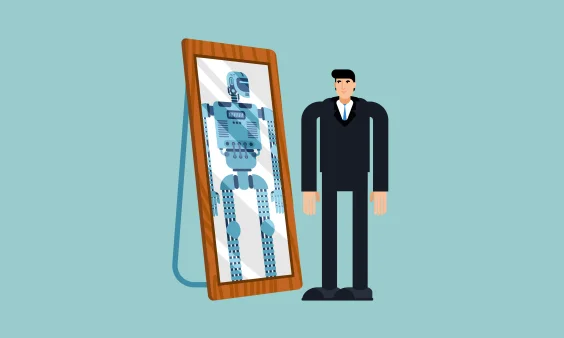
But the threat of transformation may be more real than we realize. If humans spend too much time connecting with robots, they may start to resemble them in important ways, according to new research from the United Kingdom and Scandinavia. The authors of a study in the journal AI & Society propose that when humans interact repeatedly with AI systems that are designed to feel social—particularly chatbots, service robots, and other personal assistants—they may start reshaping themselves to make it easier for a machine or an algorithm to understand them. They call this existential drift “robotoid humanness.” Over time, they say, it could result in a shift not just in communication style but in identity.
“The risk is not that people will mistake bots for humans, and not that anyone is turning into a robot,” writes study author Inci Toral-Manson, professor of marketing at Birmingham Business School in the U.K., in an email. “It’s quieter than that. It’s that we slowly adjust ourselves to fit what AI can handle.”
Social bots are already a big part of the lives of many Americans. In the United States, recent surveys found that just over half of adults and about two-thirds of teens had used a chatbot like ChatGPT, Gemini, Claude, or Copilot. And about a third of adults and teens use large language models about once a day. A tiny fraction of teens, about 4 percent, use them “almost constantly.” But it’s less about frequency than about quality, according to Toral-Manson. “Someone who asks a chatbot 20 questions a day about train times is in a very different position from someone who talks to one every night about how their day went,” she says. “The first is using a tool. The second is doing something closer to a relationship, and that’s where the effect we describe would likely show up.”
The danger lies in the way social bots are built to reward humans over repeated encounters with “frictionless alignment,” Toral-Manson and her colleagues argue. The feedback we get from these bots is fundamentally different from the kind we get from humans, because humans are messy, unpredictable, and will disagree with you, helping you to grow and reconsider who you are, they write. AI systems, on the other hand, are built to be predictable and keep you engaged. “Where human interlocutors furnish heterogeneous and contestable evidence, algorithmic feedback is engineered to converge,” they argue.
Read more: “What’s Wrong with Having an AI Friend?”
There are three sets of conditions that will accelerate the mirroring between humans and bots, according to their framework. One is that as algorithmic systems increasingly anticipate what consumers want, they will push a future that’s statistically continuous with the past, reducing the space for actual choice. Second is that if consumers increasingly allow AI to take over writing emails, bios, applications, and dating profiles, they’ll give up authorship over their own lives, creating a larger and more jarring gap between the public self that circulates online and the internal self. And the third is what they call pseudo-intimacy: affirmation on demand disguised as reciprocity. “The consumer is effectively pulled into an interaction that feels like a relationship, which raises the stakes of interpretation, trust, and self-presentation,” they explain.
Toral-Manson sees early signs that people are shaping themselves to fit their interactions with chatbots. “People change how they speak to a voice assistant,” she says. “They write job applications for the software that screens CVs rather than for a person. Writers now avoid certain words and punctuation marks so they won’t be mistaken for a chatbot.” The people most vulnerable to loss of identity and agency are the ones most exposed to social bots, says Toral-Manson: People who are lonely, unwell, very young, or having a hard time. “Something warm and attentive that’s available at 3 in the morning and never gets bored of you isn’t a trivial thing to be offered.”
Toral-Manson and her team ground their account in one of the leading cognitive science frameworks for understanding conscious experience called “predictive processing.” That account holds that rather than passively receiving sensory input, the brain is constantly generating expectations about the world and itself and matching sensory impressions against those expectations. According to predictive processing, the self isn’t stable. It’s relational, always being revised as predictions shift, and developing through social encounters that provide “recognition, resistance, and evaluative feedback.”
While the paper is theoretical, the scientists suggest ways to test their theory. They propose experiments that would measure whether, over repeated conversations with AI, people unconsciously begin to adjust how they express themselves, becoming clearer, more consistent, and more predictable. If the proposed theory is correct, these mirroring effects would be strongest when the robots have the most anthropomorphic and social characteristics. Most of all, the team of scientists is sounding the alarm: The more AI saturates daily life, through service industries and beyond, the more we risk a normalization of “reduced personhood.”
Lead image: maryvalery / Adobe Stock