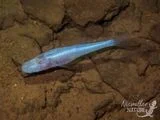
In February 2025, researcher Matthew Niemiller was surveying Bobcat Cave in Alabama, like many scientists had done before him over the last 40 years. The cave, home to the endangered Alabama Cave Shrimp, is one of the most monitored cave systems in the southeastern U.S. and is typically not somewhere scientists expect a major surprise.
However, during his survey, Niemiller spotted a pale, eyeless fish swimming in the water — a fish that didn’t look like anything he’d seen in the cave before.
After Niemiller sent the fish to Auburn University, a research team confirmed in Scientific Reports that it represented a new species and could be one of the rarest fish in the world.
“There is still so much we do not know about our own environment. For something new to show up in a place this well studied is rare. This was the right person, at the right time, able to notice that it was something different,” said Jonathan Armbruster, curator of fishes at the Auburn Museum of Natural History, in a press release.
The Demon Cavefish Gets a Name Inspired by Stranger Things
The newly discovered fish is not merely another species within a familiar group. Researchers determined that it represents both a new genus and a new species, which they named Demogorgonichthys arcanus, or the Demon Cavefish.
The name grew from a conversation between Armbruster and co-author Pamela Hart, who had compiled a list of mythological beings associated with the underground in the hope that one day she’d get to name a new cave-dwelling species. From the list, Armbruster suggested the Demogorgon, a creature now familiar to fans of Stranger Things but with much older literary roots, including an appearance in John Milton’s Paradise Lost. The species name, arcanus, means “secret” or “hidden.”
So far, scientists have found the fish only in Bobcat Cave, located on Redstone Arsenal, a federal installation in northern Alabama. Its limited known range could make it one of the rarest fish on Earth.
“Most of the time when we discover new species, we are finding differences within organisms we already knew were there. This was different. This was a new discovery that had not been seen before, and that is really rare,” said Armbruster.
Read More: A New Walking Shark Species Has Brown Freckles, White Dashes, and an Uncertain Future
What Makes the Demon Cavefish Different?
During their study of the new species, the research team compared the fish’s physical features with those of its cave-dwelling relatives. Unlike the Southern Cavefish, the Demon Cavefish lacks coloration and has a distinctive snout and body shape.
CT scans gave researchers a closer look at its skeleton, while genetic testing provided another line of evidence that the animal represented a separate lineage. One major difference involved rhodopsin, a gene associated with detecting light.
“Rhodopsin is an eye pigment gene that is one of the genes responsible for sight. Matt had looked at Rhodopsin in a past paper and found a few different genetic changes that inactivated the gene so that was his impetus to look at the gene," explained Armbruster to Discover. "Demogorgonichthys has a large deletion within the gene. Think about it like a recipe, and a major section of the ingredients are completely missing. You can’t make a cake if you don’t know what the ingredients are and you can’t make a protein if a large portion of the gene is missing."
In the permanent darkness of a cave, maintaining a working visual system requires energy without offering much benefit. Over time, cave animals can lose eyes, pigment, and other traits that no longer help them survive.
A Rare Cavefish Facing an Uncertain Future
Researchers have observed no more than 20 Demon Cavefish at once, although additional animals may live deep within the aquifer, far beyond accessible cave passages.
Researchers know little about the species’ reproduction. Scientists have yet to find an egg-bearing female from this species or either of its two closest relatives. The fish probably eats infrequently, grows slowly, and reproduces rarely — valuable traits well suited to a nutrient-poor cave but potentially dangerous when the population faces disturbances.
“When we think about conserving a species like this, it is not enough to protect the cave. We have to protect the land around it, because that land is the recharge button for the cave and the aquifer,” concluded Armbruster in the press release.
Read More: Fish and Amphibians May Have Hidden Necks, Challenging Long-Held Assumption
Article Sources
Our writers at Discovermagazine.com use peer-reviewed studies and high-quality sources for our articles, and our editors review for scientific accuracy and editorial standards. Review the sources used below for this article:
- This article references information from a study published in Scientific Reports:Surprising cryptic cavefish diversity in a long-studied karst cave ecosystem of northern Alabama