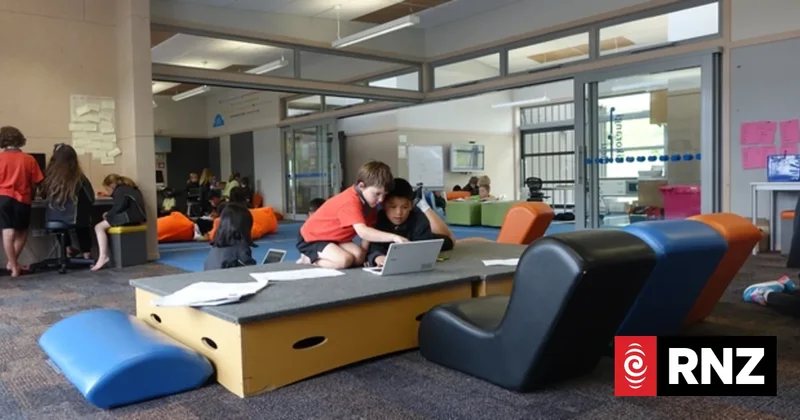
Schools weigh in on open-plan versus traditional classrooms amid changes
Karamea school backs return to traditional classrooms
An end to open-plan classrooms was announced by the government last year, but as some schools begin converting back to a more traditional learning environment there are mixed feelings about what works best.
The buildings - known variously as modern, flexible, or innovative learning environments - have attracted consistent criticism, with some schools spending their own funds remodelling the rooms to create separate classrooms.
Education Minister Eric Stanford celebrated milestones in the Ministry of Education's conversion programme for schools wanting to turn modern learning spaces back into classrooms with walls earlier this week.
Morning Report spoke with principals at two schools who had differing views on how open-plan classrooms had been working for their students.
Principal of Rolleston's Lemonwood Grove Primary School, Blair Dravitski, told Morning Report, he planned to keep the school's open-plan classrooms.
School keeps open-plan classrooms despite changes
The school near Christchurch opened in 2017 with purpose built open-plan classrooms.
Dravitski said he had worked at schools in the past that had traditional classrooms as well as the open plan spaces. He said there were pros and cons for all layouts.
"These walls aren't magical, they don't create automatic success. For us, we've got a glowing Education Review Office (ERO) review. I've made many requests to the minister's office to come and visit and they've been politely declined.
"I'd love her to come and see us."
He said when parents came to view the school they were often surprised by how well the open-plan spaces worked.
"The comment we usually get is that they thought it would be noisier.
"My staff do a wonderful job of collaborating, working together to deliver high quality educational outcomes for the learners that are in front of us. These situations are really successful for us."
Dravitski said his teachers were happier than most, because it created a situation where if a teacher was unwell there were two other teachers who were familiar with the children who could step in.
"So therefore we have this situation where child anxiety [is low], child wellbeing is at an all-time high."
There were pros and cons to all environments, Dravitski said, and no environment would work for 100 percent of the children.
"These schools that are getting repurposed, the context may be different to mine. Let's get some perspective that in some areas these environments are working. Across the educational landscape one size doesn't work for everybody.
"I fully respect my colleagues who have gone down the other path and put the walls back up, but at the same time they know their communities and their context better."
As for Stanford, Dravitski urged her to come and see how his school was operating: "She knows where I am and is more than welcome to visit any time."
On the West Coast of the South Island at one of the most remote schools, Karamea Area School, it was one of six who were turning its modern learning space back into a classroom with walls.
'Halfway through conversion'
Principal of Karamea Area School Tony Baird told Morning Report it was a school with 94 students who ranged in age from five to 18.
"We're halfway though our conversion process. We had our first phase which was to put some partition walls up to the two big main spaces. There is a second phase which hasn't been completed yet which will complete that enclosure, which is something my staff and students are all very keen on and all very much want to see happen."
The school was rebuilt in 2022 as a modern learning environment, Baird said, which meant there was an open-plan classroom with children from year 3 through to year 6.
"So seven-year-olds through to 10-year-olds in a combined space...We had a walkway on both sides of those spaces. The noise and distraction was really challenging for the staff."
He said staff were resilient and made it work but since putting partition walls up over the term 1 holidays, there had been immediate positive feedback.
"It's a much better learning environment for our children simply because of a lack of distraction, less noise and less movement passed those learning spaces. We'd love to have that second phase completed."
Baird said he could see situations where the open-plan spaces could work and he had seen that in some schools but for our context it's much better to have gone back."