Commentary: Roxy Square shoving incident - how would I react if a stranger patted my child on the head?
Children need to know their boundaries matter, but violence is not the lesson we want to teach, says CNA's Charlene Tan.
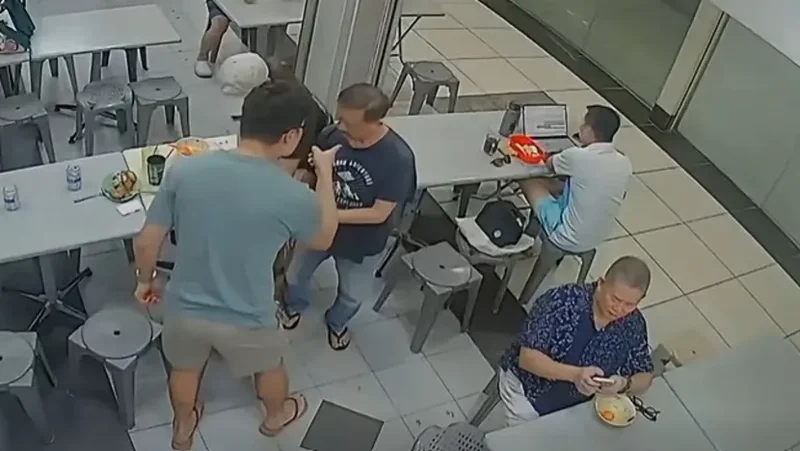
SINGAPORE: Whatever you think about patting someone else’s child on the head, I think we can all agree that a violent reaction is not acceptable. Police investigations are ongoing into an Aug 15 incident in which a father allegedly shoved a 73-year-old man to the ground after the latter patted his young daughter on the head.
But the Roxy Square incident has since evolved beyond whether that initial gesture crossed a line. How people judged the incident quickly revealed their diagnoses of what ails society today.
It’s generational: Older generations have always done this to show affection. Young parents are too sensitive about it.
It’s cultural: Young parents have filled their heads with Western ideas of parenting and personal space. Singapore’s Asian values are more communitarian.
It’s social: We’ve retreated from each other, while being constantly exposed to stories of danger in other parts of the world. Not every stranger is a potential pervert or kidnapper.
None of these explanations feels complete to me.
THE ENVIRONMENT HAS CHANGED, NOT JUST PARENTS
Personal boundaries are not a new concept, but they have become more explicit. The way we teach them to children has become more deliberate.
In school, Primary 1 students learn about a “good touch” versus a “bad touch” and to seek out a trusted adult if they feel unsafe. Age-appropriate knowledge and skills, such as recognising sexual abuse and harassment, are taught as they grow.
Even pre-schoolers are taught about respecting body boundaries – both theirs and others. Children today are taught to have awareness and a vocabulary to express it.
And every time cases of abuse involving young children make the news, especially in education or community settings that are expected to be safe, it understandably makes parents more vigilant about protecting their kids.
It does not make every unsolicited touch dangerous. But neither should parents be expected to accept it simply because the person “meant no harm” or it was “just their way of showing affection”.
Setting boundaries and wanting them to be respected are now part of the environment in which we raise children.
NOT EVERYONE DRAWS THE SAME LINES
But our children will encounter people of all ages who do not draw the same boundaries.
A pat on the head can be an innocent gesture to one and an unwelcome intrusion to another. A person who has patted the heads of children many times without protest has little reason to think the next parent will consider it inappropriate.
Social norms change and it’s legitimate to expect that people adapt to the times. But we cannot assume everyone knows when those expectations have changed.
This forces parents and children to communicate those boundaries, even within families. Parents today may ask grandparents not to demand a kiss or not to pressure children to hug other relatives and friends.
And for me, this is where reducing our different views to a generational divide feels particularly unsatisfying: Doing so assumes older people cannot change when asked and that younger parents only want to impose their own rules.
THE MISSING LESSON HERE
Still, the world is big enough and made up of all sorts of people – it’s inevitable that some will cross our boundaries, even without malicious intent. So knowing what to do when that happens is the other lesson.
Certainly, a lot of it will be situational and parents will never be able to provide an exhaustive list of scenarios.
But children do not learn only from what we tell them about personal boundaries. They also learn from watching what parents do to enforce them and how we carry ourselves in the moment. Not every crossed boundary needs to turn into a confrontation, much less end in violence.
I'm sure that parents with toddlers have, in the last week, run the Roxy Square scenario in their head (even if only to the extent of what can be seen on the CCTV footage). How would we have reacted?
In the heat of the moment, would we really be as rational then as we think about it now? And if our children had watched us respond with violence, what would that have taught them?
What I do know is this: I want my children to know that it’s okay to feel uncomfortable with an interaction. I want them to be able to say so, move away, seek help and to know it is not disrespectful or impolite to do so.
I want to model the behaviour I expect of others. Showing affection doesn’t require unsolicited touching nor does respecting boundaries require a signed consent form.
Say hello, smile and wave. Offer a high-five and let the child choose to reciprocate. It requires only a slight shift in mindset – seeing an interaction as something to be offered rather than imposed.
And if someone does cross the line with my children, I want to have the presence of mind to intervene civilly and explain our boundary. They don’t have to agree with it to respect it.
Charlene Tan is supervising editor at CNA Digital where she oversees commentaries.