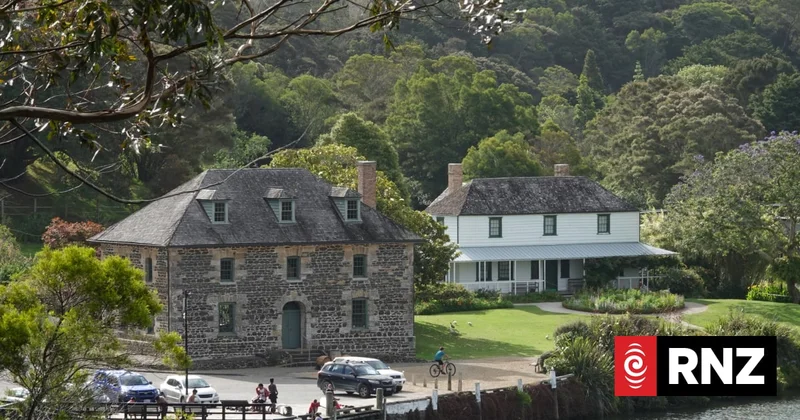
Work underway on roof of 204-year-old Kemp House in Kerikeri
Work is underway to replace thousands of shingles on the roof of New Zealand's oldest building.
Contractors have removed the weathered wooden roof tiles from 204-year-old Kemp House in Kerikeri, and are finding out what lurks beneath.
Heritage New Zealand Pouhere Taonga northern assets manager Boris Bogdanovich said the news was basically good.
"The shingles might be on their last legs, but the wooden structure underneath - including the original kauri beams that were shaped by carpenters over two centuries ago - are in incredibly good condition for their age," he said.
"There's a bit of old borer damage, but that will be fixed in a way that respects the heritage fabric of the original timbers."
Kerikeri firm Henwood Construction was leading the re-roofing project, which started by covering Kemp House with a white waterproof membrane to protect the building while the new roof was installed.
Bogdanovich said the company had extensive experience working on historic buildings, and had worked with Heritage New Zealand in the past.
"We've had a fairly dry winter so far which has been really good. It would be great if that weather were to continue, but if not, our waterproof covering will protect the house from any rain damage."
Built in 1821-22 by missionary carpenters and Māori sawyers, Kemp House was an important remnant of early contact between Māori and Pākehā.
The Kerikeri mission was established by the Church Missionary Society in 1819 under the protection of influential rangatira Hongi Hika.
Kemp House and its gardens were then passed down through the Kemp family, descendants of missionaries James and Charlotte Kemp, until Ernest Kemp gifted them to the nation through the then New Zealand Historic Places Trust in 1974.
"As the earliest surviving building in New Zealand, Kemp House has national and international significance, as a built marker of the foundational relationships developed between local Māori and the British in the 20 years prior to the signing of the Treaty at Waitangi," Bogdanovich said.
It was hoped the new roof would be revealed in time for summer.
A fundraising appeal for the roof restoration project was launched earlier this year among Heritage New Zealand supporters, and now the organisation was looking to widen its approach to the general public for support.
"Unanticipated price hikes in the cost of materials caused by rising fuel prices have stretched the budget for this project to the limit," Bogdanovich said.
Working on heritage buildings also threw up surprises which were impossible to anticipate or budget for.
"For example, where there's deterioration, we're using traditional and 21st century techniques and materials to sensitively re-introduce lost strength where it's needed. We also want to stabilise and repair fabric with the least loss, greatest respect for its context and best durability," he said.
"And that's where the original budget gets stretched. Every little bit of support from Kiwis really helps, and we're so grateful to all those people who have already donated."