The Pentagon has fired the editor-in-chief of the Stars and Stripes, a prominent United States military newspaper, as well as one of its top reporters.
Erik Slavin, the editor-in-chief, told The Associated Press on Friday that he received a notice of separation, along with the newspaper’s Middle East reporter Lara Korte.
Recommended Stories
list of 3 items- list 1 of 3USS Lincoln crisis: How it compares to past aircraft carrier deployments
- list 2 of 3Publisher of US military newspaper resigns over differences with government
- list 3 of 3Trump’s war on Stars and Stripes: Why has military newspaper chief quit?
Another notice was sent to Max Lederer, the paper’s longtime publisher, who had previously announced he would retire at the end of September.
Slavin credited the termination notices to the group’s decision to speak publicly about efforts to defend the editorial independence of the Stars and Stripes newspaper.
While the Pentagon provides funding for the Stars and Stripes, the newspaper has worked to maintain its ability to report independently on military matters.
“I stand by the principle that Stars and Stripes must remain editorially independent, as required by law and by the department’s own policies,” Slavin told The Associated Press.
He believes he was fired for “for stating in a CBS interview that hypothetical censorship of news for service members would constitute a red line”.
The Stars and Stripes has had a storied history covering the US military. Founded in the 19th century, the paper gained prominence during World War II, when it became the official news outlet for soldiers deployed abroad.
But the firings on Friday come as the administration of President Donald Trump puts in place policies that civil rights advocates fear will curtail the freedom of the press.
Under Trump’s second term, for instance, the Pentagon has restricted journalists’ ability access to areas including its press office.
Trump has also launched lawsuits against a range of media outlets, including The Wall Street Journal, The Associated Press, the BBC and The New York Times, over coverage disagreements.
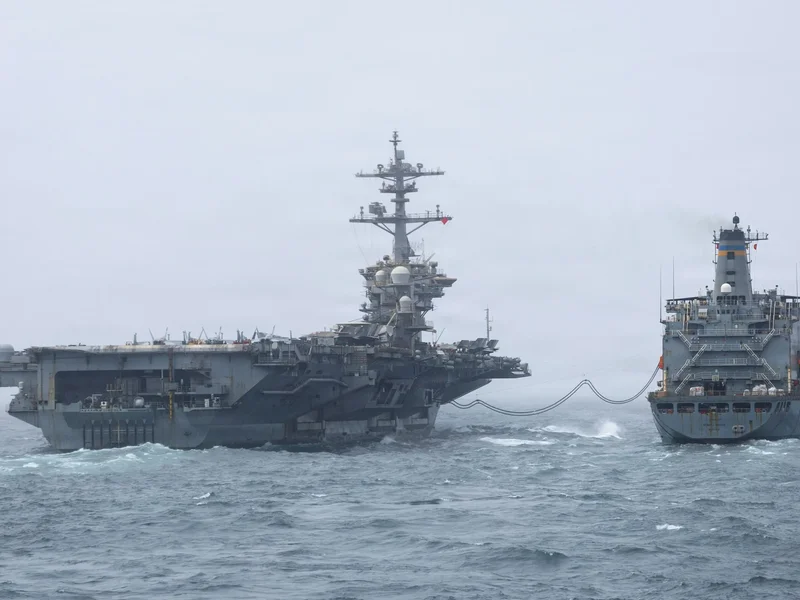
The Stars and Stripes had generated headlines in recent weeks from its coverage of the USS Abraham Lincoln, an aircraft carrier that has been on a record-long deployment since November.
The newspaper profiled cases where sailors on the ship expressed suicidal ideation or attempted to jump overboard. The Trump administration has dismissed such reports as overblown and “dishonest”.
But the pressure on the Stars and Stripes has been building for months.
In a statement in January, for instance, Pentagon spokesperson Sean Parnell announced the department would be “returning Stars & Stripes to its original mission: reporting for our warfighters”.
He added that the Pentagon would intervene to “refocus its content away from woke distractions that syphon morale”.
“Stars & Stripes will be custom tailored to our warfighters. It will focus on warfighting, weapons systems, fitness, lethality, survivability, and ALL THINGS MILITARY,” Parnell wrote. “No more repurposed DC gossip columns; no more Associated Press reprints.”
Since then, the publication has seen several changes that have alarmed press freedom groups.
In April, for instance, the newspaper’s ombudsman, Jacqueline Smith, was fired. Her role had been to advocate for the newspaper’s ethics and independence.
A Pentagon spokesperson, Navy Captain William Urban, was also appointed as the publication’s deputy publisher, reportedly without Lederer’s advance knowledge.
In announcing his resignation, Lederer gestured to the changes underway. He wrote in a memo that his “philosophy of leadership” differed in “fundamental ways from the direction the leadership of the Department of Defence has for the organization”.
For his part, Urban published a letter to the Stars and Stripes website on Friday that praised the publication’s efforts during World War II to deliver “credible, editorially independent papers” to US service members.
But he criticised the current management for being “slow to embrace digital storytelling” and pledged “modernization”.
“My commitment is to leave Stripes a better organization than the one I joined two weeks ago,” Urban wrote.
Friday’s staffing shakeup, however, prompted a fresh outpouring of concern about the fate of the newspaper and its ability to report with independence.
Chris Vaccaro, the president of the Society of Professional Journalists, wrote in a statement on Thursday, “Stars and Stripes cannot fulfill its mission if its journalists or newsroom leaders must worry that independent reporting could bring retaliation from the officials they cover.
“Service members and their families deserve journalism that is produced in their interests — not journalism shaped to serve the interests of the Pentagon,” he added.
That same day, three Democratic senators — Richard Blumenthal, Elizabeth Warren and Jeanne Shaheen — sent a joint letter to Pentagon chief Pete Hegseth, calling for answers about the “degradation” of the newspaper’s independence.
“For generations, American service members, particularly those stationed overseas and in combat zones, have relied on Stars and Stripes for credible and independent news,” they wrote.
“That trust depends on preserving a clear separation between independent journalism and the Department’s public affairs apparatus. At this critical moment of leadership transition, that independence must not be compromised.”