- See more Daily Mail on Google - save us as a Preferred Source
Powerful people who don’t like what newspapers write about them must not be permitted to destroy those newspapers.
That’s the lesson I drew from the judgment six weeks ago by Mr Justice Nicklin, when he dismissed every one of 97 claims made by Prince Harry, Sir Elton John, and five others against the Daily Mail and The Mail on Sunday.
Yesterday this lesson was confirmed in a further judgment delivered by the same judge in the High Court in respect of the enormous costs of the case. The seven claimants will be required to pay £9,544,355 to the publisher of the two titles, Associated Newspapers, by next Friday.
But that won’t be the end of it. Mr Justice Nicklin granted a rare ‘indemnity order’, which will oblige the claimants to bear the brunt of the costs of their misguided legal action. Such orders are usually only granted in cases where a judge believes there has been questionable conduct.
Associated Newspapers will now be free to seek a larger proportion of the £34.5million it spent to defend the two titles in the case spearheaded by Prince Harry, whose imminent return to our shores with Meghan has dominated the news for the past couple of days.
A larger payout would be a grave setback for the claimants, whose insurance policy is believed to cover them only for £16.2million.
They also have their own costs to consider, which are thought to be at least £20million, although it is understood that their lawyers acted, at least in part, on a ‘no-win, no-fee’ basis.
One way or another, Prince Harry and the others face a potentially gigantic bill. With one possible exception, I can’t find it in my heart to feel sorry for them, since collectively they were part of a conspiracy to ruin and destroy this newspaper.
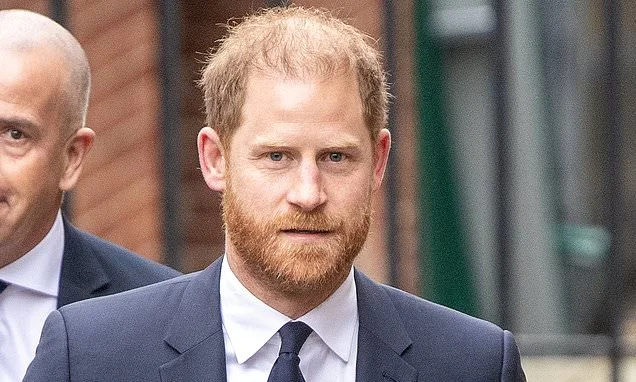
Prince Harry, along with several others, were ordered to cover Associated Newspapers Limited's legal costs after they lost their High Court case against the Daily Mail
The exception is Baroness Lawrence, whose son, Stephen, was murdered by thugs in south London in 1993. Four years later, the Daily Mail began a long, lone campaign to bring her son’s killers to justice.
For reasons that remain unfathomable, Lady Lawrence was dragged into this case by Harry and the others. I don’t want to see her ruined. She has suffered a lot. One can only hope that the Prince, who has infinitely deeper pockets, will come to her aid.
But it’s impossible to feel sympathy for any of the other claimants. It wasn’t only that they attempted to bring down the Mail. They did so with hardly a scrap of evidence, and in a way that was deliberately calculated to besmirch the reputations of innocent journalists.
Don’t just take my word for it. The judge wrote in yesterday’s judgment that ‘allegations of criminal or seriously improper conduct’ were made against witnesses in some cases for the first time during their testimony, creating a ‘real risk of reputational harm’.
Although Mr Justice Nicklin finds no evidence of dishonesty on the claimants’ part, he states that ‘with limited exceptions [their case] was speculative at origin’. He adds that ‘it was introduced and pursued in a way that went far beyond what was required’.
Yet their original Press release, the judge points out, ‘used highly charged language’, and referred to ‘abhorrent criminal activity, crimes, and terrible and reprehensible covert acts’.
Judges seldom speak in such explicit terms. It is because the claimants’ conduct was ‘well outside the norm’ and ‘unreasonable to a high degree’ that he has decided that costs will be attributed on an indemnity basis, which is likely to be expensive for Harry and the rest of them.
What on earth drove the Prince, Baroness Lawrence, Elton John and his husband David Furnish – plus actresses Elizabeth Hurley and Sadie Frost and former Lib Dem minister Sir Simon Hughes – down such a calamitous path?
They probably hoped that Associated would capitulate, and there would be a handsome payout. I also believe that, like many celebrities, they couldn’t bear appearing in anything but the most favourable light.
Prince Harry – who once represented his campaign against the Press as ‘slaying dragons’ – provides the best example. Over the years he has been portrayed as enjoying a misspent youth and, latterly, as a self-serving critic of the Royal Family and his own country.
Yet I know for a fact that he has often received praise in the Mail. His tireless promotion of the Invictus Games for injured military personnel won many plaudits in this newspaper and elsewhere.
And, although he won’t recognise it, he and Meghan received generally favourable coverage in the Mail and other papers before their wedding, and for the following year or two.
It was only when they decamped to America, and proceeded to bite (if not devour) the hand that had fed them, that newspapers took a more critical line. I can see why Harry didn’t like this, but surely the media should be free to make their own judgments.
Many celebrities (of whom Harry and Meghan are the prime examples) want uniformly positive coverage. If they don’t get it, they are apt to cry foul.
Their attitude resembles, obviously in a milder form, the insistence of potentates that they should always be shown in a good light, and that any criticism should be forbidden. But we aren’t in Russia yet.
There have, however, been calls this week for tighter controls on the media, following the tragic death of the academic Jason Arday. Green Party leader Zack Polanski, along with several Labour MPs, demanded ‘an immediate public inquiry into how to ensure a responsible Press’.
Polanski also responded to a piece in The Mail on Sunday, which celebrated this summer’s hot weather, by saying: ‘It’s time we sorted out the Press.’ He wants to bring the Press under State control – or at least to deprive it of its independence – for the apparent reason that it writes or broadcasts things he doesn’t like.
Of course newspapers must operate within the law – as Mr Justice Nicklin has concluded that the Daily Mail did – and they should demonstrate mercy and good sense. But it is an essential ingredient of democracy that they should act without fear or favour.
Where does Prince Harry lie in all this? He has lost his case, and faces huge costs that he won’t find easy to pay, particularly as he is looking for an agreeable new home in the country. Meghan’s potential return to acting may prove opportune in more ways than one.
Harry could go on playing the curmudgeon. After the initial judgment six weeks ago, he and (I’m afraid) Baroness Lawrence lashed out at Mr Justice Nicklin, describing his ruling as ‘a complete and obvious whitewash’. That was a dreadful and silly thing to say.
The Prince could continue to live in this vein, nurturing his sense of victimhood, and perpetuating his battle against the Press. If so, he is likely to make himself and a lot of people very unhappy.
Alternatively, he could accept that he has lost, having received justice. He could move on. If he behaves in a less confrontational way, and gives vent to his better nature, he may find that more nice things are said and written about him.
Is it too much to hope that he will accept that, at any rate until Zack Polanski occupies No 10, people who dislike the Press in this country won’t be allowed to destroy it?