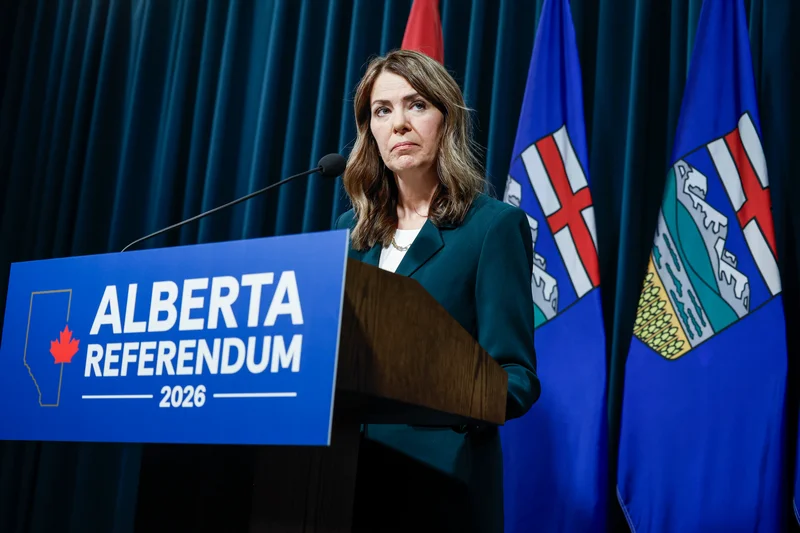
Alberta will hold a binding referendum on secession early next year if the results of October’s provincewide vote favour launching the process to separate from the rest of Canada, Premier Danielle Smith asserted during town halls this summer.
The Premier’s timeline allocates about 2.5 months for consultations with Indigenous people, a window she said aligns with what Canada pencilled in for discussions over a proposed bitumen pipeline to the west coast.
Ms. Smith outlined plans for a binding spring referendum on secession in response to questions from United Conservative Party members frustrated that the government’s non-binding Oct. 19 question kicks the separation can down the road rather than settles the debate.
Ms. Smith, speaking to UCP members in Lethbridge in August and in Red Deer in July, said if the separatist side wins the October referendum, she will tour First Nations communities in order to meet the legal requirement that they be consulted prior to a binding secession vote.
“I am willing to do the consultation, I am willing to take the months of abuse, going to every nation, holding town halls like this, and letting them know that we are going to go forward with it,” she said in Red Deer, according to video of the event posted online. “I am willing to do that if Albertans give me the mandate.”
Ms. Smith explained that she must consult with First Nations before seeking approval from the federal government to proceed with a binding question. In Red Deer and Lethbridge, she said the consultation process with First Nations would take about 2.5 months in order to withstand court challenges. This, she said in Lethbridge, mirrors Canada’s Major Projects Office’s consultation schedule for the proposed pipeline to the west coast.
The MPO did not answer questions about Ms. Smith’s characterization of its consultation timeline.
Jauvonne Kitto, who works with First Nations groups as an advisor and negotiator, said Alberta’s Premier is underestimating how long it will take to properly consult Indigenous people over the potential break-up of the country and how that would affect treaty rights.
The Crown is obligated to provide First Nations with a reasonable amount of time for consultations, which is measured against the seriousness and complexity of the issue under negotiation, Ms. Kitto said.
“Separation is obviously the most serious and complex matter possible,” she said. “The potential to undermine treaty rights attracts the highest level of scrutiny from the courts, and requires the highest level of consultation.”
Drawing on Canadian precedents, including discussions preceding the patriation of the Constitution in 1982, Ms. Kitto said consultations on secession would likely take 1.5 to two years.
Ms. Smith, when speaking to UCP members and working under the assumption First Nations consultations would be completed quickly, said Alberta would ask the House of Commons to affirm its question in early 2027, clearing the way for a spring vote. In Red Deer, she said she would go to Ottawa in February or March, with the vote taking place in April or May. In Lethbridge, she accelerated this schedule by a month.
“We have to settle it before the next election,” Ms. Smith said in Lethbridge, according to audio posted online and verified by attendee Blaine Badiuk. Alberta’s next general election is tentatively scheduled for Oct. 18, 2027.
Ms. Smith says she will advocate for Alberta to remain in Canada and defends the referendum as an opportunity for voters to have their say.
Some First Nations in Alberta are resisting the separatist campaign, turning to the courts – and the public – for support. The Assembly of Treaty Chiefs of Treaty No. 6, Treaty No. 7, and Treaty No. 8 have called on the RCMP to investigate Ms. Smith for treason, accusing her of risking Alberta’s place in Confederation and violating treaties.
Separately, Alberta Court of King’s Bench Justice Shaina Leonard in May struck down a petition aimed at triggering a referendum on separation, in part because the province failed to consult with First Nations on how secession could affect treaty rights.
Ms. Smith’s government is appealing the decision. The Premier points to this decision to explain why the government put a non-binding separation question on the October ballot.
The question will ask voters to choose between Alberta staying in Canada; and Alberta starting “the legal process required under the Canadian Constitution to hold a binding provincial referendum on whether or not Alberta should separate from Canada.”
Sam Blackett, a spokesman for the Premier, in a statement said the government “would begin the legal process under the Constitution to hold the binding referendum as soon as possible,” should Albertans opt for the second choice in the fall referendum.
He did not respond to specific questions about the consultation process with First Nations, including what Alberta considers adequate consultation, whether it sought legal advice on what constitutes adequate consultation, and with whom it would consult.
Ms. Smith’s office rejected the treason allegations from the Assembly of Treaty Chiefs.
“Accusing elected officials of treason is dangerous and unacceptable rhetoric that only fuels division,” Mr. Blackett said in a statement.
“We want to work collaboratively on a government-to-government basis to make our communities stronger. When the Treaty Chiefs are ready to do that, we’ll look forward to it.”
With reports from Matthew Scace