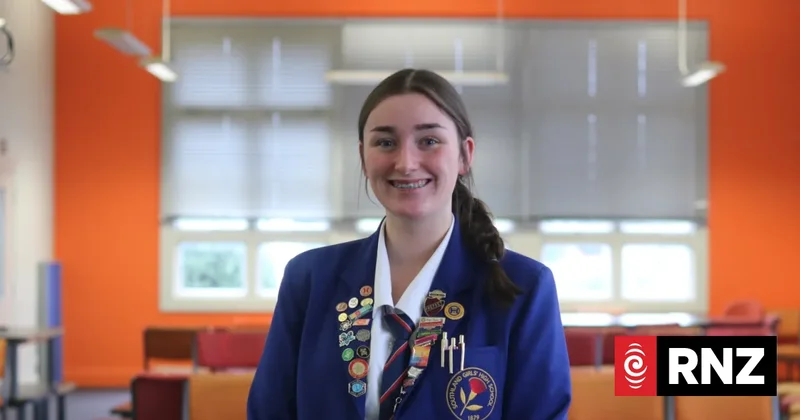
Sophie Ineson admits she never quite outgrew her childhood habit of asking "why, why, why?"
The Year 13 Southland Girls' High School student has instead channelled her relentless curiosity into complex after-school problem-solving, like inventing medical products that work in space and simulating the effect of microplastics on seabirds' digestive enzymes.
Ineson has become a local science fair phenom, with her projects earning $50,000 towards her tertiary education and a trip to the International Science and Engineering Fair in the United States in May.
"I just like doing things that haven't been done before, looking at something that's new and can actually make a big impact on the world," she said.
Ineson's latest project, an investigation into the psychology of conservation messaging, has just won her a clutch of awards at the Southland Science Fair and caught the interest of the Department of Conservation (DOC).
The idea germinated from a visit to her grandparent's house by the beach in Dunedin.
"They actually had a sea lion that was right outside their door, pregnant with a pup, and it gave birth to the pup outside on their property and was raising it there. It's now my grandparents pup, per se," she said.
Ineson said her grandparents kept a careful watch over the sea lion but she could not help wondering what would have happened if their house was owned by someone who did not want sea lions on their property.
She set to work surveying 60 local senior high school students to see how they reacted to different conservation messages.
Somewhat surprisingly, guilt-based messages like "getting too close hurts more than you think" were less effective than empowerment-based messages like "smaller actions from you: a better life for wildlife", she said.
Ineson said she was in contact with DOC staff who seemed interested in translating her findings to the real world.
She also worked on a space science project last year, designing a product called "Hydro Heal" for wounds in microgravity.
She said minor skin injuries healed differently in space than on Earth and waste had to be managed carefully, meaning it was less than ideal to have "stinky old bandages lying around".
Using hemp seed oil and other natural materials, Ineson created a biodegradable, gelatinous formula to replace plasters.
To test it, Ineson applied her prototype to cuts on apple skins, measuring the browning of the fruit to see if the gel sealed and protected the surface.
Her project was awarded the Prime Minister's Space Prize for Student Endeavour, which included $50,000 to use towards her tertiary studies in New Zealand.
Earlier, on a trip on the Spirit of Adventure ship, Ineson saw plastic floating in the water and was inspired to study the effects of microplastics on seabirds.
Again, Ineson said she was curious to understand "the why", that being the biological effects it had on the birds.
Working with her school science department, Ineson simulated a penguin's digestive tract in a lab using test tubes, water baths and incubators and learnt that the microplastics disrupted vital digestive enzymes.
"I was looking at how the plastic is actually absorbing the enzymes which are in their food, giving them less energy to survive," she said.
As a possible solution, Ineson also researched hydrophobic coatings used to stop barnacles from sticking to ship hulls and whether a similar concept could be applied to plastics to stop enzymes from binding to them.
The research earned her an endorsement through the Southland Science Fair to represent New Zealand at the International Science and Engineering Fair in Phoenix, Arizona.
"To be able to represent my country doing something I love was really awesome," she said.
The event featured "rows and rows and rows" of science fair projects from around the world, interviews with news reporters and an Olympics-style opening ceremomy, she said.
As she approaches the end of high school, Ineson said she was already looking ahead to a future in scientific inquiry.
She has applied to study Biomedical Science at the University of Otago, where she hoped to combine her interests in biology and psychology.
Ineson said letting her curiosity run free had been deeply gratifying, as was "seeing how my small little bit of research from Southland can get all the way to Phoenix, Arizona and actually make some sort of difference in the world".
"That's really pushing me to keep going, keep looking into different things and why they work and how and how they can be modified."