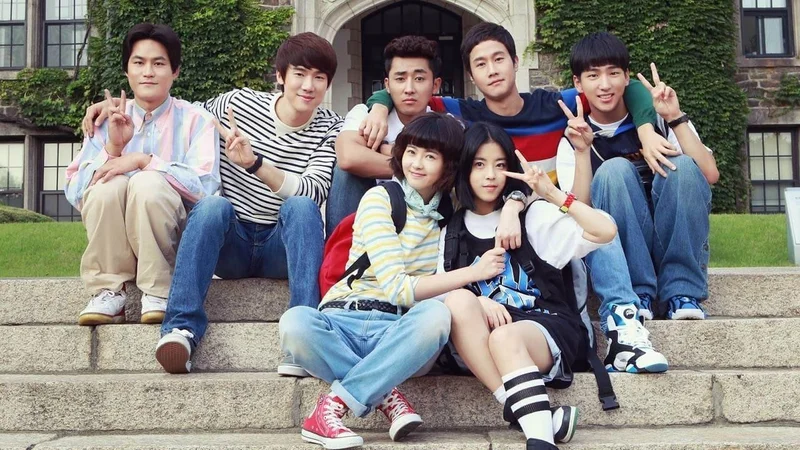
I spent this week in a Korean hospital having surgery on a hand injury I picked up playing football. Thankfully, the surgery was a success, the nurses were kind and the food was decent. The hospital was also completely modern — every MRI scan, CT and X-ray was done with what seemed like the latest technology. My insurance then helped make sure that although still somewhat expensive considering everything I'd received, I was able to walk out without needing to sell my house. That's a joke, of course. I live in Seoul. I don't own a house.
I'd brought a selection of books to keep me company: Peter Hopkirk's "The Great Game," Todd Henry's book on the city of Seoul and the famous Korean classic "A Small Dwarf Kicked a Ball." But sometimes the drugs kicked in a little too hard and I found myself unable to concentrate on the words on the page. That's when I turned to the TV in my room, hundreds of channels, countless movies and dramas at my fingertips. I pressed the button and was greeted immediately by episode one of a popular TV drama called "Reply 1994." Having not seen it, I decided to leave it on and let it run.
When it was released in 2013, "Reply 1994" was meant to remind the people of Korea of the mid-90s. Watching it today in 2026, it also reminded me of a time when Korean television dramas were not aimed at an international audience, when everything was designed with the domestic market in mind. The jokes were littered with local idiosyncrasies that made my wife — sat on the sofa by the window — burst out laughing on frequent occasions. It wasn't trying to explain Korea to the world. It didn't seem particularly concerned with whether an American or European viewer would understand the joke. This was Korean content doing what it does best: trying to make people laugh, smile, remember, forget, love, hate, swear, joke and — of course — indulge in toilet humor. The poo gags were everywhere.
On the surface, "Reply 1994" is a classic Korean melodrama, the kind where you know the two leads are destined for each other and will marry by the end. But there's something else going on beneath the surface. The drama constantly winks at us, reminding us of its own kitsch, its own constructedness. It knows it’s creating nostalgia. Watching it in 2026, I couldn't help but feel that the drama's great appeal is its ability to stir up feelings that stand in sharp contrast to the difficult economic and political situation of the present moment. It offers a last glimpse at a hopeful past, a time before the 1997 IMF crisis and the alienation of contemporary life. It's Mark Fisher's "Lost Futures" with a Korean ballad soundtrack instead of urban London jungle.
The characters don't know what is coming. They don't know about the IMF crisis. They don't know how radically the country around them is about to change. They are simply young people worrying about exams, romance, friendship, money and what to eat for dinner. And perhaps that is what makes the nostalgia so powerful. We know the future that awaits them. They don't.
The mid-1990s were a strange, contradictory time. This was when Seo Tai-ji was changing the face of Korean pop music, laying the groundwork for K-pop as we know it. When the brutal politics of the 1980s were aired in courtrooms. When corruption and negligence led to the deadly collapse of Sampoong Department Store and the developmental drive of the government's modernization program ultimately stalled under the devastating weight of the IMF crisis. And the family was still, seemingly, that.
Watching all of this was fantastic, but it wouldn't have been the same without my wife beside me. Born in the 1970s, she grew up during the setting of this drama. When songs played, she would immediately start singing along. When I asked who it was, she'd look puzzled, her eyes pointing to the ceiling, trying to remember. Sometimes she knew immediately — "SEOTAEJI!" she would shout, or "Deuce!" Other times she'd look puzzled, the melody coming to her across the decades but the name of the artist forgotten to time. What fascinated me most wasn't that she remembered these things. It was the way she remembered them. Memory isn't a database. It doesn't preserve everything equally.
And it wasn't only the songs that brought these waves of nostalgia. It was also the dramas that appeared on the characters’ television: "That one with the green eyes!" she would shout at me in Korean, asking me to Google it and remind her of the name while she carried on watching, reminiscing and remembering, hiding behind her own sofa. We got to experience a past together that we'd never actually lived through: Her memories, my imagination and our present all connected by a television show that was now 13 years old but pointing to something three decades ago.
My wife's family is originally from the southeast, and our house is often filled with the sounds of that local accent. In fact, during some of my early Korean lessons, my teacher would look at me as if to say, "That's not right, David." I eventually discovered I was using vocabulary and phrases popular in the southeast — and especially from decades ago — that were sometimes unknown to people in Seoul. "Reply 1994" explicitly uses these accents. Many of the characters come from different regions, and this isn't just to describe their personality; it's their way of speaking. It's so much fun to hear the way they swear, the way they ask questions. The actors were specifically chosen from those regions to provide a sense of authenticity. Today, there's a certain universalization or homogenization of things, people hide their origins, but go back to that era and the differences were stark.
The drama itself is also so different from what we see in the present timeline. Child-like, almost. It's a slice of life coming-of-age story about a group of friends who go through all the normal things university students go through. No zombies. No outrageous bullying. No sex, no drugs, no people dying in gruesome and terrible ways. Nothing really for mainstream media to talk about, certainly not international newspapers. But as I watched it, everything felt so Korean: the food they ate, the way they ate, the way they waited for the oldest person to start, the way they commented, the way they spoke with their mouth open and food flying everywhere — particularly when angry. What struck me was how physically close everyone seemed. People sat on top of one another, ate from the same table, grabbed one another, shouted across rooms and treated personal space as something negotiable rather than sacred. Watching it from 2026, the physicality of these relationships felt almost as historically significant as the clothes or technology.
I sometimes wish cultural studies spent more time with things like "Reply 1994." Not because it is secretly more profound than "The Glory" or "Squid Game," but because its ordinariness is precisely what makes it valuable. We tend to study culture when it screams at us: when there is violence, trauma, political controversy, sex, death or some obvious ideological conflict. But a culture is also contained in how people eat dinner, swear at their friends, sit around a television, fall in love, remember a song and argue about nothing in particular.
The drama helped me survive my time in the hospital. It helped me get to know my wife better. It helped me understand the people of this country today, the people of 2013 and, of course, those back in the 1990s when I was still running around the South of England. It was incredibly popular here, achieving great ratings on the television and while I'm sure it won't win too many rave reviews today, it's a drama I'll never forget.
We all have Korean dramas like that: ones that come to us at a certain moment in our lives and get us through something. For me, "Reply 1994" is something I'll always think of with a smile. And I'll always remember the swear words and the dialects. Yeom-byeong hal!
Explore More
- Q.
- Q.
- Q.