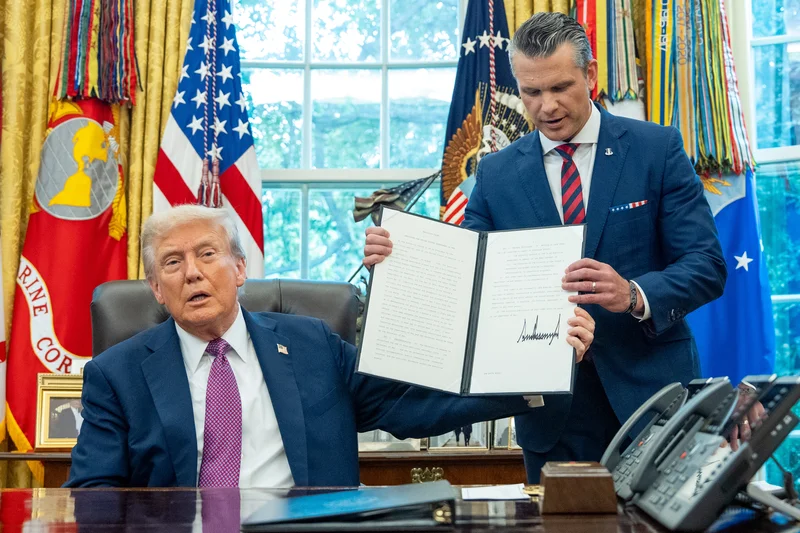
Next September will mark one year since Donald Trump renamed the Department of Defense the Department of War by executive order. “We’re going to go on offense, not just on defense. Maximum lethality, not tepid legality. Violent effect, not politically correct,” Pete Hegseth, now the secretary of war, said at the time to justify the decision.
It was not the only semantic and cultural shift within the U.S. defense apparatus. Just a few weeks later, the administration summoned all generals to an unprecedented meeting at Quantico base in Virginia amid warnings of an “invasion from within.” Among the enemies identified were progressive policies that had supposedly softened the military. Hegseth appears to believe there are too many Black people, women and overweight service members in uniform, and that the armed forces no longer project a sufficiently masculine — or virile — image. From that point on, diversity policies and political correctness were abolished, along with beards, long hair and excess weight.
Masculinity is one of the cornerstones of the MAGA movement. In its view, the United States is in danger because the central role of the white man in society has been called into question. The supposedly woke culture of recent decades has overvalued the role of women and minorities, undermining the nation’s social and cultural development. That is why it is not enough to defend; strength must be projected. War must be waged. And it must be fought not only with tactics, strategy and weaponry, but also with bulging muscles and flat stomachs. Aesthetics and the body are part of the message.
Hegseth has put this idea into practice since the start of Trump’s second term. He launched a campaign to restore the military’s “warrior ethos.” The policy has led him to remove women from most of the senior command positions they previously held and to create a special commission tasked with eliminating diversity and equality programs. On social media, he regularly posts videos of himself lifting weights or exercising alongside troops.
This vision enjoys considerable support among part of the U.S. population. According to a political tribes study conducted this year by Echelon Insights, 18% of Americans, most of them men, belong to what it describes as the “Loyal Right.” They are the most devoted followers of the Trump movement and hold a traditional view of society with the white man at its center. They fear that the loss of masculinity is driving social decline.
This idea extends beyond politics. The growing emphasis on physical strength has made testosterone treatments increasingly fashionable. This trend is visible worldwide, but especially in the United States, where prescriptions are estimated to have risen by 154% since 2020. Social media is awash with viral posts calculating how much testosterone a man should produce at a given age, while so-called gym bros increasingly recommend specialized supplements despite medical warnings against the practice. Hegseth himself recently joined the trend by announcing that the Pentagon will conduct testosterone testing for service members over the age of 30. Those found to have deficiencies will be eligible for treatment.
During the first year of Trump’s return to office, this cultural shift went hand in hand with an increase in the lethality of the U.S. armed forces, prompting allegations of possible human rights violations. During that period, the military carried out 658 airstrikes worldwide, almost as many as the 694 conducted by the Biden administration over its entire four years in office. And they were proud to show it. Videos of drug-smuggling boats being destroyed, strikes on Iranian nuclear targets and the pre-dawn capture of Nicolás Maduro went viral on social media. War as a visual and digital spectacle.
But now it seems the gunpowder has run out. Masculinity without strategy has collided head-on with reality. Recent reports suggest that the United States has called off attacks on Iran because it has begun to run short of munitions. Plenty of muscle on social media, but not much real firepower, because the art of war involves far more than firing indiscriminately without doing the math. Perhaps they should have spent more time reading Sun Tzu and less time watching and making gym-bro videos. Plenty of testosterone treatments, but not enough munition.
The situation has strained relations between Trump and Hegseth, who had become one of the president’s favourite Cabinet members. According to The Washington Post, Trump has reproached him for failing to anticipate the munitions shortage and for allowing the war in Iran to drag on far longer than expected. The secretary has also yet to persuade Congress to approve the new defense budget. Everything seems to suggest that excessive zeal in the culture war came at the expense of understanding how conventional warfare is actually fought. We are in the hands of agitators, not professionals.