- See more Daily Mail on Google - save us as a Preferred Source
During the sweltering summer of 2026, Germans have flocked to outdoor swimming pools in ever greater numbers to escape the scorching heat.
And with baking temperatures in Berlin reaching a record 39.9C (104F) this summer, there have been plenty of days when diving into cool water has seemed particularly appealing.
But as temperatures have soared, tensions have also boiled over.
And in Germany this has resulted in the politics around pools blowing up into a heated national debate – as left and right fight a bitter battle for control.
Of course this is not the first time that swimming pools have been caught up in the frenzy of culture wars – witness the ongoing fraught conflict between the transgender community and gender-critical women around access to the women-only pond at Hampstead Heath in London.
But in Germany the febrile atmosphere around the politics of swimming has been more about ethnicity or identity than gender.
The most recent flare-up came at Berlin's iconic Volksbühne theatre where a temporary outdoor pool had proved wildly popular all summer.
But when those running it decided to increase participation from ethnic minorities by announcing last week that it would be 'open exclusively to Black communities' for a day – the consequences were explosive.
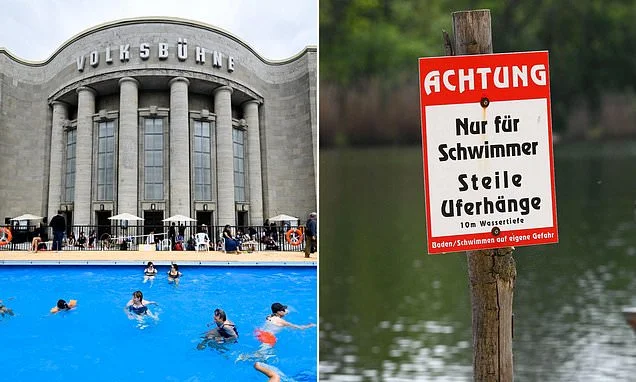
During the sweltering summer of 2026, Germans have flocked to pools to escape the scorching heat. The most recent flare-up came at Berlin's iconic Volksbühne theatre (seen) where a temporary outdoor pool had proved popular all summer
A German beach has caused a racism row after its lifeguard ruled bathers must speak German
When the Mail visited this week the 25-metre outdoor pool directly outside its imposing building on Rosa-Luxemburg-Platz seemed benign enough.
The Volksbühne itself is a huge monumental building, with its distinctive socialist-classical architecture looming over the square, and in front of that grandeur there is now that swimming pool.
Six metres wide, 25 metres long and 1.3 metres deep, the pool is controlled through two-hour time slots. It is free to use and, unusually for Berlin swimming facilities, there is no identity check to get in. There are constant queues to get in.
But behind the sound of laughter and splashing, the fallout from that 'Black communities only' day is still simmering. The theatre is reeling from a PR hammering after triggering a political firestorm.
And this all came about after the Volksbühne announced that one six-hour swimming session would be reserved for Each One Teach One (EOTO), an organisation working on racism prevention and the empowerment of Black people.
Many were furious at this. Typical was the hard-Right AfD party which slammed the decision as 'apartheid'.
Volksbühne director Matthias Lilienthal admits the last few days had been very tough, but he vehemently rejected AfD leader Alice Weidel's comparison with apartheid.
'Alice Weidel said that I was realising an apartheid policy, and this is a really bad joke. Apartheid was a system in which rights were separated and given according to race.'
He also denied that his organisation had done anything wrong by holding a swimming event which critics have slammed as racial segregation.
'The organisation which had organised it just asked, "Do you feel yourself belonging to the Black community?'" At the door, we would not do a race check, of course not.'
Lilienthal claimed the event was not about racial exclusion, but about bringing marginalised people into the centre of Berlin: 'That was the idea. And nothing else.'
In the midst of the fierce PR war, the theatre finally backed down and the planned controversial swimming session was cancelled last Friday after it received a torrent of messages which the theatre describes as not just hostile, but openly racist threats.
'I was totally shocked by the reaction to what we had been doing.'
On the day when the pool had supposedly been closed, a yellow rubber duck carrying an 'Antifaschistische Aktion' flag was left floating in the water, and there were also signs reading 'Fickt euch' (F*ck you!).
When challenged on this, Lilienthal said as soon as his team spotted this, they removed it and that they don't condone it.
But for others - the explosion of anger around all this is clearly the fault of the theatre for taking the controversial decision for a Black-only swimming session.
The Volksbühne itself is a huge monumental building, with its distinctive socialist-classical architecture looming over the square, and in front of that grandeur there is the swimming pool
Not only has the theatre been slammed on the hard-Right and by German conservatives – it has also sparked shock and outright disgust from some members of the liberal Free Democrats (FDP).
Christoph Meyer, lead FDP candidate for the 2026 Berlin state election, voiced his outrage to German media outlets.
'A "people's pool" that divides people according to their skin colour makes a mockery of its own name.
'Public places must bring society together, not separate people according to skin colour.'
And then comes another public swimming-related scandal in Halle on the river Saale, in the eastern state of Saxony-Anhalt – and this time the setting could hardly be more different.
Forget the monumental theatre and the traffic of central Berlin. The Heidebad, a 110-mile drive south-west of Berlin, is a natural swimming complex built around the Heidesee lake, on the southern edge of the Dölauer Heide woodland in Halle's Nietleben district.
And here, too, escaping the heat has been serious business this summer, with temperatures in Halle reaching around 40C (104F) during an extraordinary heatwave.
When the Daily Mail visited, we saw how, though lush and picturesque, the lake itself is a relic of the area's gritty industrial past.
Brown coal was mined on the site from the 19th century until 1931, when the Neuglück mine finally closed.
After mining ended, the ground subsided as old workings collapsed and rising groundwater and rainwater gradually filled the former mining area, creating what became the Heidesee.
The transformation into a bathing resort continued during the GDR - the German Democratic Republic, the communist state commonly known as East Germany, which existed from 1949 until German reunification in 1990.
Development of the Heidebad began in 1954, turning the legacy of Halle's industrial past into a place for swimming and recreation.
Today the lake covers roughly 13 hectares and is the largest natural bathing water in Halle.
There are separate textile and FKK, or naturist, bathing areas, for Germans keen on baring all.
Both have sandy beaches and lawns for sunbathing, with lifeguard supervision, food and drink facilities and even a beach café and Biergarten!
But there is one fact that hangs over the entire place: beneath the apparently tranquil surface, the former mining lake reaches considerable depths.
And it was here that manager Mathias Nobel recently introduced an entry rule which was widely reported as meaning people without sufficient German would not be admitted.
But Nobel told the Mail that the story had been distorted and insisted he had never introduced a blanket German-language ban.
Heidebad beach in Halle, north-east Germany, saw rules introduced after Mathias Nobel said swimmers' safety was threatened
'It was not my statement at all that people have to speak German. That is wrong. For me it is simply about the safety aspect.'
The dispute was made even more politically charged by the fact that Saxony-Anhalt has become one of the AfD's strongest strongholds.
Indeed, the party is currently polling at a remarkable 43 per cent ahead of the September 6 state election, putting it 20 points ahead of the CDU on 23 per cent.
If that support translates into sufficient seats for the AfD to form a government, it would be an historic political earthquake: never before has the party held the reins of government in any of Germany's 16 federal states.
And the stakes are particularly high because Germany is far more decentralised than Britain.
Its 16 federal states, known as Länder, wield enormous power over everyday life, with responsibility for schools and universities and significant authority over areas including healthcare and hospital planning.
An AfD government in Saxony-Anhalt could therefore find itself exercising power over everything from what happens in classrooms and universities to major decisions affecting hospitals and other public services.
That wider political backdrop has inevitably made the row at the Heidebad even more combustible.
Critics claimed Nobel was operating in a climate in which tougher attitudes towards migrants and foreigners had become increasingly acceptable. For him, however, the decision had nothing to do with politics.
It followed a frightening incident in which he personally had to rescue a small child from dangerously deep water.
'It is not about German as such. It is just about whether people understand the instructions. If a lifeguard gives an instruction, that instruction has to be understood and followed.'
For others, however, this is nothing short of a brazen attempt to whitewash discrimination. Hendrik Lange, a Halle city councillor for the hard-left Die Linke party, said: 'What the Heidebad is doing here is not a safety measure, but clear discrimination.
'Anyone who excludes people from a swimming pool because of their language is telling them that they do not belong to this city. It is a transparent manoeuvre. Because, taken to its logical conclusion, deaf people would also have to be excluded.'
But speaking to the Mail, Halle resident and medical equipment procurer Dirk Willmann said he had sympathy with the swimming pool.
'Obviously this looks very shocking when you read stories about how people are supposedly not being let into a swimming pool because their German isn't good enough. That suggests a form of hostility or even xenophobia and no-one wants that. I certainly don't.
'What I can sympathise with, however, is the idea of a person who runs the place feeling that it's really important, for safety reasons, that people can at least follow the instructions there.
'After all this is a place where you can literally lose your life if you end up drowning. Safety can be a matter of life or death.'
And that is what makes the two controversies so striking.
The Heidebad, 110 miles south-west of Berlin, is a natural swimming complex built around the Heidesee, on the southern edge of the Dölauer Heide woodland in Halle's Nietleben district
In Berlin, a theatre has physically turned the street outside its grand entrance into a 25-metre swimming pool – a bright, temporary piece of blue water in the middle of the capital.
In Halle, an entire former brown-coal mining site has effectively become a swimming destination, with bathers lying on sandy beaches beside a lake created by the legacy of mining.
One is a deliberately artificial urban experiment. The other is an old industrial landscape transformed into a natural bathing resort.
Yet both have now been dragged into the same explosive German argument over race, immigration, integration and the rules governing who gets to use public swimming spaces.
But these two swimming-based scandals reveal just how toxic the issue of public swimming areas in Germany has become, with pools repeatedly hit by reports of overcrowding, violence and sexual harassment.
In June 2022, Berlin's Sommerbad am Insulaner saw a water-pistol fight escalate into an all-out brawl involving around 100 men.
Police needed 13 patrol cars and parts of a riot-control unit to bring the situation under control.
That same year, Berlin's Columbia swimming pool saw a confrontation between guests and staff followed by a fight in which 11 people were injured and three arrested.
Other parts of the country have also seen serious incidents. In September 2023, a 13-year-old girl reported being sexually assaulted at Cologne's Agrippabad. Police investigated eight suspects, including four Syrians, three Turks and one Iraqi.
And on June 22 last year, two separate incidents were reported.
In Gelnhausen, around 25 miles outside Frankfurt, eight girls aged between 11 and 16 reported being touched across their bodies in a swimming pool by a group of men, leading to four Syrian men aged between 18 and 28 being investigated.
In Hof, police said a 12-year-old girl was repeatedly pushed underwater by two men aged 18 and 20 and suffered a bloody nose. Both suspects were Syrian.
The cases have fuelled a fierce political argument over whether German swimming pools have become unsafe — and over the role of immigration and integration in that debate.
The argument has even crossed Germany's border into Switzerland. In July 2025, the Swiss town of Pruntrut/Porrentruy temporarily restricted access to its public swimming pool for foreign nationals.
The decision immediately triggered comparisons with Germany's long-running swimming-pool security debate.
Local authorities cited allegations including harassment of young women, inappropriate language, swimming in underwear and violent behaviour after people had been reprimanded.