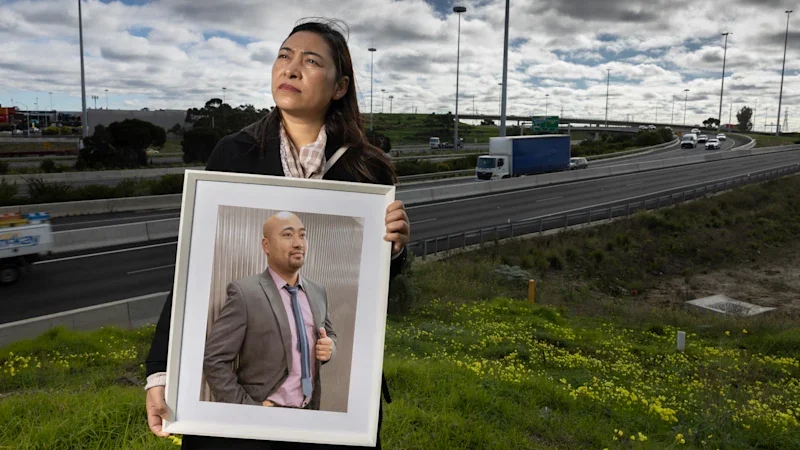
When Bikram Dangol’s daughter asks where he is, her family point to the sky. Her dad is the brightest star, the young girl is told.
But her mother, Bina Rajthala, still struggles with her husband’s death in a motorcycle crash eight years ago, when their child was just a few months old.
In April, coroner Kate Despot finally released her finding into the death: authorities had “missed opportunities” to fix a water leak that might have mitigated the risk of a crash.
Six different organisations knew about the problem, some for months, but the coroner found “nothing constructive occurred until after the fatal collision” on the busy M80 off-ramp at Laverton North on July 26, 2018.
Despot questioned whether the hazard would ever have been fixed had the crash not happened, noting the “absurdity of the situation in which this issue was ‘handballed’ between various companies and entities”.
“Even after the collision occurred, there were arguments between [Greater Western Water] and other entities about the ownership of the water assets in question,” she wrote.
“I note that the issue was rectified the same day as the collision, so it is evident that it was not a particular[ly] onerous or complex task.”
Rajthala says: “If steps had been taken on time … things would have been different, and he might be here with me.”
The rider
Bikram Dangol was born in Nepal and moved to Melbourne in 2007 for university. He settled in Williams Landing after meeting his wife.
“Bikram was full of life,” Rajthala says. “He was adventurous … caring. He was a family person.”
Dangol worked as a welder in Campbellfield. The 30-year-old was riding home from a shift just after midnight when he reached the end of the Western Ring Road and joined the M1 on-ramp towards Geelong.
The warnings
According to the coroner’s finding, on that bend two months before, Mark Kelly noticed the ground was soaking wet.
Winslow Construction’s safety co-ordinator had just started work on Dohertys Road nearby and figured a main was leaking, so he called Greater Western Water (then City West Water) on May 10.
Eventually, a worker turned up but concluded on June 7 the leak was not coming from a water authority asset. The water authority employee contacted VicRoads about the issue, but couldn’t find the right person to speak with.
Meanwhile, police officer Sergeant Timothy Noisette drove past and “encountered an unexpected patch of water on the road which caused his motorcycle to lose traction”. He reported it to Greater Western Water (GWW) on July 4, but received no response.
As part of road upgrades throughout July, workers reported problems painting new markings and blacking out redundant lines “due to water running across the road”.
Kelly kept raising “serious safety concerns for motorists” and complained to the energy and water ombudsman about Greater Western Water’s response.
“At night ... the water was running across the road,” Kelly says. “But during the day, it would dry out with the sun and the cars constantly running over it, so it wasn’t as obvious.”
Kelly remembers hearing about the crash on early morning radio “like it was yesterday” and calls it “entirely preventable” – which the coroner did not.
“It makes you feel sick,” he says.
The crash
The coroner found an SUV driver had approached the M1 on-ramp about 12.30am on July 26 when he saw Bikram Dangol and his motorcycle lying on the road.
He pulled over to help, but behind him was a truck that couldn’t stop. The driver went around the car and heard a thud under his truck, which then “jack-knifed” and hit the Honda too.
Dangol was trapped under the truck and died.
Police subsequently found “a large wet patch over the road surface” and water-soaked painted-over lines that were “considerably more slippery” than others.
The investigator concluded the black paint, without less abrasive coating thanks to the water leak, “would have led to the loss of control by the rider” if crossed.
“There were no other reasons provided as to why Mr Dangol lost control of his motorcycle,” the coroner wrote.
The aftermath
The source of the water leak was found about 6.30am, when an excavator dug up the adjacent overgrown embankment to reveal a rusty fire hydrant.
Greater Western Water still insisted the asset did not belong to the company, but it needed to turn off the water supply that fed it.
GWW’s solicitors later told the coroner “a significant degree of responsibility lay with VicRoads” for delays fixing the water leak and not having a dedicated contact person.
The coroner issued one recommendation: that the Department of Transport and Planning consider working with all water authorities in Victoria to establish a shared asset register.
Bina Rajthala just wants bureaucratic finger-pointing to stop and wishes public authorities would take greater responsibility.
She is also upset about having to wait almost eight years for the coroner’s finding.
“It took me back all the way to 2018,” she says. “I [felt] devastated. I cried a lot again, but I cry in silence … Everyone thinks I am strong from outside.”
Her brother, Bijay Rajthala, adds: “The justice delayed is justice denied.”
Her lawyer, Matthew Naughtin, of Zaparas Lawyers, worries the Coroners Court is underresourced. The family is considering legal action.
He says the delayed finding not only stopped Dangol’s family from moving on, but also meant lessons are taking longer to be learnt.
A Coroners Court spokesperson said only about 0.8 per cent of investigations completed last financial year were older than five years.
”We are constantly striving to reduce case time frames, while balancing the need to ensure each death is thoroughly investigated,” the spokesperson said.
In a statement, Greater Western Water managing director Cameron FitzGerald said the authority was “working diligently with the Department of Transport” to implement the coroner’s recommendation.
A spokesperson for the Department of Transport said: “Our thoughts and condolences are with the Dangol family, whose lives have been immeasurably impacted by this tragic road death.”