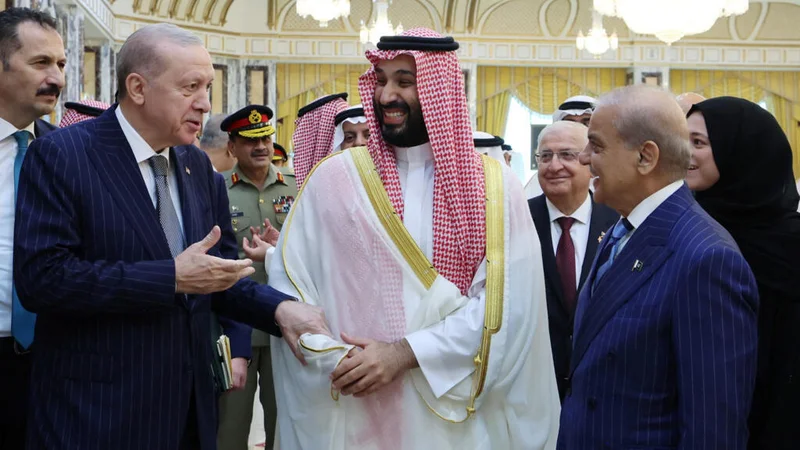
Tensions between Turkey and Israel have intensified after an Israeli airstrike targeted a Syrian military airbase near the Turkish border. The strike came days after Turkey’s new military pact with Saudi Arabia and Pakistan.
Ankara swiftly condemned Tuesday's Israeli airstrike on Syria’s Abu Duhur military airbase, 70 kilometres from its border, calling it illegal and a breach of Syrian sovereignty.
Ankara is a key ally of Syria's new authorities. Israel justified its actions, accusing Turkey of seeking to expand its military footprint in Syria, which it sees as a serious threat.
“Israel is uneasy about the Turkish presence in Syria, and Turkish ambitions to play a major role in Syria’s future are unsettling from an Israeli perspective,” explains Turkey expert Gallia Lindenstrauss of Israel's Institute for National Security Studies.
“There's concern that Turkey will establish its own bases in Syria,” she added.
Israeli-Turkish tensions have risen over Israel’s war in Gaza and Lebanon, and Ankara’s support of Hamas, evolving into a broader regional rivalry.
“In general, there's uneasiness [in Israel] about Turkey's assertiveness, both in Syria and in the Mediterranean and other parts of the Middle East and the greater regional arena," said Lindenstrauss.
Landmark agreement
Earlier this month, Turkey, Saudi Arabia and Pakistan made headlines by signing a landmark military accord in the Saudi city of Mecca. Known as the Mecca Accord, this alliance pledges mutual defence if any member is attacked, akin to NATO’s Article 5.
Turkish international relations expert Soli Ozel claims the impetus for the agreement is uncertainty around Washington’s willingness or ability to protect its regional allies amid ongoing tensions involving Iran.
“Undoubtedly, the United States is proving to be an increasingly unreliable partner. Countries worldwide, especially in the larger Middle East region, are looking for other ways to provide security for themselves,” said Ozel.
The Mecca Accord members view each other as bringing complementary strengths to deal with shared concerns.
"Pakistan brings military capabilities and is a nuclear power. The Saudis have the money. Turkey has a budding defence industry and a large army. It claims not to be against any country, but I think those three parties agree that Iran is a destabilising actor, as is Israel,” explained Ozel.
The Mecca Accord is set to boost defence and intelligence ties, with Saudi Arabia expected to bolster Turkey’s expanding defence sector.
But many analysts see Iran and Israel as the accord’s principal focus.
“The deal is meant to signal both to Iran and Israel that they will be isolated in the region if they continue with assertive, belligerent policies,” said Asli Aydintasbas of the United States-based Brookings Institution.
'Two axes in the Middle East'
Despite Iran’s recent attacks on Saudi Arabia, Aydintasbas argues that while the Mecca Accord has a mutual defence clause – meaning an attack on one member is an attack on all – Turkey and Pakistan will not be drawn into a conflict with Iran.
“We know that they have no desire to get involved. But it does mean there will be greater military cooperation,” said Aydintasbas.
Countering Houthi rebel attacks in the Red Sea on Saudi tankers could be the first real test of the alliance.
But Aydintasbas cautions that the Mecca Accord will not replace the US as the “ultimate security provider” for the region. Instead, it's more about burden sharing, a move that fits well with Washington’s wider agenda.
Washington has given its blessing to the accord, and expansion talks are already under way.
Turkish Foreign Minister Hakan Fidan hinted that Egypt could be the next member, with Turkish media reporting that Egypt’s foreign minister will join his Saudi, Turkish and Pakistani counterparts for a meeting in Istanbul later this month.
“Developments in Egypt are of major concern to Israel,” said Lindenstrauss. But she believes the Mecca Accord is an opportunity for Israel, given there are mutual concerns among its allies over the Accord.
“Israel already has very close relations with Greece, Cyprus, the United Arab Emirates and India,” she noted. "And I do envision a deepening of this relationship. And so we have the formation of two loose axes in the Greater Middle East."