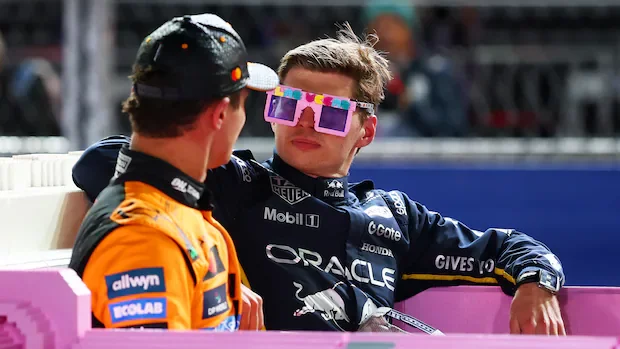
How streaming and social media have helped build the modern F1
Between smash-hit reality show Drive to Survive and online success, the F1 media landscape is reshaping itself
Enzo Ferrari famously said, "If you ask any child to draw a car, they'll draw a red one." When she was a child, Sofia Valente Pierini was the prototypical example.
"Every Sunday that we would go over, my maternal grandfather, my Nonno, would have his little early 2000s tube TV perched on the kitchen counter," she recalled. The Formula One Grand Prix would be playing, and Valente Pierini's eyes would naturally be following the Ferraris.
In 2025, Lewis Hamilton, Valente Pierini's favourite driver, stepped into the iconic red uniform for the first time, and in June 2026, he won his first Grand Prix as a Ferrari driver.
"It hasn't been easy, emotionally, to be a Hamilton fan and a Ferrari fan," Valente Pierini admitted. She's made F1 content under the handle @formulasofia since 2022, much of it capturing the highs and lows of Ferrari fandom. "Seeing him at the top step of that podium was amazing, it was like a homecoming."
Valente Pierini is part of a new generation of content creators helping to redefine the F1 media ecosystem for a younger, more diverse audience — one whose association with the sport might have otherwise been a faded Ferrari flag hanging in their grandfather's living room.
Along with the smash-hit Netflix reality show Drive to Survive, user-generated content is helping to engage a new F1 audience, in much the same way that radio acted as a catalyst to draw in baseball and hockey fans.
- Transforming F1: How female and Gen Z fandom is shaping the sport’s future
- COMMOTIONWhy we're still watching Formula 1: Drive to Survive, 8 seasons in
Different sports suited to different media
Every new form of broadcast technology has had peculiarities that perfectly suited them to certain sports. F1's online content is just the latest instance of media synergy powering a sport to cultural ubiquity, according to Stacy Lorenz, vice dean at the University of Alberta's Augustana Campus and a professor specializing in the sociology and history of sport.
For example, Lorenz noted how radio helped turn baseball into America's pastime and firmly entrenched hockey to the Canadian identity. Radio's play-by-play and colour commentary were particularly well-suited to baseball's sequential nature.
"The pauses where you can tell stories in between the pitches and everything? It really does suit that kind of narrative style and the storytelling," he said.
Similarly, Lorenz notes how fluid sports like basketball and football thrived on television, using multi-camera broadcasts to capture whole-field action for the living room.
In Lorenz's eyes, F1's relationship with short-form video and streaming is the next logical step in this lineage. Specifically, he calls out the importance of the "placeless consumer," that is, fans who aren't tied to a sport geographically the way a Leafs fan living in Toronto might be.
"I think F1 is probably the highest developed form of that experience that we have now," he said. "You can experience these sports live no matter where you're at, but also all of the other culture and storylines and narratives around that through the media."
New ownership, new ideas
James Hinchcliffe, a former IndyCar driver who hosts the podcast Off Track with Hinch and Rossi and does commentary and analysis for F1TV, says everything changed with the 2017 acquisition of F1 by Liberty Media.
"When Liberty took over, there was a natural willingness to embrace the online side of things, the digital side of things, in a way that didn't exist in Formula One before," he said.
The Liberty purchase brought about a sea-change in the sport, according to Laurel Walzak, an associate professor at Toronto Metropolitan University's School of RTA Sports Media.
"It's something that hockey did 10 or 15 years ago, where they realized that in order for us to get people to know the sport a little bit more they needed to take the helmets off the players," Walzak said, referring to efforts like arena walk-in cameras and in-game bench or locker room interviews. "And Formula One has done a very, very good job of that on social media."
- Why F1 racing is set to become the next big fashion show
- COMMOTIONWhy we're still watching Formula 1: Drive to Survive, 8 seasons in
Hinchcliffe says Drive to Survive showed how easy it is to follow F1 drivers as a group of characters, in the same way people might follow reality television stars. With only 22 drivers across the sport and all of them competing every race weekend , putting cameras in the paddock guarantees content.
"You've got some big egos, big personalities — all of these things are perfect ingredients in the recipe for a successful sort of reality program," he said.
Online content a big draw for fans
Valente Pierini says F1 is an incredibly tight knit sport, as many of the drivers are lifelong friends who met while competing in junior racing leauges as children.
"The content space is founded on a lot of drama between them," she said. "But at the end of the day, there's something so beautiful about the community."
Cadence Willie, who posts F1 content to more than 80,000 followers on Instagram as @cadencebraking, says the F1-oriented corners of the internet let fans dial in their experience even further, algorithmically locking into aspects of the sport that speak to them.
"You could definitely say the Netflix bubble has popped," Willie said, explaining that the content being produced in the social media space is just as big a draw for new fans as Drive to Survive.
Because every F1 car is equipped with several cameras and a team radio, creators have a wealth of footage to pull from to better cater to their specific niche and expand on what Willie calls the different kinds of F1 lore, be it memes or high-profile relationships.
"If you've got the surface level information covered right away, it doesn't take a lot to get you to your next step," Willie said. "There really is something for everyone."
Valente Pierini hopes the new wave of digital accessibility in the F1 space helps make it more affordable, as well. Even as an F1 content creator living in a Grand Prix city, she says it's still difficult to afford tickets.
"It's always been such a glamorous sport, and now there are young people and people everywhere watching," she said. "I wish it was more accessible to the general public."