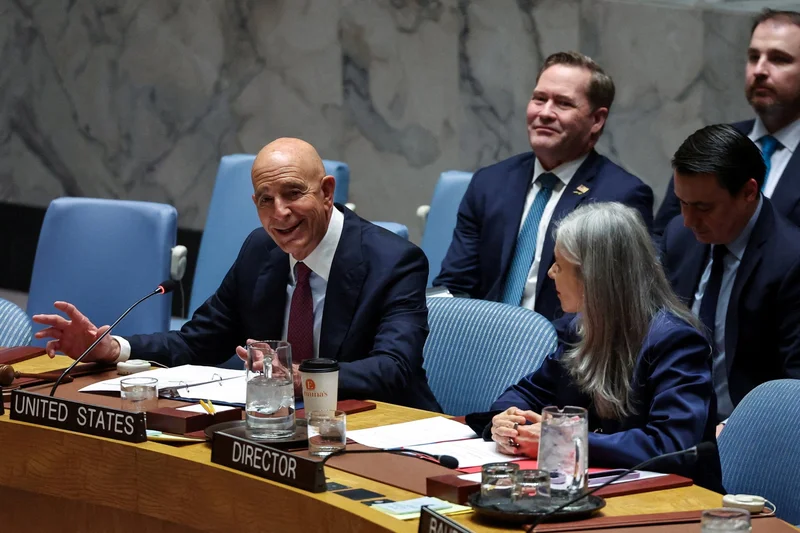
Israel’s strike on a Syrian air base nearly triggered a direct military confrontation with Türkiye, according to U.S. Ambassador to Türkiye Tom Barrack, who said Israeli aircraft approached within about 80 kilometers of the Turkish border without notifying Ankara.
Barrack said Israel had received intelligence suggesting Türkiye might be moving military equipment or personnel onto a Syrian air base. Washington checked the information and determined that the deployment was not taking place.
The issue was then discussed through diplomatic channels, including what Barrack described as a two-hour backchannel conversation between Syrian Foreign Minister Asaad al-Shaibani and Mossad chief David Barnea.
But Israeli aircraft appeared anyway.
Israel struck runways at the Syrian base without notifying either Washington or Türkiye, Barrack said in an interview with PBS NewsHour.
That transformed the incident from another Israeli strike inside Syria into a potentially far more dangerous confrontation involving two of Washington’s key regional partners.
Türkiye detected the approaching aircraft but did not know their purpose or target, Barrack said. With the Turkish military potentially forced to respond, the situation raised the possibility of a direct clash between Israeli and Turkish aircraft.
"That difficult political rhetoric between Israel and Turkey, by the way, in my opinion, is mostly politics," Barrack said. "But it came 80 kilometers to their border without notification. Israeli jets."
Barrack said the United States is now focused on lowering tensions between Israeli Prime Minister Benjamin Netanyahu and Turkish President Recep Tayyip Erdoğan and preventing another incident from escalating.
"The answer to all of this is lower the temperature, increase the dialogue, increase the discourse, and avoid these abrupt kinetic action," he said.
Barrack offered two possible explanations for why Israel carried out the strike despite the diplomatic discussions.
One, he said, was a serious breakdown in communication between Mossad, the Israeli military and Netanyahu’s office.
The other possibility was more deliberate: "The Israelis were baiting the Turks."
Barrack did not say which explanation he believed was correct.
He also described the broader dispute as part of a growing strategic competition over Syria’s future and Israel’s ability to operate against Iran.
According to Barrack, Israel wants Syrian territory kept free of military systems that could threaten its ability to operate in the region. He said Israel views Syrian airspace as providing a "clear line of sight to Iran" and has sought assurances that Syria will not become a platform for defensive or offensive military equipment that could interfere with Israeli operations.
Türkiye, meanwhile, has emerged as an increasingly important military and political force in post-Assad Syria and has sought a major role in helping shape and secure the country.
That has created a potentially dangerous overlap between the interests of the two countries.
Israel says it wants to preserve its freedom to strike Iran and prevent military threats from emerging in Syria. Türkiye wants to maintain influence over its southern neighbor and has its own security interests in shaping Syria’s new political and military order.
Barrack said the United States wants those competing interests addressed through dialogue rather than military surprises.
"Let's bring this back to a table where you can all sit down and talk," he said. "If you're going to have issues with each other, fine. But avoiding kinetic action or surprises is the goal."
He urged Israel to communicate with Türkiye before conducting operations close to the Turkish border, arguing that Ankara has a powerful military and air force and could interpret an unexpected Israeli operation as a direct threat.
"Israel is smart. They have one of the best intelligence organizations in the world. We all have great respect for them," Barrack said. "The way to handle that is just have a discussion with Türkiye on a backchannel or front channel, rather than taking independent action."
Barrack also said Türkiye’s growing regional influence should not necessarily be viewed as a threat.
"Türkiye's going into a new powerful mode, which makes everybody nervous, but it's a great thing for Türkiye," he said, describing the country as a strategically important hub linking Europe, the Middle East, Central Asia and the Mediterranean.
He said the priority now is to prevent the rhetoric between Ankara and Jerusalem from turning into military confrontation.