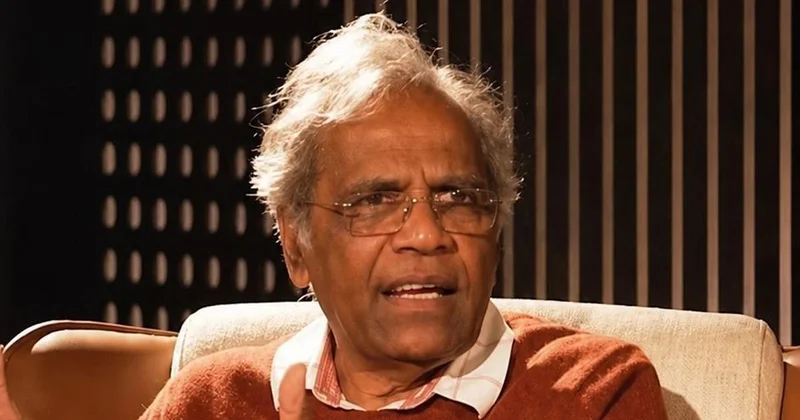
Poet, essayist, fiction writer, translator, editor – Udayan Vajpeyi occupies a singular place in contemporary Indian literary life. Widely regarded as one of the most original voices in Hindi, his writing has consistently expanded the language’s imaginative and intellectual horizons.
Some of Vajpeyi’s best-known works are Kuchh Vakya, Pagal Ganitagya Ki Kavitayen, Sudeshna, Door Desh Ki Gandh, Saatavan Button, Charkhe Par Barhat, and Patjhar Ke Paon Ki Mehndi, among others. His novel Qayas, recently translated by Poonam Saxena into English as Love Is Participation in Eternity, has introduced him to a wider readership. As a translator, he has brought writers such as Borges, Chekhov, Octavio Paz and Shuntaro Tanikawa into Hindi, opening new aesthetic and philosophical pathways for readers.
Alongside his literary work, Vajpeyi spent more than four decades teaching Physiology at Gandhi Medical College, Bhopal. The coexistence of medicine and literature, science and imagination, appears to have shaped a distinctive sensibility in his writing, one deeply attentive to memory, grief, the human body and the unseen dimensions of experience.
In a conversation with Scroll, Vajpeyi reflected on childhood, books, poetry, translation, literary traditions and the making of a life in literature. Excerpts from the interview:
When you look back at your childhood now, what returns first: people, places, books, or silences?
People wrapped in silences return first and also the vibrating absences which endlessly suck into themselves whatever enunciations were there. But let me add that silences which wrapped people of my childhood were all different from one another. For example, my mother comes to mind surrounded by an almost untouchable sacred silence which is completely different from that which surrounded my father. My grandmother was a ruthless teller of ghost stories and she lives in me quietly with her ghosts around her.
What do you consider the true beginning of your life as a writer?
In my childhood, it was extremely difficult for me to understand anything without either writing or pronouncing it in solitude. Words were like my sixth sense organ. I touched the world much more with them than with my fingers or lips. I, therefore, used to write diaries. They were not written to save a memory or an event for the future but to somehow be in the “present”.
Was there a decisive moment, person, or book that altered your understanding of literature forever?
When I was around 18 years old and was in medical college, I was deeply in love. On one such day, I heard a poem in my ears. The voice was as if coming from inside and outside too. I immediately wrote it down. With that poem, I suddenly felt, I don’t know how, that I was born to write. That was the moment which decided the kind of life I was going to live: that of a writer.
You have written poetry, fiction, essays and criticism. Do you see them as separate forms, or as different expressions of one continuous search?
Imagination brings its own form. Different kinds of imagination evoke different literary forms but they are, as you have suggested, continuous in their longing for truth. Yes, all forms in which I write have different shades of this emotion in common: longing. They are connected to each other through this emotion. Perhaps.
Your work repeatedly returns to memory. Why does memory remain such a powerful literary and philosophical force for you?
I rediscover memory in my imagination. What you are calling memory is actually the imagination, which is impregnated by my memory. Or you can say imagination in the garb of memory. It is so because I lost too many of my intimate people early in life. I go on re-creating them; rather go on giving bodies of my words to them so that they can reappear as vibrant presences. Was it Marcel Proust who said, “A writer smuggles across the border between life and death”? Writing for me is a way to bring the dead back to our surroundings in new bodies, in the bodies of words.
Readers often feel your writing asks them to slow down and inhabit experiences that modern life urges us to move past. Has literature become one of the few places where reflection and silence still survive?
Literature slows one down, makes one sit down and take a deep breath. It changes, as the American poet Denise Levertov said, the chemistry of the soul. This change makes the reader see her memories, desires and relationships in a new light, which gives her a deep pleasure because it brings her close to herself.
You spent more than four decades teaching Physiology at Gandhi Medical College. How did medicine and the classroom shape your understanding of suffering and human vulnerability?
I once happened to meet the great Mexican poet Octavio Paz. One of my gurus, a wonderful painter and thinker, Jagdish Swaminathan, was his close friend. When Paz was told by Swaminathan that I write poetry and also am a doctor, he said, “Well, both have a lot to do with suffering!”
I would add that my work at Gandhi Medical College kept the sense of human vulnerability alive in me; it gave me a deep sense of mortality which my poetry, perhaps, kept alive. Coincidently its the realisation of one’s limits that gives rise to one’s ethical perspective. Awareness of one’s mortality is one such realisation.
Science studies the body through certainty while literature often survives through ambiguity. Did these two worlds ever come into conflict within you?
Let me tell you that the subject I was teaching, i.e. physiology, speculates about bodily processes; it too presents the body as the collection of mysteries rather than certainties. Only the poor teachers of science speak of certainties, because they have not gone into the depths of it, which contain numerous mysteries, uncertainties, etc. But let me add that the truth of science is always transitory, whereas literature searches the eternal in us. It is because of this that the theories of science become redundant in time but Kalidas’s writings remain contemporary to us even after two thousand years.
Looking back, did teaching young students teach the writer something books alone could not?
Teaching has an immediate effect, whereas books take time to be absorbed. Teaching gives immediate gratification to good teachers, whereas books take a long time to give any pleasure to the writer from her readers. But one thing is the same in both: the process is pleasurable and reflective. Teaching is essentially communication, whereas literature is evocation.
Translation has been one of the defining dimensions of your literary life. What happens to a writer while translating another writer?
Translations change the way you look at your language. It brings into the open the uniqueness of your language. And also, you learn to get rid of yourself more easily because you have to divide yourself incessantly into two writers while you translate. It’s like playing chess from both sides.
You have translated Borges, Chekhov, Octavio Paz and others. Which writers from world literature transformed your imagination most deeply?
I translated many world writers because I felt I should visit my language, Hindi, from different angles that translation provides. But you are asking something else. Jorge Luis Borges’s work, along with my readings of Yogvashishth, transformed the way I look at life and the world. I translated Borges and he allows no internal censors to interfere with his writing. His way of writing is the realisation of freedom.
Is there a writer whom you believe the world has still not read adequately?
There is a poet from Indonesia called Sapardi Djoko Damono. I heard that he has died recently. He was a great poet and his writings belong broadly to Indic civilisation, as is found in his country. But the lucidity of his imagination is remarkable.
You have read extensively across South Asian and world literatures. Are there shared anxieties or recurring questions that unite writers across cultures?
I have read a very good number of poets, writers, and thinkers from across the world. Unfortunately, I have read not many authors from South Asia but I have seen some wonderful cinema from here. Apichatpong Weerasethakul is my favourite filmmaker. The way he sees continuity between life and death, rather than living beings and the dead, and also man and nature is remarkable. Cinema of Won Ker-Wei too is magnificent in its portrayal of subtleties of love and togetherness. I noticed one anxiety across the cultures of the world: how to go beyond what you are. And also, how to bring the “unsayable” emotions into the realm of experience. I also noticed that writings of writers and poets across the world don’t consider the borders of their nations as the borders of their experience. In other words, they travel across borders, languages, and cultures, almost invisibly.
Which writers and poets from the subcontinent remain essential to your life as a reader?
Valmiki, Ved Vyas, Kalidas, Bhaas, Haal, the poet of Gathashaptshat. Let me tell you a story. I was 18 years old. Even at that tender age, I was close to my other guru, the great filmmaker Mani Kaul. I went to see him. It was in Bhopal. Mani was instrumental in the making of Dhrupad Kendra and in bringing Ustad Zia Fariduddin Dagar and his elder brother, the great Veena player Zia Mohiuddin Dagar, to Bhopal. One day, late in the evening, Mani told me a story from Yogavashishth. It was about the idiosyncratic nature of time and the truth of many kinds of realities. After listening to that story, I fell down, and a completely new insight into the idea of time and temporalities was evoked in me. Other than this, the writers who influenced me deeply are Nirmal Verma, Shrikant Verma, Marcel Proust, Renu, Roberto Juarrhoz, Krishna Baldev Vaid, Mirza Ghalib, and more recently writers like Khalid Jawed, Shamsurrehman Faruqi, Madan Soni, and Wagish Shukla.
What about those writing in English?
Arundhathi Roy. I feel she is not only a very lucid writer but also a very courageous one.
What have you been reading recently? Are there books that have stayed with you in unexpected ways?
I am reading a mid-20th-century novel called Samudra Sangam, written by the Sanskrit scholar Bholaram Bhatt. It is a fictional biography of the great poet Jagannath. It speaks of the time when there was serious competition between Dara Shikoh and Aurangzeb for the throne of India. Alongside it, I am also reading one of the last novels by José Saramago, Cain. It is a comic take on the biblical story of Cain and Abel. The short stories of Borges and Chekhov, and the poems of Nirala and Shrikant Verma, always remain with me.
You belong to a remarkable literary family. Your brother Ashok Vajpeyi has been an important poet and cultural figure. How did your relationship as brothers and fellow literary practitioners shape your own journey?
Ashok and I are very close. Our relationship is based less on language and literature, and more on understanding each other without saying anything. Both of us read a lot. We often talk to each other about books, ideas. Now that I am part of the Raza Foundation, we also speak to each other about ways to do certain literary or artistic events. And of course we also speak to each other about children of the family, our brothers, sisters, nephews, nieces, etc. He always stood for me in my varied literary endeavours. Allowed me to do what I wanted to. Otherwise, how many elder brothers would support their younger doctor brother to not practice medicine but take literature as a profession? His presence and support always gave me an enormous amount of creative energy to work with. My twin sons, Aasteek and Hutashan, are also poets-writers. Aasteek writes in Hindi and Hutashan in English. It might seem strange, but let me say that both these fellows are brilliant poets-writers.
Does literary companionship also cause disagreements?
Yes, they do. For example, there are some authors and poets whom Ashok loves but they seem intolerable to me. But no disagreement can distance us.
Your engagement with visual arts has been as serious and sustained as your engagement with literature.
Both painting and poetry seek the truth of oneself and attempt to evoke the same in the readers and viewers. I don’t think that art or poetry communicate much; they instead evoke the wisdom in their sahridayas (readers and viewers). This wisdom, in turn, evokes an inherent sense of ethics. But their sources may or may not be the same.
Language is often treated merely as a medium of expression. For you, has language itself been a place of discovery and experience?
I don’t think that language is only a medium of expression. Language in literature evokes rather than communicates the sense or senses; it also evokes memory and values. It does not give you any information but illuminates those parts of yourself which are covered in darkness. This way you find yourself in new colours. Take, for example, a haiku. It’s a very powerful form of poetry in Japan. It hardly gives any information (Ancient Pond/Frog Jumps/Splash), but it succeeds in evoking a series of insights in its readers.
Much of literary criticism in India has historically borrowed from European frameworks. Do you think Indian literature has developed its own independent critical vocabulary?
There are very few literary critics who are trying to develop their own ways of writing literary criticism. Wagish Shukla and Madan Soni are two such Hindi critics. One reason for this, perhaps, is the colonisation of literary criticism by different kinds of ideologies; leftists or rightists, of course, rightist ideology is weak because rightists take literature to be a fruitless thing. Like Plato, they don't throw it out of their republic, they, instead, demean it. Whereas Marxist ideology tries mostly to appropriate literature.
Classical Indian aesthetics gave us concepts such as Rasa, Dhvani and Auchitya. Do these concepts remain living tools for understanding contemporary literature?
I do think that concepts like Rasa, Dhvani and Auchitya remain essential insights for writers and readers. They are equally significant tools to critique a work of art, including literature. All three are organising principles of a literary text.
Hindi literature has moved through several major literary movements. Looking back, do movements enrich literature or sometimes limit the freedom of individual writers?
The very idea of literary movement is essentially Western. West has always imagined the movement of literature through thesis and antithesis. Indian critics tried quite clumsily to fit the literary history of Indian literatures into Western categories of literary movements. It has harmed our literary endeavour. How can an act of appropriation benefit anyone?
Contemporary literary discourse increasingly privileges questions of identity and politics. How do you see the relationship between aesthetics and artistic freedom?
Identity politics is the worst kind of politics human beings ever developed. In an attempt to give form to one’s identity, you have to create an opposition because identity can only be oppositional. This way, our continuity with others gets obstructed; we lose sight of multiple continuities we live with, and we end up concentrating only on giving an oppositional name to ourselves. We inadvertently cut off our numerous sources. Aesthetics is a way to go beyond identities. You don’t experience the pleasure of reading a book, what is called “anand”, if you do not get rid of your individualistic identity and feel everyone in yourself and yourself in everyone. Literature attempts to find that in human beings, which is unique and yet universal. It is through such artistic practices that one realises one’s artistic freedom. Arts and literature are like trees whose roots may be in one place but whose flowers grow for everyone in the world to smell.
Did travel change your understanding of literature, or did it ultimately deepen your understanding of home and belonging?
I love travelling. It takes me to places which give me completely new vantage points to look at my civilisation and cultures and languages. It is like looking at your loved one from a certain angle, from where they look completely different. Thus, the traveller cannot essentialise their homes, their cities, their countries. It’s like this: If you put green colour next to yellow, you would get a kind of yellow and if you put red colour beside the same yellow. It would look like a different yellow. In a sense, countries, cities and of course “yellows” are not the same.
Has the digital age transformed the experience of reading?
It has transformed it. It has made it fast and shallow. There is some kind of inherent association of reading and the touch of the paper. I sometimes feel that reading some text on digital media is like talking to a person running, whereas reading a book is like sitting with someone and talking at ease.
Your essays suggest that reading is not merely an intellectual activity but a way of inhabiting the world. What makes someone a serious reader?
Curiosity. Curiosity is a fundamental quality of any good reader. She has this awareness that curiosity leads to pleasure and experience of oneself. She also remains aware that curiosity would, in the end, enrich a person. The second quality of the reader is to be attentive to a text. It’s the quality of attention, my guru Mani used to say, which evokes insights in readers.
You have witnessed Hindi literature across several generations. What do younger writers possess today that your generation perhaps did not, and what do you think has been lost?
The younger generation is in a hurry. Most of them don’t enjoy the act of writing; instead, they enjoy only its acceptance or appreciation by their readers. Yet they are more competent in dealing with the multiplicity of languages which surround them. Some of them write extremely fast. I do think this too is important.
Is there a book you wish you had written?
I wish I had written Orhan Pamuk’s My Name Is Red. The way he has intertwined the narrative of the novel with the discussion on miniature paintings is most wonderful.
Across your years of reading and travelling, have you encountered a writer, artist or thinker whose presence changed you more as a person than as a literary figure?
There were many such persons. First was my guru Mani Kaul. He changed the way I looked at suffering and partings. Second was Nirmal Verma. He taught me to experiment with writing and made me feel the pulsations of language. Third was Jagdish Swaminathan. He changed the way I looked at paintings and Indian civilisation. In the light of his insights, I learnt to examine the colonisation of our ways of living in India. I met Navjyoti Singh, a remarkable philosopher; he too enriched me immensely with his insights into the ontology of arts and literature.
Looking back on your life as a writer, translator, teacher and reader, what remains unfinished?
Everything is unfinished. I wish to teach more, read a lot more, and write more. I have a few novels in my head. I also wish to translate more, particularly “abhang” of Tukaram into Hindi.
If your readers 50 years from now remember only one thing about your work, what would you want that to be?
I would want them to remember that there was a poet who treated time as a flexible, reconfigurable entity and tried to evoke subtle emotions through his creativity. Whose language pulsated like a throbbing wound or heart.
As one grows older, certain questions become deeper and certain silences become larger. What questions stay with you today?
I more and more experience the endlessness of life, of being. From childhood to now, I think about the transformations my being has gone through. I also think about why my body is growing older whereas my mind feels as if I am still no more than 18 years old, eager as ever to know whatever crosses my field of vision, so to speak.
We welcome your comments at letters@scroll.in.