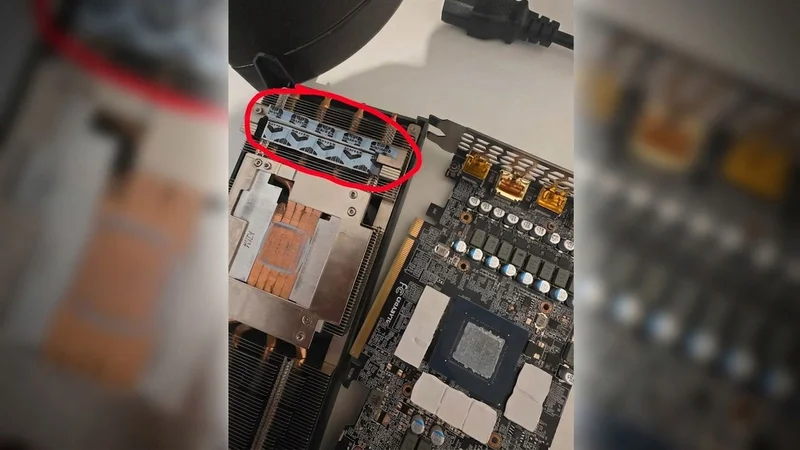
In a bizarre quality control issue, a gamer discovered protective film on the VRM thermal pads of their Gigabyte RTX 3070 Gaming OC graphics card. As per a Reddit post by u/buczi94, the GPU was purchased brand new and had never been disassembled or sent for any sort of repairs. After using the GPU for almost five years, the owner of the GPU started noticing high temperatures on the VRMs. They also faced frequent black screens during higher loads, waking the PC from sleep, and cold boots.
The Redditor claims that they upgraded their motherboard BIOS and GPU firmware and drivers, alongside disabling several settings including custom PBO curve, XMP, and Resizable Bar. Unfortunately, none of these measures helped alleviate the problems. They further performed some benchmark tests using Furmark and OCCT, where the GPU temperatures would reach as high as 80°C with the GPU hotspot at 105°C. While these numbers were not alarming, they also found that the cooling fans would randomly ramp up to their highest speed, despite setting a custom fan curve in MSI Afterburner and limiting the fans to 90%.
Fed up with the situation, the owner of the graphics card eventually took the decision to disassemble the GPU for cleaning and repasting, upon which they found protective films on the VRM thermal pads. They claim that peeling off the protective film and repasting the core resulted in a sizable reduction of 15°C on the GPU and 30°C on the GPU hotspot. Additionally, after three hours of stability tests on Furmark and OCCT, no errors were recorded.
The GPU owner also provided an update on the black-screen issues following the fix. While the problem initially occurred once every month or two, it became an everyday concern just a few days before the thermal pad films were discovered, specifically after waking the PC from sleep, during cold boots, or under heavy loads. After the fix, the owner claims that they experienced just one black screen during a cold boot, although they acknowledged that it was too early to determine whether the problem had been fully resolved.
Removing the protective film from the VRM thermal pads fixed the overheating problem. However, the damage caused by years of excessive heat cannot be undone. The owner alleged that since the VRMs were running much hotter for a long period, they have potentially affected several components on the graphics card, including the MOSFETs, as well as the capacitors around the VRM. The owner believes the excessive heat may have also caused the PCB to repeatedly expand and contract over the years, which can put stress on the board and potentially contribute to tiny cracks in solder joints. While they suspect this could be the reason behind the black screen issue, it is just a theory and can only be confirmed through proper testing.
As the flaw occurred at the production and assembly level, the GPU owner contacted Gigabyte’s support team to report the issue and asked for a replacement. However, instead of addressing the alleged manufacturing defect, Gigabyte’s support staff advised the owner to test their GPU in another system. They also informed the GPU owner that since the card was out of warranty, they should contact the retailer or pay a local repair shop to fix the issue.
It is unclear whether the protective film caused any damage to the VRMs, which ultimately resulted in the GPU's black-screen problems as claimed by the owner. However, the case raises questions about how a factory assembly error could go unnoticed for years and whether manufacturers should address such defects even after the standard warranty has expired.
Get Tom's Hardware's best news and in-depth reviews, straight to your inbox.
Kunal Khullar is a contributing writer at Tom’s Hardware. He is a long time technology journalist and reviewer specializing in PC components and peripherals, and welcomes any and every question around building a PC.