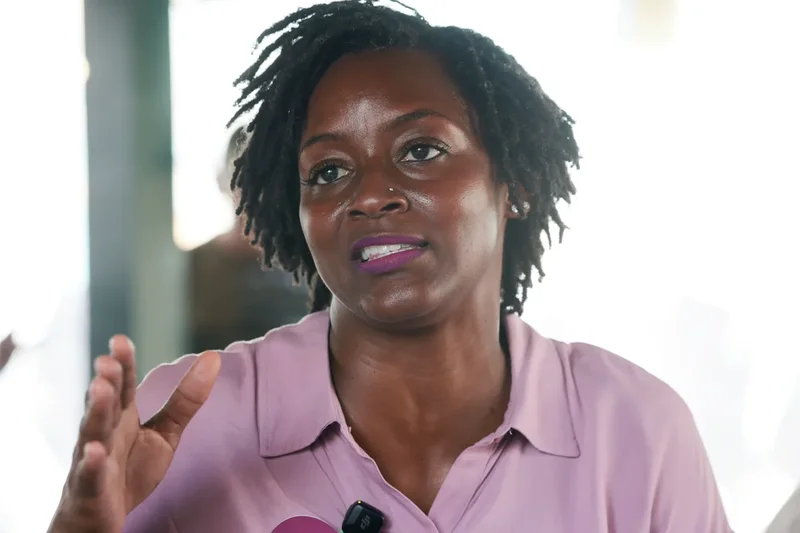
Angie Nixon, the minority leader in Florida’s state house, shocked many last week when she beat Alex Vindman, the incredibly well-funded former national security official who became a hero for many liberals after he testified during President Donald Trump’s first impeachment trial.
It immediately sparked conversations about far-left candidates beating more mainstream Democrats, given that Nixon is a Democratic socialist. In reality, the narrative is not that simple: Nixon is a Florida native who served in the state legislature while Vindman was seen as a carpetbagger. But the data shows a more important trend — one that might shape voting and elections for 2026 and 2028: Black voters are turning out in higher numbers since the Supreme Court gutted the Voting Rights Act.
In May, the Supreme Court’s Louisiana v. Callais rule required the state to redraw its congressional maps saying it had “no compelling interest” to use race to create a congressional map that increased Black representation. That effectively neutered Section 2 of the Voting Rights Act, the landmark 1965 law that prevented electoral discrimination based on race.
Florida Gov. Ron DeSantis wasted no time — within days he passed and signed legislation creating a new congressional map giving the state more Republican-leaning seats. Tennessee followed shortly thereafter, breaking up that state’s majority African-American district.
The response from Black voters has been furious.
Votehub.com, which analyzes election results, showed that counties in the so-called Black Belt of the South, where many African-Americans descended from enslaved people live, had higher turnout after Callais than Black Belt districts that went before.
“And people are pissed off about that,” Kristal Knight, the founder of Organize Tennessee, told The Independent.
“That's not something that the state legislature had to do, but they wanted to do it to disrupt black voting power. They wanted to do it to disrupt minority voting power.”
But if anything, that undersells the story. In fact, many – though not all – majority-Black counties in the Deep South saw increased turnout compared to previous elections. Nixon’s victory proves that out.
Florida’s Gadsden County boasts a 52.7 percent Black population, making it the blackest county in the state. In 2022, the state had a contested Democratic gubernatorial primary to determine who would challenge DeSantis and Val Demings – who, like Nixon, was a Black woman – was the Democratic nominee to challenge then-Sen. Marco Rubio.
As a result, Gadsden saw 34.2 percent turnout in 2022. But on Tuesday, 36.32 of Gadsden’s voters went to the polls.
For comparison, 58.5 percent of voters in Nixon’s home county of Duval, home of Jacksonville, are white while 30.1 percent of the population is Black. In 2022, Duval had about a 29 percent participation rate in its primary. But on Tuesday, it had only about a 23.34 percent participation rate.
That appeared to have a cumulative effect: Nixon won the counties that had the highest Black populations in droves.
Another example comes in the form of Georgia, the hotbed of the Civil Rights Movement. In 2024, the most recent data on the secretary of State’s website, roughly 5.1 percent of the state’s 7 million Black Georgians voted in primary. But in May, right after the Supreme Court’s ruling, that number jumped to 8.6 percent.
State Rep. David Wilkerson told The Independent that Georgia voters were already mad about the cost of living, which boosred the public service commissioner races.
“You definitely continue to see that spark of people that want to make sure that the voices are heard and that you know we push back against what the Republicans are doing,” he told The Independent.
The number is even more stark when zooming into Dougherty County, where 70 percent of the county is Black. In 2024, roughly 12.5 percent of its Black population voted in the presidential primary. But in May of this year, that number spiked to 17.1 percent.
Ultimately, Georgia Republicans decided against redrawing the congressional map this year, but left the door open to changes in the future.
“Everybody knows that if Republicans maintain control come November, they will have a blank check to do whatever they want,” he said. “Because partisan gerrymandering is allowed, racial gerrymandering is allowed, unless you can you know prove that that's their sole intent.”
The same trend played out in South Carolina.
After the Callais decision, the state legislature in South Carolina attempted to break up the 6th district, which James Clyburn represents and about 44 percent Black. The legislature ultimately failed in May, but a few weeks later, South Carolina held its primary. In Williamsburg County, which has an 63 percent Black population, saw 31 percent of its voters turn out. But in 2026, 36 percent of voters in Williamsburg County would turn out.
The same trend played out in Lee County, which is about 62 percent Black, where 31.05 percent of registered voters turned out in 2022, but 32.92 percent would vote in the 2026 primary.
To be clear, this likely will not cause major shifts in most southern states. The only states where this could possibly have an impact are Georgia, where Democratic Sen. Jon Ossoff is seeking re-election, and North Carolina, where Rep. Don Davis, who is Black and used to represent more Black voters, was redrawn into a more Republican-leaning district before Callais.
And it might influence how Democrats seek the 2028 presidential nomination. This month, the Democratic National Committee officially voted to make South Carolina the first primary contest in the nation.
Now, any Democrat will see the numbers from Black voters and at least feel compelled to tell Black voters they will push for a renewed version of the Voting Rights Act and make it a priority if they win.
“Obviously it's diluting our voting power,” Knight said. “But it's also making it harder for candidates coming in because this is a demographic of of voters and people that you cannot ignore if you want to win.”
Tellingly, on Saturday August 28, Rep. Alexandria Ocasio-Cortez, a potential candidate for president, will speak at an event commemorating the anniversary of Martin Luther King’s March on Washington to advocate for voting rights.