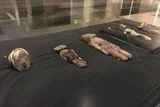
The Chinchorro culture — a fishing and hunter-gatherer society that inhabited the coast of the Atacama Desert more than 7,000 years ago — left behind no writing and built no monumental cities. Yet, it developed one of the most complex funerary technologies known in the ancient world.
Their artificial mummies — now recognized as a UNESCO World Heritage Site — were created up to two millennia before those of Egypt, displaying a level of technical, aesthetic, and even sculptural detail that continues to astonish researchers.
“They transformed their loved ones into true works of art,” Bernardo Arriaza, director of the Chinchorro Management Center and a researcher at the Institute of High Research at the University of Tarapacá in Chile, told Discover. “These mummies are the earliest examples of pre-Hispanic art in the Americas.”
Read More: 700-Year-Old Mummy Reveals Bacterium That Causes Scarlet Fever in the Americas Before Europeans
How the Chinchorro Mummified Their Dead
For the Chinchorro, the deceased were not merely human remains; they remained part of the world of the living. Creating their mummies involved dismantling and reconstructing bodies, using wood and plant fibers, modeling faces, applying clay and ash, and coating surfaces with mineral pigments.
Now, a new study puts a number on that extraordinary investment: a single adult mummy could require around 3.1 pounds (1.4 kilograms) of manganese to produce its characteristic black coating.
Published in the Journal of Archaeological Science: Reports, the study quantifies, for the first time, the amount of manganese required to create the so-called “Black Mummies” — one of the most complex forms of Chinchorro mummification, practiced between 4000 and 2800 B.C.E.
The process involved removing the skin and soft tissues, extracting the organs, drying the body using fire or ash, and then reconstructing and modeling it with clay, wool fibers, and plant fibers. Unlike the “Red Mummies,” incisions or sutures were used less. When the original skin was insufficient, it could be replaced with sea lion skin, and the bodies were fitted with wigs. This technique was practiced for nearly two millennia.
The mineral was crushed and processed to produce a black pigment — sometimes with a dark bluish hue — capable of covering the entire body. That amount offers a glimpse of the scale of just one part of what Arriaza describes as a “chain of operations:” The stones had to be located and collected, selected, transported, crushed, processed, and mixed with other materials before being applied to a body that had been carefully disassembled and reconstructed.
Where Did the Manganese Come From?
The Chinchorro people mummified men, women, the elderly, children, and even newborns from across the social spectrum. But before they could mummify a body, they first had to obtain the raw material. And that is where the operational sequence began.
One of the identified sources of manganese is located in the high Andes, near the headwaters of the Lluta Valley, at an elevation of almost 16,400 feet above sea level. There, manganese occurs in surface rock outcrops — hard stones with black patches that can be scraped or broken into pieces.
“Complex technology isn’t required to collect it. You can gather the stone, and then you have to go through the whole process of scraping or crushing it,” archaeologist Marcela Sepúlveda, also of the University of Tarapacá, told Discover. Sepúlveda did not participate in the study led by Arriaza.
So how did the manganese reach the coastal communities? The researchers have proposed several possibilities. Sepúlveda argues that highland groups mined the mineral and traded it with coastal populations.
“Fish remains, shells, and shark teeth are found in the Puna de Atacama. We think it was an element used for trade and to maintain social contact with other groups,” she explained.
Arriaza hypothesizes that the Chinchorro themselves traveled to the mountain sources to obtain the mineral. But manganese was also available closer to the coast, with low-altitude deposits along the Lluta River, between 5 and 7.5 miles inland, as well as near its mouth on the Pacific Ocean.
“They could obtain it without traveling great distances,” he said.
How Much Manganese Did They Really Need?
Whatever the procurement route, the new calculation helps explain why this question matters. Using samples of the coating taken from a mummy and the dimensions of an adult body, the team calculated the volume the manganese layer would occupy on each body segment — face, torso, arms, hands, legs, and feet — and then converted it to mass.
The complete coating would weigh between 3.7 and 5.5 pounds, but, based on the manganese concentrations measured in the samples, the researchers estimated that about 3.1 pounds of manganese itself would be required. According to Arriaza, it was a material “of fairly high purity.”
The Chinchorro crushed the manganese and processed it into a pigment, which was then mixed into a paste and applied to the body. The layer was not uniform in thickness: on the face, it averaged about 0.1 inch, while on the torso it averaged about 0.04 inch.
These figures are also a conservative estimate of the raw material required. To obtain the refined manganese, additional material had to be removed and discarded, so the total amount of rock extracted and processed was probably several pounds greater than what ultimately ended up on the mummy. If several adults were mummified at the same time, the investment in raw materials, time, and labor would have been even greater.
But the 3.1-pound figure comes with an important caveat. Sepúlveda, who has studied the coating layers of Chinchorro mummies, points out that they are not composed exclusively of manganese.
“The paint layers mix coloring matter, which would be manganese, with other compounds, such as clay,” she explained. Therefore, she argues, it is still necessary to determine how much of those 3.1 pounds actually corresponds to the mineral and how much to the other materials that made up the paste.
Furthermore, she notes that manganese has strong coloring power, meaning that a relatively small amount can be enough to produce intense pigmentation.
“If you can create a mixture with a small amount that takes advantage of that black color and enhances it in some way, you don't need as much,” she told Discover.
To more precisely determine how much manganese was needed to produce a mummy, Sepúlveda proposes experimentally replicating the mixtures used by the Chinchorro and assessing how much of the mineral was required to produce the different shades of the coatings, ranging from deep black to more grayish tones.
Specialists of the Time
“When you analyze the details, you see how meticulous they were. The perfection [of the mummies] demonstrates to me that there were undoubtedly specialists involved — but who were those specialists? That is another major question,” Arriaza told Discover.
In this regard, the researcher maintains that women played a more active role during the first period of mummification — corresponding to the “Black Mummies” (6000 to 4750 B.C.E), while men played a greater role in the second period, corresponding to the “Red Mummies” (4500 to 4000 B.C.E.). His hypothesis is based in part on the fact that the earliest bodies prepared were primarily newborns and children; the grief surrounding these deaths may have prompted mothers to play a particularly active role in the mummification process.
The next step in Arriaza’s research is to delve deeper into the role of women in these funerary practices. After all, behind every mummy lay not only a complex technology for transforming a body but also a community that invested time, knowledge, materials, and labor in keeping its dead within the world of the living.
Sepúlveda, meanwhile, is conducting a systematic review of the Chinchorro mummies recovered to date — nearly 300 individuals — to better characterize their coatings and the variability in the colors and materials used. The goal is to determine how the mixtures differed, what types of manganese were employed, and how the hues varied across individuals and time periods. This work could help reconstruct, in greater detail, the technologies and decisions behind each mummy.
“We know the Chinchorro were deeply engaged with death, yet we know very little about their daily lives. It is likely that they painted themselves while alive, too,” Sepúlveda said. “It is a vast universe for further research.
Read More: Fragments of Homer’s Iliad Found Buried with Roman-Era Mummy
Article Sources
Our writers at Discovermagazine.com use peer-reviewed studies and high-quality sources for our articles, and our editors review for scientific accuracy and editorial standards. Review the sources used below for this article:
- This article references information from a study published in the Journal of Archaeological Science: Reports: Assessing manganese mass in adult Chinchorro mummy preparation
- This article references information from a study published in the Journal of Archaeological Science: Reports: To move or not to move? Manganese oxide procurement during the Archaic period in the Atacama Desert
- This article references information from the Museo De Historia Natural de Valparaiso: Chinchorro Mummies of the Valparaíso Natural History Museum
- This article references information from UNESCO: Settlement and Artificial Mummification of the Chinchorro Culture in the Arica and Parinacota Region