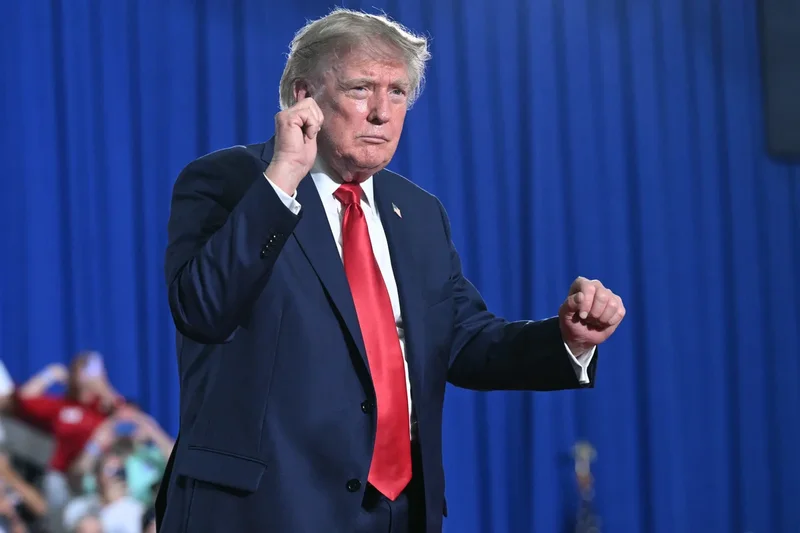
Rather than planting additional flowers, President Donald Trump has filled the White House Rose Garden with sculptures.
Sculptures depicting key American founding figures now sit in the space adjoining the Oval Office.
This follows Trump's decision to substitute the traditional grass lawn with a paved white stone terrace, creating an aesthetic reminiscent of his private Mar-a-Lago estate in Palm Beach, Florida.
One featured artwork was donated outright, while several others were provided on temporary loan by undisclosed contributors.
The most recent installation is a bronze sculpture of a seated Thomas Jefferson drafting the Declaration of Independence, crafted and presented by Colorado-based sculptor George Lundeen.
The piece stands alongside depictions of George Washington, Alexander Hamilton, and Ben Franklin, along with a fifth work entitled "Freedom’s Charge."
These installations are part of an extensive program of White House alterations overseen by Trump, including a gilded redesign of the Oval Office and a new ballroom and landing pad being constructed on the southern lawn.
The Republican president's alterations reflect his desire to reshape the capital's architectural landscape, which also includes plans for a monument park on federal grounds near the National Mall.
Lundeen originally produced the artwork representing Jefferson, the third U.S. president, several decades prior, retaining it at his property before deciding to refurbish it and send it to Trump for display at the executive mansion ahead of the Independence Day festivities marking the country's semiquincentennial.
His associate, Steven Barber, initiated communication with administration officials on Lundeen's behalf.
"I thought it would just be a real nice thing on the 250th for people to look at Thomas Jefferson as he was writing the Declaration of Independence," Lundeen said in a telephone interview.
Deliveries were delayed, however, so the piece failed to arrive before the holiday.
According to Barber, transport vehicles faced holds amid strict event security protocols. After reviewing photographs of the work, Trump was sufficiently impressed to select a location for it within the Rose Garden.
Direct contact was missed when the president placed an appreciative telephone call that went straight to Lundeen's answering system. Following the holiday period, an office administrator urged Lundeen to review a specific recording.
"Hi, George. It's your favorite president, Donald Trump, and I just wanted to thank you," the president said on the recording, which Lundeen shared with The Associated Press.
"The sculpture, it looks really beautiful ... just by the picture I can see it's really incredible, and we have a wonderful place right in the Rose Garden, and I appreciate it."
Barber said in a separate telephone interview that early attempts to engage White House staff had yielded minimal traction over several months. That changed rapidly roughly three weeks prior to July 4, when officials sent a "flurry of emails saying they wanted it."
Limited background information has been made available regarding the remaining sculptures situated in the patio area.
The White House said Harlan Crow supplied the portrayal of Washington, America's first president, on loan. Representatives for the Texas real estate developer and GOP megadonor, noted for his personal ties to Supreme Court Justice Clarence Thomas, did not respond to email messages seeking comment.
Meanwhile, "Freedom's Charge," a 14-foot-tall (4.3-meter-tall) bronze artwork representing two Revolutionary War soldiers flanking a flag, was moved from Dallas. Artist Chas Fagan did not respond to written requests seeking comment.
According to executive staff, the pieces representing Franklin and Hamilton were supplied by unidentified donors.
Addressing the installations, White House spokesperson Davis Ingle asserted that no chief executive in history has committed as much effort toward enhancing the grounds and structure of the residence.
"From restoring our treasured landmarks, which had suffered years of abuse and vandalism, to cleaning our parks and the Reflecting Pool, President Trump’s bold vision ensured that America rang in its 250th birthday celebration with glory and pride," Ingle said in an emailed statement referencing recent maintenance efforts surrounding the Lincoln Memorial pool.
Ingle added that Trump remains committed to delivering "long-overdue and necessary" structural and aesthetic updates throughout the estate.
"Thanks to the Builder-in-Chief, the White House will be properly glorified and remain in excellent condition for generations to come," Ingle said.
On the adjacent property of the Eisenhower Executive Office Building, Trump oversaw the placement of a Christopher Columbus monument during March.
Additionally, the National Park Service recently erected a collection of works depicting figures and themes from the Revolutionary era at a nearby public plaza.
Trump's most ambitious monument initiative centers on establishing a National Garden of American Heroes close to the National Mall, intended to house statues of 250 historic American figures who made significant cultural, political and historical contributions. However, the proposal faces legal challenges from multiple historic preservation groups, who contend that explicit congressional approval is legally required before work can proceed.
Barber indicated that he and Lundeen remain "in the mix" to contribute sculptures for that proposed memorial grounds as well.
At his private golf facility in West Palm Beach, Florida, Trump displays a 7-foot (2.1-meter) bronze piece capturing his raised-fist posture following the 2024 assassination attempt at a Butler, Pennsylvania campaign rally. Created by Lundeen, the sculpture was presented as a gift by Anthony Constantino, a New York entrepreneur and Republican congressional candidate.
The White House has historically served as a showcase for notable artistic works, most famously Gilbert Stuart's portrait of Washington in the East Room—rescued by first lady Dolly Madison during the 1814 burning of the building by British forces during the War of 1812.
Sitting presidents hold access to an extensive collection of historic art. Trump noted that he personally examined the "vaults" to select presidential portraits and decorative pieces for display across the Oval Office and executive rooms. Likenesses of former presidents and former first ladies routinely line the public halls and reception rooms.
During Trump's initial term, first lady Melania Trump arranged the placement of a work by Japanese American artist Isamu Noguchi near the Rose Garden, marking the first inclusion of an Asian American artist in the White House collection.
Previously, a 2015 redecoration of the Old Family Dining Room led by then-first lady Michelle Obama introduced a painting by Alma Thomas, who became the first African American female artist represented in the national executive collection.
A portrayal of Thomas Jefferson arrives at the executive mansion Administration officials suggest additional sculptures could follow Sculptural projects expand beyond executive residence grounds The executive mansion maintains a tradition of displaying artwork