- Do YOU have a story? Email tips@dailymail.co.uk
- See more Daily Mail on Google - save us as a Preferred Source
Britain needs to make itself much less appealing to asylum seekers if it wants to control soaring numbers coming here illegally.
That's the verdict of the Danish politician whose hardline policies drove a significant reduction in the number of migrants coming to the Scandinavian country to try to gain residency status as a refugee.
Denmark is governed by the centre-left Social Democratic party – whose values are similar to those of new Prime Minister Andy Burnham's Labour – which has been following a tough policy aimed at 'zero asylum seekers' for several years.
When measured in relation to per capita population, Denmark and the UK until recently had quite comparable numbers: as recently as 2023, Denmark had an average of 57 per 100,000 while in Britain it was 55.
But since then the two nations' experiences have dramatically diverged: Britain's number has almost tripled and now amounts to 145 claims per 100,000 citizens while Denmark's number has fallen by a third to just 40 claims.
And when the Mail visited previously troubled areas of the capital Copenhagen this week we saw the positive social results of the change – more of which later.
But Denmark's statistical turnaround alone is one that new PM Andy Burnham would love to achieve – having pledged to tackle the small boats crisis.
Indeed we know that the Labour government has looked to the Denmark model for inspiration: Rasmus Stoklund, until recently Denmark's immigration and integration minister, was invited to host Shabana Mahmood to share his insights earlier this year.
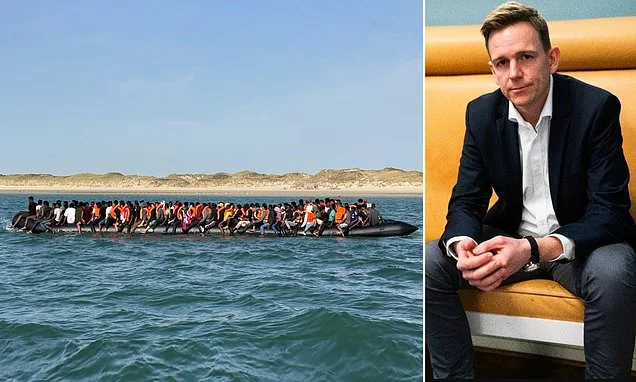
Britain's migrant crisis - that has seen the introduction of so-called mega dinghies carrying 230 people to our shores - is being exacerbated by our weak approach to asylum applications
The UK needs to make itself 'less appealing to migrants' - seen here waving to a smuggler's boat in an attempt to cross the English Channel, on the beach of Gravelines, in northern France
Rasmus Stoklund, Denmark's former immigration and integration minister, has been integral in the country's number of applications dropping by a third to just 40 per 100,000 people
That meeting came when the British Home Secretary visited Denmark on a fact-finding tour and held high-level discussions with Mr Stoklund and his team, with the Danish MP saying he hoped the talks had been 'fruitful and useful'.
Mr Stoklund said he was unable to share details of his discussions with Ms Mahmood – 'Far be it for me to advise the UK government on policy' – beyond saying he hoped they had been 'fruitful and useful'.
But he was happy to tell the Daily Mail how he turned Denmark around.
He told us: 'What we have done is to make clear that asylum seekers without a valid reason are not welcome in Denmark.
'We [now] have very strict criteria and everything is checked and checked again and decisions made very quickly - and many of them are rejected and the claimants sent back to where they came from.
'We are sending a signal to human smugglers and migrants considering trying to get into Denmark that it is not that easy anymore, and we have strict rules and regulations that will be used and will probably get you sent back.
'During the last ten years we have taken a number of initiatives that have kept the numbers down, and the focus has been on securing and controlling our borders and who gets in.
'People who apply for asylum have their applications processed very quickly and thoroughly and a lot of them are rejected straight away because they don't have any real reason to claim it - they come from safe countries.
'They are [therefore] rejected and they are deported, they are not told please leave and then go back into society, they are put in centres and then returned home.
'On average we have around 50 people a week put on planes from Denmark who have no right to stay in the country.
'We send people back to Afghanistan and Syria as often as possible and we are able to control the numbers well. We have repatriation schemes where people volunteer to go back, and many have taken this opportunity.'
Denmark's attempt to turn the tide on migration goes back to 2019 when the left-leaning government first indicated an ambition to protect Danishness – and acted on the pledge.
The country famously banned the burka, the garment fully covering the face and body worn by devout Islamic women.
And new rules came in compelling all newcomers and their children to learn Danish or lose asylum seeker benefits.
Mr Stoklund went on: 'It is tough but it has worked - we have made ourselves less attractive and less inviting and that's how we have dealt with the issue, it's as simple as that.'
Mr Stoklund is adamant that it's not in his remit to tell the UK what to do – but when pressed on where we are going wrong he does have thoughts in that direction.
Mr Stoklund explained: 'Britain needs to focus on what is good for Britain
'What I can tell you is that here in Denmark we try to make it as unappealing as possible to come here because of the demands and restrictions.
'If you have no viable legal reason to arrive then you will be sent back, it's as simple as that, the asylum process is very thorough, and you need to have detailed documentation.
'If you cannot provide this then your claim will be rejected but if you are fortunate enough to be granted asylum then you will be expected to work and give back to society, and if you turn to crime then you will also most likely be deported.
Denmark Prime Minister Mette Fredericksen, met Sir Keir Starmer in Downing Street last year to discuss her approach to immigration
'Your right to benefits is also very low and with these incentives the aim is to show that Denmark is not an attractive place to come to and maybe that's where the UK is going wrong but it's not for me to tell the government there what to do.
'We also have very strict regulations for people who want to come here and join family members who may be in Denmark already - it's not as simple as just turning up, they have to fulfil their obligations.
'It's not just possible for them to arrive and move in.'
This compares to a much less strict regime here: in a case that emerged just last month a single refugee from Afghanistan was astonishingly able to successfully argue that 22 family members should be allowed to enter the UK to join him.
Mr Stoklund went on: 'These family claimants are put in centres, and their claims are examined and if they meet the requirements then fine but it's a very hard process and Denmark is good at investigating thoroughly the backgrounds of all migrants.
'To be honest the likelihood is that any application will be rejected and that's the incentive we use, to make people realise that it's just not worth coming here because you will more than likely be sent back.
'Of course, we are a small country with a low population which makes the numbers easier for Denmark to handle but the structures we have in place undoubtedly help keep the figures down.
'But we expect people who come here to contribute and if they don't then they are sent back, that's if they get in in the first place.'
Mr Stoklund, who held the migration job until this June, even argued – unsuccessfully – that his country should ignore judgments from the European Court of Human Rights, a policy that both the Conservative and Reform parties here have adopted.
And his successor in the role, Morten Bødskov, is keeping up the hardline approach: just this week he floated plans to ban the Islamic call to prayer being used in Denmark, claiming parts of the country felt like 'a suburb of Islamabad'.
Denmark has cut asylum claims by 90 per cent with policies like banning the burkha, the garment fully covering the face and body worn by devout Islamic women
Denmark and the UK until recently had comparable migrant numbers: In 2023, the Danes had an average of 57 per 100,000 while in Britain it was 55
Meanwhile when the Mail toured Copenhagen – and visited the three districts most affected by migration – we saw the context that caused the Danish government to take drastic action.
All three have seen crime and rental costs go up – while social cohesion, according to many, has gone down.
In Ishøj, an outer suburb of Copenhagen, where native Danes are expected to be outnumbered imminently by those with ancestry from overseas (the current ratio is 51 per cent/49 per cent), there is widespread relief that the numbers are falling.
Local mayor Merete Amdisen, a Social Democrat, said earlier this year that the area had no capacity to take any more new immigrants.
Mark, a pensioner and long-term resident, said: 'An enormous number of immigrants have arrived, and older Danish people like me are worried about our country and what the future holds.
'There has been an increase in serious crime and now it is practically children who are carrying knives and guns and being recruited by gangs.
'So we welcome something finally being done.'
Mr Stoklund was invited to host Home Secretary Shabana Mahmood to share his insights into migration and how Denmark has achieved a reduction in asylum claims earlier this year
In the Rødovre district, Mayor Britt Jensen, also a Social Democrats, had said she will not accept any more Ukrainian refugees and they will have to build temporary accommodation units in car parks if the numbers coming don't decrease.
She said: 'The main problem is that we don't have space. We don't have any housing available. We are in the process of renting out commercial properties and converting them into housing. And then we have to build pavilions in all our available parking spaces.'
In Brøndby, Mayor Maja Højgaard, again a Social Democrat, says that the municipality's already large proportion of people with a foreign background means that there is no room for more Ukrainian refugees. Today, immigrants and descendants make up 42 per cent of the municipality's inhabitants.
She said: 'It is no use putting the people who need help the most in the place where there are already the vast majority of other local residents who also need help'
A local there, a middle-aged man, said: 'Rental costs here have sky rocked in recent years so much so that many people cannot afford somewhere to live. It has now become profitable for landlords to relocate original inhabitants, renovate the apartments and then double the rent.'
More positive was resident Anna who said: 'I like having a diverse population. There is a lot we can learn from the newcomers. So, I'm not afraid. Crime gets far too much attention and creates a gloomy atmosphere.'
But a neighbour said: 'We used to get told all about the positive aspects of migration and how we would have a positive, multicultural Denmark but now the talk is all of parallel societies with conflicting interests.'
Mr Stoklund addressed his point in his final comment.
He said: 'We realised a long time ago that we wouldn't be able to maintain a high level of social cohesion and trust in our society if we accepted migrants from countries who would end up being unemployed or turn to crime.'