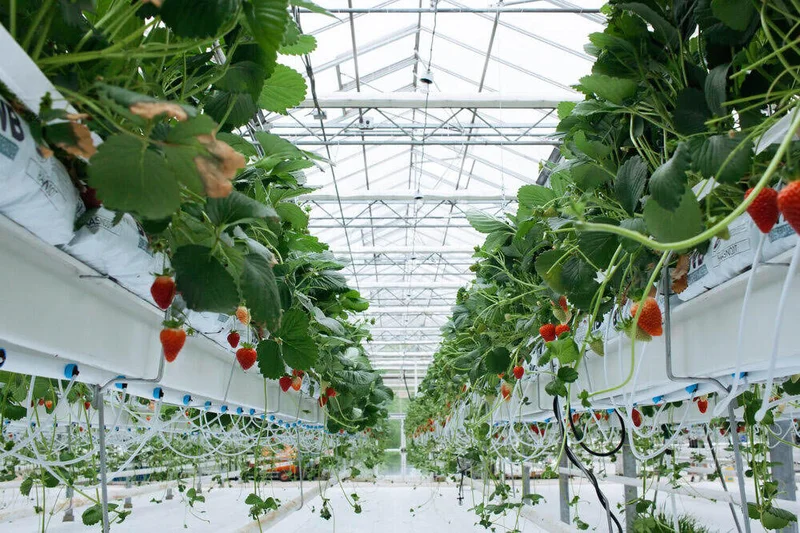
Greenhouse products exports rise 12% thanks to modern technology, water crisis management
TEHRAN- Despite sanctions and escalating international tensions, Iran's greenhouse product exports surpassed 770,000 tons in the past agricultural year, recording a 12% growth.
According to the Director General of the Greenhouse, Medicinal Plants, and Edible Mushrooms Office at the Ministry of Agriculture, this success is attributed to the application of modern technologies, a focus on water and energy efficiency, and targeted planning for developing suitable regions.
Elham Fatahifar stated in an interview with IRNA that total greenhouse product exports exceeded 770,000 tons, generating approximately $390 million in foreign currency earnings for the country. She noted that this 12% growth was achieved even though only 20% of greenhouse production is currently exported, indicating considerable potential for increasing the export share.
Fatahifar reminded that under the Seventh Development Plan, the ministry is tasked with raising national greenhouse production to 10 million tons per year by the plan's conclusion. Current total production stands at under 4 million tons, requiring a 6-million-ton gap to be filled through precise planning across provinces, particularly in the well-suited Fars province. She emphasized that achieving this goal will require principled planning and targeted investment, with the private sector and greenhouse owners playing a pivotal role.
Energy imbalance and water crisis: serious obstacles
The Director General identified energy imbalances and the need for greater water efficiency as two major challenges and obstacles to greenhouse development. She stressed that any new expansion must be concentrated in regions with adequate energy infrastructure and water resources to ensure sustainable production while managing the crisis.
Fatahifar also highlighted the decisive role of knowledge-based companies in modernizing production methods, noting that a significant portion of the country's export success stems from adopting new technologies that improve productivity, reduce water consumption, and enhance the quality of export products.
Regarding the export basket composition, she reported that bell peppers, tomatoes, cucumbers, and greenhouse-grown eggplants rank highest in export volume. Greenhouse strawberries and other commercial vegetables are gradually carving out their place in export markets and receiving positive reception, reflecting the growing diversity of the export portfolio.
Fatahifar stressed that through scientific solutions and private sector support—especially from greenhouse operators—Iran can both ensure sustainable food security and expand its share in regional and global greenhouse product markets. She also described major scientific events and modern methodologies as valuable opportunities to bridge universities, research centers, and the greenhouse community, expressing hope that such interactions will spark a new leap forward in Iran's greenhouse industry.
The Deputy Agriculture Minister for Horticulture Affairs has announced the targeting of 10 million tons of production in the country's greenhouse sector and emphasized the necessity of moving from traditional methods toward advanced agriculture, along with removing infrastructural obstacles and active trade diplomacy for sustainable foreign currency generation.
Mohammad Mehdi Boroumandi, on Wednesday at a specialized greenhouse growers' conference in Shiraz, while emphasizing the necessity of transitioning from traditional agriculture to advanced agriculture, announced the targeting of 10 million tons of production in the country's greenhouse development.
He stated: Relying on active trade diplomacy and removing infrastructural obstacles, we are moving firmly on the path of sustainable foreign currency generation through the export of premium Iranian products.
The Deputy Minister, referring to the performance of the past agricultural year, said: In this period, over $390 million in export value was obtained from the country's greenhouse production.
Boroumandi added: Last year and for a period, the European Union disrupted our export situation and did not allow our products, especially pistachios—which are among the best and healthiest products of the country—to be exported to target countries.
According to him, pistachios, with value of 1.7 billion dollars, have the highest export revenue among the country's agricultural products.
The official further emphasized: We must resolve people's concerns about the production of healthy greenhouse products through cohesive planning.
Boroumandi stated: Currently, we export agricultural products to over 80 countries worldwide, but only 20% of the country's greenhouse products are in the export basket.
He also said: Iran is among the countries that consume the least amount of fertilizers and pesticides in its production.
EF/MA