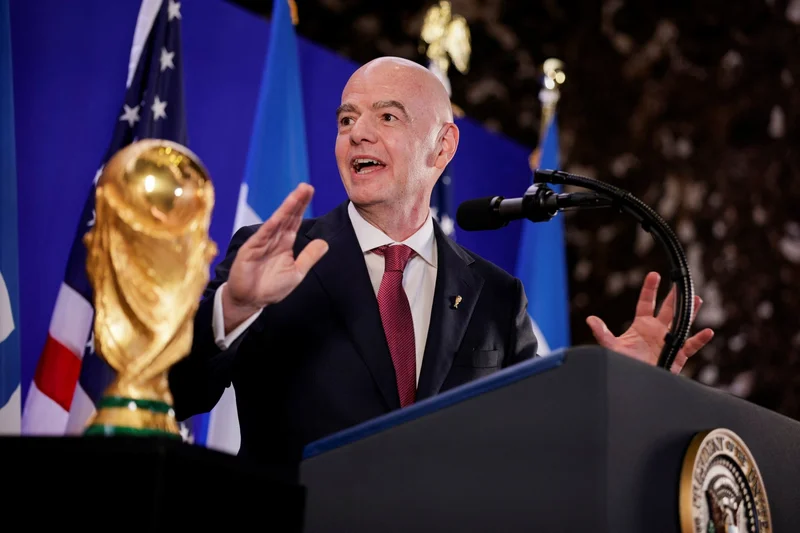
The fallout from the 2026 FIFA World Cup has escalated into one of the biggest leadership challenges of Gianni Infantino's presidency, with senior figures across European football accusing FIFA of putting commercial gain and political influence ahead of the long-term health of the sport.
Spain's 1-0 extra-time victory over defending champion Argentina in the World Cup final at MetLife Stadium on July 19 brought the curtain down on the first 48-team tournament, co-hosted by the United States, Canada and Mexico.
While Infantino hailed the competition as "the greatest human, social and cultural event that mankind has witnessed," the tournament has instead fueled growing criticism over fixture congestion, governance, commercialization and political interference.
Leading that criticism is La Liga president Javier Tebas, who on Tuesday said Infantino should step down, accusing FIFA of "destroying the football industry" by prioritizing an expanded international calendar over the domestic leagues that underpin the global game.
"The football industry isn't just the World Cup," Tebas told La Gazzetta dello Sport. "National competitions sustain this sport. They generate tens of thousands of jobs. They are destroying the football industry for an event that lasts 40 days and involves only a minority of players."
Tebas renews attack on FIFA
Tebas has been one of Infantino's fiercest critics for years, regularly opposing FIFA's efforts to expand international competitions. His latest remarks come as FIFA continues to evaluate a proposal from South American governing body CONMEBOL to increase the 2030 World Cup from 48 to 64 teams.
According to Tebas, further expansion would only worsen an already overcrowded football calendar.
"Increasing the number of national teams makes no sense," he said. "Everything cannot revolve around the World Cup."
Asked whether Infantino should remain FIFA president, Tebas left little doubt.
"In my opinion, his time is up," he said.
"He has the support of the system and the federations, so there's not much more to add. There is no opposition candidate because nobody wants to stand just to lose. The system is rotten at its core."
Tebas argued that many influential figures privately share his concerns but refuse to challenge FIFA publicly.
"I've heard many people who are against Infantino," he said. "They say it, but then they do nothing. I don't know what's worse, the silence or the complicity."
Over-commercialization
Among Tebas' biggest complaints were several changes introduced during the World Cup that he believes prioritized television revenue and entertainment over the sport itself.
He dismissed the tournament's hydration breaks as little more than commercial opportunities.
Fans display a banner of FIFA president Gianni Infantino inside the stadium before the 2026 FIFA World Cup quarterfinal match between France and Morocco at Boston Stadium, Foxborough, U.S., July 9, 2026. (Reuters Photo)
"Hydration breaks are a lie," he said. "In La Liga we use them only when it's genuinely hot. Here, the stadiums in Dallas, Los Angeles and Atlanta had air conditioning. They were simply advertising breaks."
The breaks, introduced midway through each half to help players cope with summer temperatures across North America, drew criticism from some coaches and supporters who argued they disrupted the rhythm of matches while giving teams additional tactical timeouts.
Tebas also criticized the World Cup final's extended halftime, which reportedly lasted about 27 minutes instead of the traditional 15, saying it unnecessarily disrupted the match and further highlighted FIFA's emphasis on commercial programming.
Political interference
Tebas also pointed to the controversial handling of United States forward Folarin Balogun's suspension as evidence of what he believes is growing political influence over football.
Balogun's red-card suspension was lifted after intervention linked to U.S. President Donald Trump, who publicly acknowledged speaking with Infantino about the matter.
Although Belgium later eliminated the United States from the tournament, Tebas argued the incident exposed serious governance concerns.
"FIFA arranges things as it wants, for its own interests, certainly not for football," he said.
The controversy echoed broader concerns voiced by former FIFA president Sepp Blatter, who has warned that political involvement risks undermining the credibility and independence of world football.
UEFA boycott exposes widening divide
Relations between FIFA and UEFA also appeared to reach a new low during the tournament.
UEFA president Aleksander Ceferin did not attend the World Cup final, marking the first time a UEFA president has skipped football's biggest match.
Ceferin attended the tournament opener in Mexico City but stayed away from the final amid growing frustration over several issues, including the Balogun disciplinary case, refereeing operations, match management and what UEFA viewed as increasing political influence over FIFA decision-making.
His absence was widely interpreted as a public protest and underscored the widening divide between European football's governing body and FIFA.
Supporters demand structural reform
Criticism has not been limited to football executives.
Football Supporters Europe (FSE), the UEFA-recognized umbrella organization representing supporters across Europe, issued a strongly worded statement calling for sweeping reforms to FIFA's governance.
Describing the tournament as "a World Cup that failed supporters," FSE said FIFA had prioritized spectacle and commercial interests over fans and the traditions of the game.
"The 2026 World Cup should have been a celebration of football and the supporters who give it life," the organization said. "Instead, it became a case study in what is so deeply wrong with football today."
The group criticized historically high ticket prices, soaring travel costs, limited transparency, changing regulations and what it described as the growing influence of political figures over football operations.
It also called for structural reforms that would return greater decision-making authority to FIFA's Council and Congress while ensuring clubs, leagues, players and supporters play a larger role in shaping the sport's future.
"The future of the game cannot rest in the hands of a man who has proven yet again that he puts financial and political interests ahead of football," the statement said.
Infantino remains firmly backed
Despite mounting criticism, Infantino's position appears secure.
More than 200 of FIFA's 211 member associations are reported to support his bid for a fourth term when presidential elections are held in Morocco on March 18, 2027.
The FIFA president has consistently defended the tournament, arguing that disciplinary decisions were made independently under FIFA regulations while highlighting record attendance, global audiences, commercial success and unprecedented worldwide interest.
Infantino has also praised cooperation with the Trump administration on security and logistics throughout the tournament.
Critics, however, contend that the World Cup accelerated the commercialization of football through dynamic ticket pricing, extended broadcast windows and growing political involvement, while placing additional strain on players and domestic competitions.
With calls for reform now coming from league officials, supporters' groups and former FIFA leaders, the debate surrounding the 2026 World Cup has evolved beyond a single tournament into a broader battle over who controls football's future.