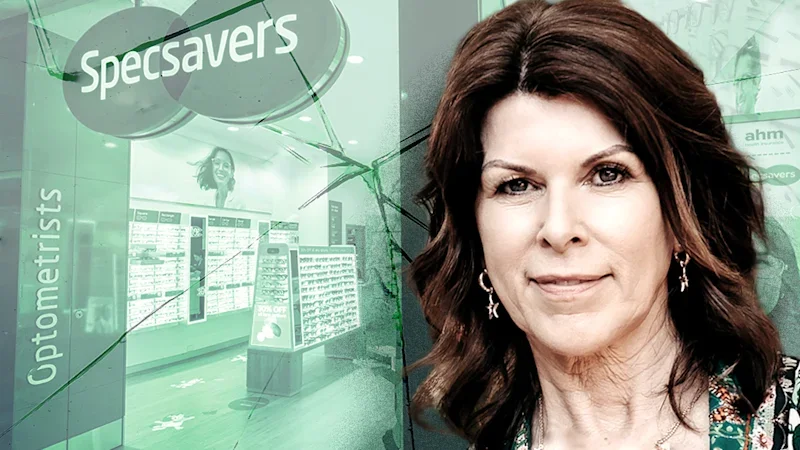
Three months after visiting Specsavers, wearing the bifocals she felt she was pressured into buying, Nicole Donovan had a car accident.
“It could have just been from stress or hurrying,” the NSW mid-north coast resident said, “but I really couldn’t see properly”. When she called the store to ask why she was still having problems despite the new prescription, she was assured that she simply needed to get used to them.
“[The worker] was quite short on the phone with me,” Donovan said, and she wasn’t offered a follow-up appointment. “So I kept on trying, thinking it was me.”
When Donovan sought a second opinion at an independent optometry clinic, she was promptly diagnosed with advanced cataracts which required urgent surgery.
She felt she had no choice but to travel five hours to Sydney for an $11,000 procedure: “I was frustrated that [Specsavers] didn’t pick it up, so that I may have been able to go on a public waiting list and get the surgery for free.”
Donovan was one of the more than 70 people who contacted this masthead following its investigation into corporate optometry, which detailed how chains including Specsavers and OPSM pressured optometrists to hit sales targets, potentially jeopardising patient care.
Professor Konrad Pesudovs, a leading optometrist researcher and clinician, said cataracts are to optometrists what high blood pressure is to GPs: “You can’t miss a cataract. It’s just so fundamental, it’s right there.”
While he said it was possible that there had been a misunderstanding during Donovan’s initial appointment, her care should have been followed up: “What isn’t defensible is not seeing a patient when they’re unhappy, because that’s when you detect the problem.”
This masthead’s investigation found optometrists were routinely pressured to prioritise “convertible” appointments which would result in a glasses sales.
Another Specsavers customer, who spoke on the condition of anonymity, said a manager “snatched the appointment card out of my hand” after he attempted to book a follow-up consultation because the glasses he was prescribed for a sudden vision change did not improve his eyesight: “My guess was that he wasn’t getting a sale, so he didn’t want to deal with me.”
The patient instead visited a neighbouring independent optometrist, who escalated his concerns to an ophthalmologist. It was then – two weeks after his initial visit to Specsavers – that he was advised to go immediately to the emergency department, where it was confirmed that his sudden vision loss – diagnosed as hemianopia – was due to a stroke.
Dr Tim Fricke, the director of research and education at the Australian College of Optometry, said while mistakes happen, a hemianopia should be picked up in a basic examination, during an initial consultation. He was also concerned by the refusal to book a patient in for a follow-up.
“Practitioners are paid for a health service through Medicare,” he said. “I don’t think it’s particularly [profitable for Specsavers], but there is an obligation to provide a health service.”
In a statement, Specsavers said more than 5 million Australians trust the brand with their eye care each year, “a responsibility we take seriously, and in the rare instances where a patient believes their experience was not what it should have been, we have well-established clinical governance and review processes”.
“We are proud of the professional standards of our optometrists in detecting and managing eye-threatening conditions,” the statement said. “These governance and review processes are designed to understand what occurred in these rare instances and identify opportunities for continuous improvement.”
No longer a local operation
A July 2026 report by industry research group IBISWorld highlighted the growing monopolisation of the sector, with Specsavers and EssilorLuxxotica (OPSM’s parent company) expected to account for just over half the industry’s revenue in 2026-27.
Specsavers opened its first Australian retail store in 2008 and now holds more than one-third of the market share, with $1.8 billion in annual revenue. Specsavers Australia represents the second-largest market by revenue for its global parent company, behind only the UK, where the chain originated.
The brand’s “competitively priced products and services has forced other optical retailers to match”, the report found, with about 94 per cent of initial eye tests across the industry bulk-billed.
The report noted that other outlets – which included a mix of independent optometrists and smaller chains such as Oscar Wylee, George & Matilda, and Bailey Nelson – still hold a 48.7 per cent market share, with $2.51 billion in revenue.
The true cost of bulk billing
Across the industry, costs for rent and equipment have skyrocketed while Medicare rebates have remained stagnant.
“The squeeze has been on for decades,” Fricke said. “You get less payment per unit of time than you used to, and all your costs [have gone] up. So something has to give at some point.”
Optometry Australia chief executive Mark Nevin said the peak body has consistently advocated for higher rebates, which he said were “unsustainably low” and needed to be cross-subsidised by sales of spectacles and contact lenses to remain viable.
However, Nevin said financial KPIs that compromise clinical autonomy, including the quality and safety of care, were unacceptable: “We can assure the public that care provided by optometrists is safe and high quality, evidenced by the very low level of complaints to our regulator.”
Nigel Chesterfield-Evans, who has been an optometrist since 1978 and ran five independent practices before converting them to Specsavers franchises, said public expectation around bulk billing had damaged the industry: “People do not appreciate what they don’t pay for.”
“I have sat in a consulting room, found a retinal tumour, photographed it, sent it to the GP and then sent it to the ophthalmologist. The fee that I got from Medicare for that was less than the lady at the nail salon,” he said.
Optometrist and Health Services Union (HSU) delegate Shereen Kassir said the government should “step up” to ensure MBS fees matched both current inflation and optometrists’ scope of practice.
“It’s not just affecting the optometrists under these really strong KPI pressures, but it’s also impacting the patient care,” she said. “Medicare disincentivises being a clinical-focused eye care provider.”
A spokesperson for the Department of Health, Disability and Ageing said in a statement that optometry services are indexed every year on July 1. The spokesperson said changes to MBS optometry services came into effect in March 2025, including creating two new MBS items for glaucoma patients at high risk, amending low vision assessment items to align with contemporary best practice, and increasing schedule fees for domiciliary visits.
Clinicians, not retail staff
Last month, the HSU lodged a bid at the Fair Work Commission which called for optometrists to be explicitly covered under the Health Professionals and Support Services Award, to ensure industry recognition and improved pay, breaks and rosters.
“We know Specsavers have said: You fall under the retail award, you are not a health professional,” HSU president Kate Marshall said. “Simply knocking that argument out means that we can legitimately have a go at these companies.”
Kassir said the award will allow optometrists to work under an enterprise agreement, and if needed, participate in protected industrial action: “That gives [us] the power back.”
Make the most of your health, relationships, fitness and nutrition with our Live Well newsletter. Get it in your inbox every Monday.