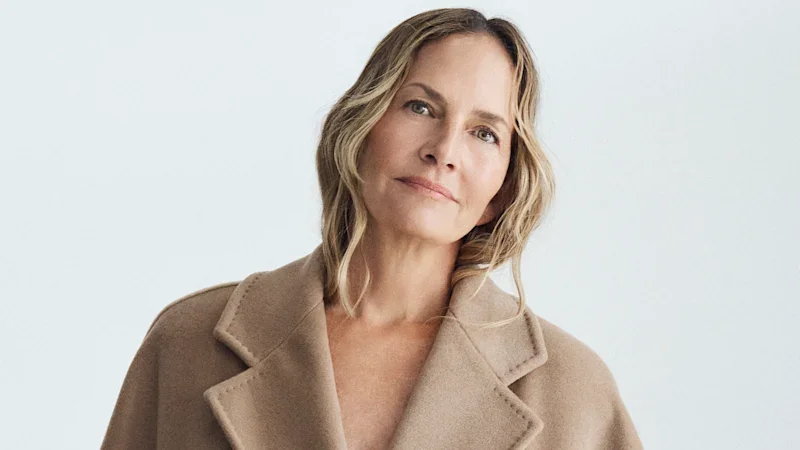
Rather than quietly fading into the background, women in their 50s, 60s and beyond are stepping into the “power decades” to make them their best yet. Here, we speak with five women who have turned their age into their greatest asset.
Wendy Euler, model and writer
Embracing age with grace has become a calling card for model, writer and podcast host Wendy Euler, who moved to Australia from the USA a year ago at the age of 57.
“The sixth decade of my life has been the strongest, the best and the hardest,” she says. “Life hits us with a lot. I had a baby at 46, so I have a 12-year-old daughter now as well as two older daughters. Being in my 50s has given me the freedom to define success for myself.”
As founder of the online platform and podcast Goodbye Crop Top, the 58-year-old doesn’t sugar-coat age, she celebrates it. Her first book, The Self-Sovereign Woman, due for release next April, draws lessons from Stoicism that aim to empower women to age positively.
Work aside, Euler says her 50s have also been a time to reflect deeply on her personal relationships. “You realise the most important things in life are the people in it,” she says. “It’s a time when you wonder what does love mean, what does home mean, what does forgiveness mean.”
Physical and mental health also have a more central role in Euler’s day-to-day life. “I’ve learnt that time is my most valuable currency,” she says. “I have become ruthless about protecting my peace, and I don’t have to explain myself. I’ve taught my daughters that, too. I’ve also become a lot quieter, and there’s power in that. I don’t want to get sucked into the ‘loud’.”
Euler says her book, which took four years to write, extends on the work she did to shine light on topics that were rarely being talked about when she began. And while she’s had approaches to begin modelling again, the 58-year-old remains “super selective about it nowadays”.
“I moved from Montana to Australia a year ago – that was huge for me. I was the one getting in the way of what came next because I was fearful of putting myself out there, but I don’t think you’re really living unless you’re on the edge of a little bit of fear.”
Bruna Papandrea, film and TV producer
In Australian film and TV circles, the name Bruna Papandrea has become synonymous with stories centred on strong women, many of them over 40 – among the award-winning producer’s credits are the TV series Nine Perfect Strangers, Strife and The Lost Flowers of Alice Hart. Her latest, The Good Daughter, starring Rose Byrne, is coming in November. She’s also launched a podcast, Invisible Roadmap, jets back and forth to LA for meetings, and is ticking off her dream holiday destinations.
“I noticed a big shift in my late 40s and [early] 50s, where I learnt not to sweat the smaller stuff,” the 55-year-old says. “I am much more philosophical. Some things sell, some are easy, some are not. I don’t take things personally. I approach work with a confidence and experience you don’t have when you’re younger.”
She’s aware, too, that improved mental health isn’t always matched physically. “Author Liane Moriarty said in an interview that being in your 40s to 60s is like being in sniper alley – you don’t know what’s coming at you. That resonated with me. Health-wise; it all starts to happen.
“I also lost a lot of close friends when I was 54 and chose not to make a negative of it. I thought, ‘How do I want to spend the rest of my time on Earth?’ My 50s are the decade I have chosen to get out of my comfort zone.”
For Papandrea, who grew up in public housing and has “a side hustle in the travel sector coming soon”, being in her 50s is all about having choice. “Who do I want to work with? What stories do I want to tell? I wish I were that person who could make anything, but I don’t work like that.
“The years have passed swiftly since I turned 50 and I don’t feel I have time to waste.”
Denni Francisco, fashion designer
Some women would resist the idea of starting a new business in their 60s, but not proud Wiradjuri woman Denni Francisco, who was into her seventh decade when she founded First Nations fashion label Ngali in 2018.
After spending most of her career running a successful children’s brand, Billiecart Clothing, Francisco was looking for her next chapter. “I was working in the corporate world in 2017 and was missing the creative process,” she says. “I didn’t feel I was doing enough to support our First Nations communities, so the driving force wasn’t just fashion for its own sake but to make meaningful change with clothing.”
Having plenty of life experience also meant Francisco was better equipped to start a business the second time around. “When I got back into fashion, I was seeking purpose,” she says. “And that became clearer as I got older.”
Since its launch, Ngali’s star has risen, with highlights including taking the collection to Milan in 2022 and, in 2023, staging the first solo runway by an Indigenous brand at Australian Fashion Week. “Milan forced me to see Ngali’s vision as globally relevant, reinforcing my belief that First Nations culture belongs on the world’s stages,” says Francisco. “It broadened my perspective as a creative, inspiring me to think beyond Australia and pursue international opportunities with confidence.”
Francisco says her decades of experience have also helped her to appreciate and trust the creative process. “Over time, I’ve found the centre of creativity is space – physically, mentally and spiritually. It is in the quietness of Country, where there is no noise, no rush, no having to do, just the sky above, the earth beneath, and the air all around. It is there that my mind settles, my spirit reconnects and new possibilities quietly reveal themselves.
“I’ve also learnt that energy is best directed to things that are working. What we nurture flourishes, creating opportunity to do more of the work that brings purpose and joy.”
Terri Vinson Jones, scientist and businesswoman
It was during the GFC that Terri Vinson Jones, then in her 40s, had her “a-ha moment”. The scientist was running a cosmetic treatment clinic in Melbourne’s inner east and the economic downturn meant clients could no longer afford her treatments. “But,” she recalls, “they said they couldn’t afford to be without my products”.
Having already invested $40,000 in savings into her business, Vinson Jones closed her clinic and devoted herself full time to Synergie Skin, of which she remains the sole owner and chief formulator. And while her business and skincare philosophy haven’t changed in the two decades since, the language around ageing has.
“It was easy to fall into the trap of promising women they would be more beautiful if they used these products or had this treatment,” she says. “My philosophy now is that ageing is the biggest gift we can have. Rather than seeing it as something we have to fight, or as a problem to solve, we must do our best to go through those years with great health.”
With a new beauty brand – and trend – born every minute, Vinson Jones, 63, prides herself on her slow approach to success. “My son is 30 and told me he was worried he hadn’t ‘made it’ yet. I was in my 40s when I finally saw what I needed to do. And at 63, I still have so much to learn and give.”
For Vinson Jones, leaning into her “power” years means trusting her team of about 70 staff. She now divides her time between the Sunshine Coast and Melbourne, where Synergie Skin products are manufactured. “Zooming out gives you the ability to look into the business more closely,” she says. “When you’re involved day to day, you get caught up in the weeds. I was struggling with that.”
As for succession, Vinson Jones intends to work for a while yet, but “won’t be a 90-year-old spruiking skincare”.
“My mission is to have a grandchild on my shoulders in my 80s and be walking up a hill, laughing,” she says. “That, to me, is powerful ageing.”
Cynthia White, graphic designer and personal trainer
For over two decades, deputy art director Cynthia White has been a core part of the Sunday Life team. But when she hit her 40s, despite being busy raising four kids, she realised, “It’s time to do something for me.”
It was exercising regularly and boxing at least four times a week that transformed White, mentally and physically. “I started feeling good about myself. I got hooked on the endorphins, the mental health benefits and feeling physically strong.”
At 51, following a separation, she completed the qualifications to become a personal trainer, something she describes as “the best thing I ever did”.
Initially, White’s focus was on younger people. “I had teenage children and noticed that teenage girls in particular were struggling with mental health. I just knew if I could get them outside and moving it would make a big difference, and that they would love boxing as much as I did.”
Even though she was warned it would be a tough market to break into, White ran weekend sessions anyway. Before long, mature women noticed her in the park. “I had women my age coming up to me, asking if I could train them. I realised that was my primary market.”
One advantage White has over some of her peers is that she offers clients a shared experience. “I remember what it felt like to be new to working out – I felt self-conscious and embarrassed. I also understood what it was like to be a woman juggling a multitude of issues.”
White has learnt to adapt workouts to make them safer for older women, recognising that not everyone can do push-ups or skip.
Thanks to her own training, at 60 her personal fitness remains extraordinary. She does three strength sessions and at least two cardio sessions a week and her favourite exercise is five-kilo weighted pull-ups.
“I love going to the gym and training with men and women of all ages and walks of life,” she says. “It also feels pretty good to be able to do as many push-ups as everyone, sometimes more!”
Looking ahead, White has no plans to stop: “I’ll still be deadlifting, squatting and training when I’m 80,” she says, laughing. Her advice to anyone hesitant to start? “It is never too late, and it is the single best ticket to feeling good about yourself.”