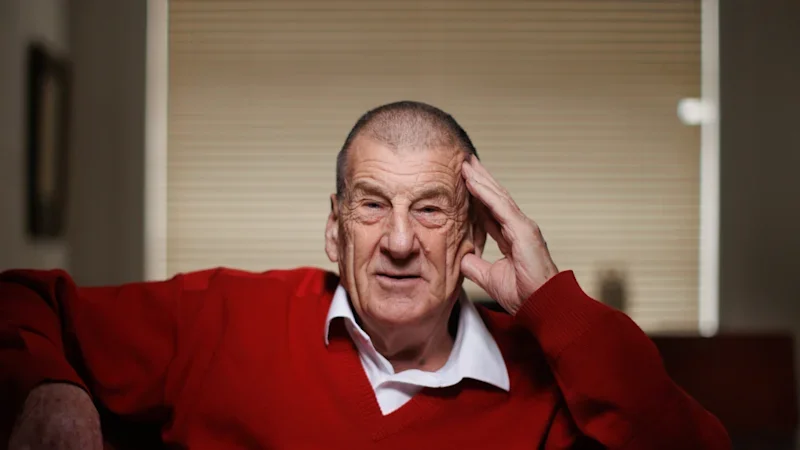
The Hon Jeffrey Gibb Kennett AC is – he admits we might find this surprising – reluctant. “Jeff does not do interviews over lunch,” emails the personal assistant to Victoria’s polarising 43rd premier, instead offering coffee and a chat at his office, housed in a terrace in the inner-east suburb of Cremorne, so much trendier in temperament and attitude than his old state seat of Burwood.
As I wait for Victoria’s leader from 1992 to 1999 to descend from the upper floor, a glance around his meeting room reveals the measure of the man.
The vibe is corporate man cave. A Hawks scarf (Kennett was Hawthorn president twice and is now a life member) lies draped over some mini premiership cups. Stacked bottles of red wine cohabit the shelves with books on Kokoda, Changi, wool sheds and Howard Hughes.
A photo of Kennett, youthful, ecstatic, meeting Queen Elizabeth, sits near a model yacht, while in another photo of a man in a flannelette shirt holds a sign that refers to Kennett’s mental health charity Beyond Blue, which he chaired for 17 years: “I didn’t vote for Jeff but I love him now for what he is doing for men’s and women’s mental health.”
Kennett is smiling, courteous, interested and interesting. He asks about my role at The Age. It’s part question, part challenge. This chat is also an audition.
“I don’t do many interviews, as you know,” he says.
But you are always popping up on 3AW or in the Herald Sun fog-horning about this or that, I think but do not say.
But Kennett means interviews about himself. “I don’t like this sort of stuff, it’s bullshit,” he says with feeling at one point, subsequently voicing second thoughts about the whole thing. He acknowledges I might find this surprising.
When he has built up a sufficient head of steam talking about how greatly concerned he is about the state of modern politics – “people are generally disillusioned” – I make moves to turn on my recorder. There are no objections.
“The political class has not lived up to expectations. I think there has been a fundamental lack of leadership,” Kennett says, taking aim at Victorian and federal leaders while praising state Labor premiers in South Australia and NSW as well as the Queensland Liberal National Party government.
But generally, quality candidates are shying away because of the damaging impact modern politics will have on them and their families.
Independent ACT senator David Pocock gets a big tick. “He is, without a doubt, a very valuable independent to the parliamentary system.”
He says people living on new estates in western Melbourne are particularly disillusioned while they see billions spent in the east. “They just feel as though they’ve been ignored,” he says.
Kennett wears a red woollen jumper, black trousers, sensible black sneakers of a kind popularised by media baron Rupert Murdoch and is sporting the shortest buzzcut ever seen on a 78- year-old. But he is smiling, clearly enjoy his post-politics and post-charity third act.
Kennett has zero interest in talking about his legacy – “I don’t look back because life’s too short, and it’s shorter for me than it is for you” – but he does talk about the time Jacinta Allan thanked him, what the Queen’s greatest fear was and the time Julia Gillard and Barry Jones came over for dinner.
But he does say: “Oppositions never win; governments lose,” he says. “We didn’t win in ’92. The government lost, and we were the beneficiaries of the communities sending a message to government. The same is going to happen now.”
Kennett’s election loss in 1999 shocked many at the time. Rural electorates turned on his government, which won one more seat than Labor, but independents chose to make Labor’s Steve Bracks premier.
Does he feel he stuffed up the campaign? “No, no, no. Life is what it is, you know.”
Back in the 1990s, Kennett’s aggressive premiership and radical policies were polarising and transformative in a state deeply in debt and ravaged by a recession. Hundreds of schools were closed, hundreds of councils were merged, public assets were privatised, tens of thousands of public servants sacked. State debt was paid off, major public works initiated. Melbourne took the Formula 1 Grand Prix off Adelaide and founded major events such as the Melbourne Fashion Festival and Melbourne Food and Wine Festival. Some Victorians praise him; some have never forgiven him.
Large Indigenous art canvases dominate the room, pointing to Kennett’s nine-year stint as chairman of arts charity The Torch, which runs Indigenous art programs in prisons.
Kennett says he was the first Liberal leader back in the 1990s to criticise One Nation leader Pauline Hanson’s statements attacking the Chinese community and notes that she is not really interested in Victoria.
He says it is unclear how many seats One Nation will win at the November Victorian state election, and he is against any coalition or preference agreement between the Liberal Party and One Nation.
“You don’t need to have formal arrangements between the two parties. If they’re both going to practice what they preach, both of them are going to put Labor last or near the bottom,” he says.
He gets on well with Premier Ben Carroll. “We can disagree with policy, but most people don’t see that sort of human interaction.
“I have found in my time that I can speak to any premier, Labor, Liberal, doesn’t matter on a private matter.”
“When I see Daniel Andrews, we’re always polite to each other.”
“I don’t say we get on well, I say we’re always polite to each other.”
He is expressive, folding and unfolding his arms, shifting, exhaling. As if his body, even at 78, can’t contain his energy.
In 2025 Damien Hardwick, coach of the Gold Coast Suns, publicly attacked then-premier Jacinta Allen. She had criticised Richmond’s decision to return defender Noah Balta to play before his formal sentencing over after an off-field assault she described as sickening.
Kennett called in to 3AW and criticised Hardwick, saying a leader such as Allan had the right to call out unacceptable behaviour.
“Jacinta sent me a note back saying thanks very much, and I went back to her and I said, just, ‘it’s just a pity no one of your own side said that’.”
After our interview, Allan announced she would be retiring from politics at the election.
“Did you send Jacinta Allan a note after the leadership spill?”
“Yeah.”
“What happened there?”
“The answer is yes, and she responded. But I’m not telling you what I said.”
Kennett says he enjoys similar warm relations with former Labor prime minister Julia Gillard, at one point referring to her as his friend.
Is she really his friend?
“Oh, well, she’s a friend in as much as I’ve had her around to my place a couple of times, lunch or dinner with Barry Jones.”
His friendship with Gillard is testament to his desire to make community organisations politically bipartisan. He persuaded Gillard to replace him as chair of BeyondBlue, which she did for seven years until stepping down at the end of 2023. Gillard now mainly lives in London and is chair of The Wellcome Trust, one of the world’s biggest charities.
“I keep referring to her as Dame Julia now because I said, ‘the government will give you a damehood’,” Kennett jokes. Gillard’s response to this is unrecorded.
The photograph of a younger Kennett greeting Queen Elizabeth was taken on one of his yearly road trips to Europe, which he says were part of his drive to reignite the economy.
“It was extraordinary,” he chuckles at the memory.
“Mr Kennett, I am very worried about what [UK prime minister] Mr Blair has done in allowing there to be parliaments in Scotland and in Wales. And I’m terribly worried that that will lead to the breakup of the United Kingdom,” he says she told him.
He deems it “quite amazing” that “this extraordinarily experienced monarch” would be sharing her inner thoughts.
“I have been gobsmacked ever since about this suburban bloody politician and here he is as the Queen’s confidant.”
But he is primarily concerned with what is happening right here in Melbourne. Last month, a couple of blocks from his office, the Undefeated gym on Chapel Street was firebombed.
“What the hell have we let ourselves become?” he says, referring to this and recent shootings and firebombings that have shocked the city.
He references The Age’s forthcoming Melbourne Assembly and the appearance of the former New York City mayor Bill de Blasio, who will headline the city identity forum.
“But what chance have you got [to reshape the city] if you’ve still got crime happening everywhere? Enough is enough, right? We’ve got to have zero tolerance,” he bangs the table.
“And you mightn’t like incarcerating a young person, but you don’t have to put them in a maximum-security prison.
“I’ve always thought, because of my army background, if you put them into a prison farm, where they physically have to work most of the day, where they can be educated in the evenings and the night, where you can carrot and stick ...”
“Some of them are still kids, though,” I point out.
“I don’t care whether they’re kids or not, are you serious about attacking the problem?”
He decides the greatest contribution his government made was “giving people confidence again in their own community”.
“And that meant that they could run risks and go and start businesses and do whatever they liked.”
Major initiatives during his era included poaching the F1 Grand Prix, The Melbourne Convention and Exhibition Centre (“Jeff’s Shed”), Crown Casino, CityLink, and the aforementioned fashion and food and wine festivals.
“And the major events was part of that because it was the yin and the yang to the economic issues that we obviously have to address.”
All of those projects and his solutions to the state’s economic woes were not without controversy – including numerous hard questions from this newspaper.
“I enjoyed my tussles with The Age,” he says. “It used to be so far left,” he continues, before heaping praise on our star investigative reporter Nick McKenzie.
Peeking out from his red jumper is a bracelet of brightly coloured plastic skulls. It comes from his four-year-old grandson, who starts each weekly Zoom session with “grandfather, wrist”, to ensure his Christmas present is still in constant use.
“I’ve never taken it off since he gave it to me. They’re all skulls, which makes me wonder whether he wants me to still be here, or he’s thinking that this is how I’m going to look in due course.”
He sees me to the front door.
The rest of his day will be spent visiting two ailing former colleagues and attending a Liberal Party function in the evening.
“I can’t stop,” Kennett says on the front step.
“If you stop, you rot.”