- See more Daily Mail on Google - save us as a Preferred Source
A suspected Russian attack against an airport in Germany using an explosive-laden drone is linked to a parcel bomb campaign that targeted Britain, The Mail on Sunday can reveal.
A drone packed with Semtex slammed into the wing of a stationary Ukrainian cargo plane at Leipzig/Halle Airport late on August 4 but failed to detonate.
The drone was discovered close to the giant Antonov An-124, which was being used to fly military supplies into Ukraine, by a bus driver, who pinned it under his foot and alerted airport security.
The MoS has learnt that the incident has sent shockwaves through Western capitals and is viewed as a ‘game-changer’ by security experts because it shows Vladimir Putin is prepared to use drones to destroy targets in Europe.
This newspaper can also reveal that investigators discovered traces of DNA on the drone that matches at least one unnamed individual suspected of involvement in a Kremlin-backed sabotage campaign that included sending parcel bombs from Lithuania to the UK two years ago.
One incendiary parcel with a pre-programmed electronic timer exploded and caused a fire at Leipzig-Halle airport in July 2024 as it was about to be loaded on to a DHL flight to Britain.
Two days later a second device, which had been flown to the UK, caught fire at a DHL depot near Birmingham. Two similar packages were also found in Poland.
All the devices were mailed from Lithuania’s capital Vilnius in what is believed to have been a series of ‘practice runs’ to eventually target commercial flights to the US.
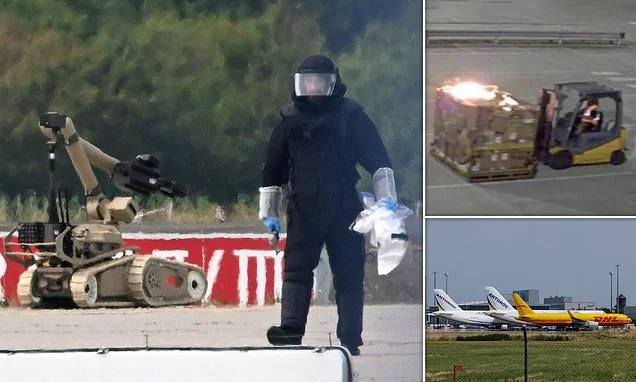
On August 4, a drone packed with Semtex slammed into the wing of a stationary Ukrainian cargo plane at Leipzig/Halle Airport - but failed to detonate (Pictured: A Ukrainian Antonov cargo plane with a DHL cargo plane)
Traces of DNA on the drone match at least one individual suspected of involvement in a Kremlin-backed campaign that included sending parcel bombs to the UK two years ago (Pictured: a fire caused by a suspected Russian incendiary device at a DHL facility in Birmingham)
A joint investigation into the parcel bombs by British, German, Polish, Dutch and Lithuanian detectives identified 22 suspects in Lithuania and Poland believed to have been working on behalf of Russia’s GRU military intelligence service.
Five men suspected of mailing incendiary devices are on trial in Lithuania.
Now forensic evidence is mounting that the suspected GRU sabotage network behind the incendiary devices was also involved in this month’s drone attack.
Professor Peter Neumann, an expert on the German security services at King’s College London, said: ‘They found DNA on the Leipzig drone and... the person that matches that DNA is a person who is suspected in Lithuania of involvement in the parcel bomb plot of 2024.
'This was the attack that went to a Birmingham warehouse. The parcel bomb attack was basically led by the Russian GRU. This is the smoking gun.’
Roderich Kieswetter, a German MP and former officer in the Bundeswehr armed forces, said: ‘If it is true that the DNA [on the drone] is similar or is the same as it was with the DHL arson attack in 2024, then we know that the GRU, the Russian military secret service, was behind it.
'I have heard this from two sources. The pattern of behaviour matches with the Russian conduct of such operations.’
A spokesman for the prosecutor’s office in Lithuania confirmed that ‘the drone incident at Leipzig Airport is linked to Lithuania’.
A forensic technician is pictured at Leipzig/Halle Airport with a bomb-disposal robot near the Ukrainian aircraft
Lithuania’s defence and interior ministers have reportedly been briefed about the link.
It comes as the MoS can reveal astonishing new details about the audacious Leipzig drone attack.
Around 600 grams of Semtex is understood to have been squeezed into a sweetcorn can, which was then attached to the ‘quadcopter’ drone. The can detached from the drone when it hit the aircraft. Only a defective detonator prevented a huge explosion.
Polish investigators are understood to have identified that a cache of similar explosive-filled cans were smuggled into Poland by Russian agents.
Rather than being radio-controlled, the military-grade drone had either a 4G or 5G antenna and two mobile phone SIM cards inside it, which allowed it to be controlled via the mobile phone network.
The sabotage gang are believed to have secretly lodged another small antenna in a tree in the village of Kursdorf near the airport’s perimeter, which boosted the phone signal used to control the drone.
Crucially, experts say this means the saboteurs could have been controlling the drone from a huge distance away – and possibly even from a different country.
And, alarmingly, experts warn that drones controlled via mobile phone networks are also more difficult to detect and jam than those that rely on radio frequencies.
A Polish man called Kamil who owns a garage in Kursdorf, told the MoS that he spotted the drone approaching the airport’s northern runway on the night of the attack – and then watched hours later as the police swooped on the village.
‘I was about 60 metres away, in a straight line, from where the drone was flying,’ he said. ‘After about two or three hours, airport security turned up here, and then later the police from Leipzig.’
In another extraordinary twist, investigators believe a second drone was hovering above Leipzig-Halle Airport at the time of the attack, relaying live video images to the operators of the attack drone.
A DHL cargo plane from Marseille is believed to have collided with the second drone and was forced to make an emergency landing about 150 miles away in Hanover with minor damage.
Describing the Antonovs, Professor Neumann said: ‘These are really important. They transport ammunition, they transport helicopters and all sorts of stuff via Leipzig.
'If the bomb had worked, it would have exploded the fuel tank of that plane and it would have created a huge fireball.’
Experts last night warned that the UK could also be targeted by exploding drones after the Kremlin threatened ‘consequences’
over the use by Ukraine of British-made drones to strike Russia.