In short:
James Griffiths has found a new purpose through vision-impaired archery.
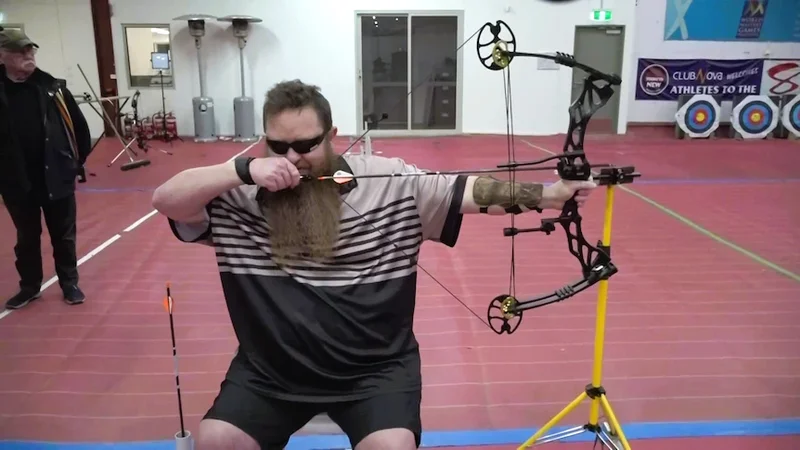
Mr Griffiths uses a special scope, wears blackout glasses and receives feedback on whether he has hit the target.
He hopes to inspire others and aims to compete at the highest level of vision-impaired archery.
As James Griffiths draws his bow, he steadies his breath and aims at a target he cannot see.
Mr Griffiths is a newcomer to vision-impaired archery after a Type 2 diabetes diagnosis cost him much of his vision.
Now, he relies on touch, sound and trust to ensure his aim is true.
But the 46-year-old from Sale in Victoria's east is targeting more than just a bullseye when he picks up a bow.
"When they say you can't do this and you can't do that, I will prove people wrong,"Mr Griffiths said.
"[We're told] blind people aren't supposed to do this … why not? Why shouldn't we?"
Mr Griffiths discovered archery through a "come and try" session promoted by Gippsland Disability Advocacy Incorporated.
It didn't take long for him to be hooked.
"I can shoot at a target I can't see, and the only person I'm competing against is myself," he said.
He is now working towards the World Archery Para Championships while holding onto the dream of becoming a Paralympian — if vision-impaired (VI) archery is one day added to the games.
How vision-impaired archery works
Mr Griffiths uses his cane to familiarise himself with the range before aiming with a tactile sight that rests against the back of his hand.
He also wears blackout glasses while shooting, designed to block out any remaining vision and ensure all VI archers compete on a level playing field.
After each shot, Mr Griffiths' support worker uses a spotting scope to locate where the arrows have hit.
The target is described like the face of an analogue clock, with his support worker relaying a specific "time" back to him.
It allows him to build a mental picture of the target, whilst also listening to hear if his shot hit the target.
Peter Bennett, president of the Twin City Archers in Morwell, said Mr Griffiths is a tenacious and determined athlete.
"The challenge is you've got no relationship to the target," Mr Bennett said.
"So he's got to feel for it and listen to the people around him that are helping him get there."
Mr Griffiths is the first vision-impaired archer Mr Bennett has trained and one of around a dozen or so competitors nationally.
"There's not a big amount yet, but they're getting there; It's growing," Mr Bennett said.
Health battle
Mr Griffiths' journey to the archery range followed years of health challenges.
He was diagnosed with Type 2 diabetes at 19 before complications from the condition affected his eyesight and kidneys, eventually leading to a kidney-pancreas transplant that saved his life.
Mr Griffiths said his illness forced him into early retirement and that his experience has driven him to encourage others to take their health seriously.
"Diabetes is not a joke," he said.
"I'm lucky I've only gone blind from diabetes ... but other people lose their hands, their feet, their legs, their life."
Mr Bennett said Mr Griffiths has already shown the commitment needed to pursue the sport.
"He's got a good attitude; he's come in here, he has some goals that he wants to achieve and he's quite happy to put the work in to get there, which is great, that's what you need," he said.
"He's achieved a lot, his scores are going up, and so far the scores he's shot are doing very well in Australia ranking-wise."
The para-archer said he hoped to make his granddaughter proud by competing in archery competitions around the world.
"She's absolutely beautiful, full of beans, full of energy, loves to run around, yell, scream, sing, everything," Mr Griffiths said.
He wanted his journey to encourage others living with disability to try something new.
"If you find a sport you're interested in, just see if they can modify it to help you,"he said.
"The guys here are absolutely great … wonderful people, really helpful, patient, great advice."