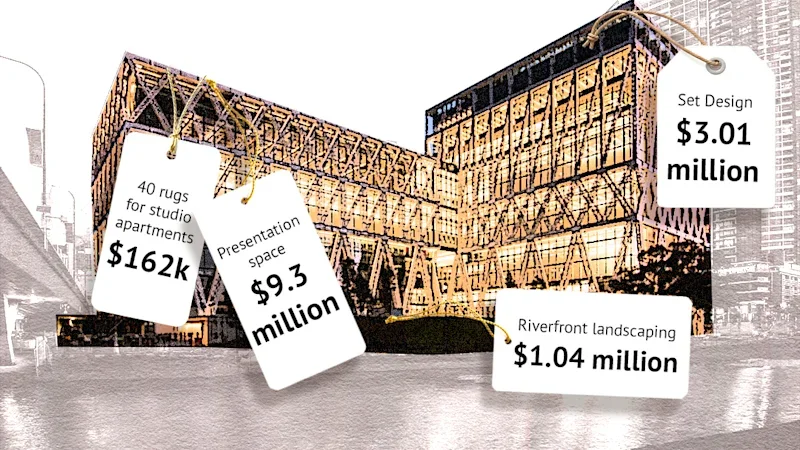
NSW Treasury has been brought in to scrutinise the operating budget of the new Powerhouse Museum as contracts show the institution has burned through more than $70 million in the lead-up to its headquarters’ grand opening.
Treasury executive Cassandra Wilkinson was confirmed as the museum’s acting chief operating officer in a letter circulated to staff on Friday morning as an internal investigation into a whistleblower complaint about procurement and recruitment issues remains ongoing.
Procurement documents show the museum has locked in stand-alone and multi-year contracts for cybersecurity, cleaning, recruitment, ticketing, software management, landscaping, rigging, and audiovisual and lighting packages ahead of its doors opening in four months’ time.
It also paid $362,000 for eight promotional films for an international digital channel, alongside local and international public relations, while spending $26 million on exhibition design and fit-outs, according to procurement records.
In addition, the museum has been busy decorating 30 in-house studio apartments – hiring a high-profile interior designer at a cost of $333,000, commissioning about 40 custom rugs at roughly $4000 apiece, and spending $2 million on customised wardrobes and bedheads.
One of the largest single expenses has been a $13 million fit-out of the walls, ceilings and floors in the museum’s two largest exhibition spaces. Some $3 million has been spent on the set of its children’s show The Dark and a further $10 million on LED screens, staging and backdrop for an immersive experience created by British artist Es Devlin, and stage and backdrop for music and choral performances on its outdoor terrace.
The spending snapshot was extracted by the Herald from contracts and consultancies uploaded and updated to the state’s Buy NSW platform.
The Parramatta Powerhouse represents the biggest cultural infrastructure investment in NSW since the Sydney Opera House.
It will be western Sydney’s first major state cultural institution and the museum’s leadership has been intent on delivering a museum worthy of regional pride and showcasing Australian craftsmanship.
The task of delivering the massive project is weighing heavily on successive NSW budgets, with the museum allocated a record $138 million this financial year, more than for any other cultural institution, including $89 million in unidentified grants. But it’s been set a massive target to raise $50 million revenue across the first seven months after opening, and its first year operating budget is yet to be publicly confirmed.
Treasury officials have been brought in to review the underlying operational needs and test the assumptions dating to the original 2019 business case commissioned by the former Coalition government and prepared pre-COVID when the Ultimo campus was to have been closed, the government said.
Given the two significant construction projects now total more than $1.215 billion, it was an appropriate moment for operational budgets to be tested.
“With the Powerhouse Parramatta ready to swing its doors open this year it’s the right time to make sure its operating model is fit for purpose, with this Treasury review,” Arts Minister John Graham said.
The Art Gallery of NSW underwent a Treasury audit after experiencing a $16 million budget deficit following the opening of its Sydney Modern campus in 2022, which ultimately led to painful staffing cuts.
The review will likely be welcomed by the Public Service Association and supporters of the former Ultimo museum, who have been raising questions around spending and procurement policies for two years.
The museum last month axed its highly contentious $2.6 million artistic consultants’ program amid calls by a parliamentary inquiry for greater transparency and accountability.
The museum has not denied reports that the budget for the opening shows has now pushed beyond $70 million.
That is roughly 10 times the estimated cost of the Art Gallery of NSW’s opening show lineup for its Sydney Modern expansion in 2022.
Defending exhibition expenditure, the museum said the opening shows would run across multiple years and were engineered for long-term efficiency.
“The exhibitions have been designed so that future displays will reuse existing construction materials, providing efficiencies and sustainability for the museum,” a spokesperson said.
“The exhibition budgets also cover international, national, and local freight and logistics, lighting, seating, access requirements, signage, showcasing, mount-making, security, painting, interpretation, 2D design, 3D design, registration, object labels, and permanent acquisitions into the Powerhouse Collection.”
Among the contract details, a Sydney workshop specialising in solid timber crafting was paid $2 million for shop drawings, material samples, and off-site fabrication of bedheads, wardrobes, and specialised joinery for the apartments in the museum’s eastern wing.
The studio apartments will house visiting scientists, researchers, and artists from Australia and overseas collaborating on Powerhouse research and programming.
The 2021 Interior Design Excellence Awards interior designer of the year and co-host of ABC’s Grand Designs Transformations, Yasmine Saleh Ghoniem, has been engaged for interior design advice at a cost of $333,520.
A further $162,833 was spent on 40 rugs for the apartments, averaging roughly $4,000 apiece. A separate contract was let for the design development, fabrication, supply and delivery of bespoke furniture pieces and associated fit-out elements at a cost of $175,406.
The Powerhouse previously trumpeted its commission of more than 50 leading designers from across Australia to shape the spaces and experiences of the new museum. The “generational showcase” of Australian design and innovation had been partially offset by a $2.5 million donation from an anonymous philanthropist.
The contracts show the museum securing heavy-duty rigging, audiovisual services and custom software design, recruitment, landscaping for the riverfront, cybersecurity and cleaning. Alongside that, the museum is spending $2.5 million positioning the institution as a domestic and international cultural destination on top of its own communications team.
Sydney-based agency KI Community was awarded a $2 million, one-year contract last December for “marketing and engagement”. The company describes itself as a “community of world-class creative thinkers who see value where others don’t.”
In addition, the museum hired the global digital video channel NOWNESS to produce eight promotional films for the opening at a cost of $362,000.