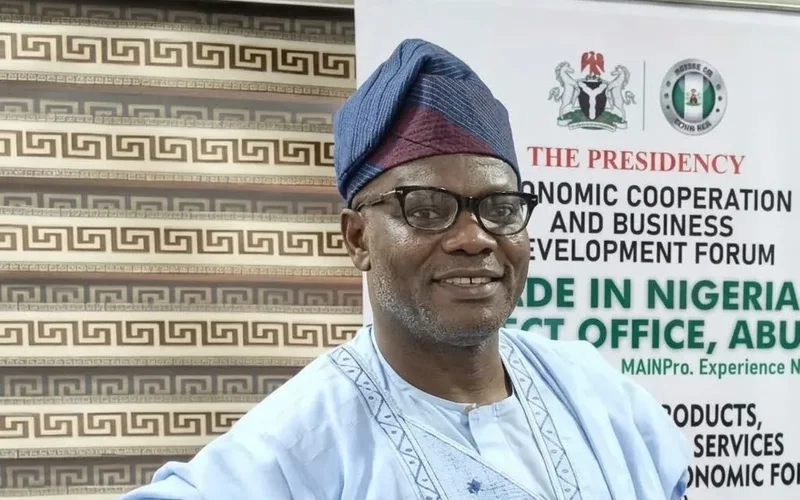
On Friday, the Nigerian government flagged another “fake” agency, with President Bola Tinubu suspending three top officials identified as enablers and ordering the arrest of the frontrunner.
This makes the fourth phoney agency that the Independent Corrupt Practices and Related Offences Commission (ICPC) has uncovered in its just-concluded 30-day investigation, which it submitted to Mr Tinubu.
The new agency- National Brands Development and Made in Nigeria Special Project Office- was uncovered by the ICPC barely two months after a similar case made headlines, ensnaring senior government officials, including the Chief of Staff to the President, Femi Gbajabiamila.
The agency allegedly operates under the Office of the Secretary to the Government of the Federation (OSGF), the ICPC chairperson, Musa Aliyu, told journalists after meeting with Mr Tinubu
| | |
|---|
The discovery came amid the ICPC’s investigation into the earlier case. Although the commission said the organisation operated without presidential authorisation, documents exclusively obtained by PREMIUM TIMES show that it presented itself to state governments as an official federal initiative operating from the OSGF.
Among the documents bearing the insignia of the presidency were a letter of appointment, approvals, and a series of correspondence to state governors, seeking financial, land, and other forms of support. Aside from this, the agency has a dedicated website and state coordinators across the country, including the Federal Capital Territory (FCT).
Between January and February, it wrote to governors in Lagos, Imo, Ondo, Sokoto, Edo and Nasarawa, seeking government support, state coordinators, funding or fee, land and participation in programmes in Nigeria and abroad.
All the letters were signed by Nwabueze George, the promoter of the agency, whom Mr Tinubu ordered to be arrested immediately. In the letters, Mr George was identified as the Executive Director of the National Coordinator, Made in Nigeria Project.
The ‘Presidency’ office that governors interacted with
The agency repeatedly identified itself as a federal initiative operating from the OSGF office.
Its letters were headed “The Presidency – National Brands Development and Made in Nigeria Special Project Office” and identified the office as being under the OSGF, Director SGF Office, at Shagari House, Three Arms Zone, Abuja.
In a 9 January letter marked “Third Reminder” and addressed to Lagos State Governor Babajide Sanwo-Olu, the agency sought the nomination and appointment of a Lagos State coordinator for its purported Made in Nigeria project.
The letter said the appointment would facilitate collaboration between the federal and state governments and promote local production, small and medium-sized enterprises (SMEs), industrial growth and international trade.
The letter told the governor that the nominee’s details would be used for “formal confirmation” and the issuance of an appointment letter from the Abuja office.
Letter addressed to Edo provided bank accounts for payment
In one of the letters dated 23 February, the agency sought authorisation to pay for a summit in Bahrain.
The letter directed the state to make payments into accounts belonging to the Made in Nigeria Project Office, Abuja.
It provided both a naira account and a dollar domiciliary account at Zenith Bank.
The agency said it was awaiting payment of $2,500 per person for registration, exhibition and participation in the Bahrain engagement.
It proposed a quota of five government officials and 25 private-sector participants from Edo State.
At the stated rate, a full delegation of 30 people would have amounted to $75,000, equivalent to about N100 million at the estimated exchange rate at the time.
A correspondence to the Nasarawa government
The agency’s correspondence with Nasarawa State provides a clearer picture of the scale of its operation.
It sought Governor Abdullahi Sule’s support for a “national stakeholders’” meeting in Lafia, scheduled for 28 to 30 April.
The proposed meeting was to involve national coordinating officers and state coordinators and, among other objectives, to inaugurate a State Coordinators Executive Council comprising representatives from the 36 states and the Federal Capital Territory.
The organisation said the event would formally launch its national structure.
Demanding a land, more financial support
The agency also sought a physical presence in Ondo State.
On 13 January, it wrote to the state governor, Lucky Aiyedatiwa, requesting land for a “Made in Nigeria Product Market.”
The proposed facility was described as a national platform for promoting, producing, exhibiting and commercialising Nigerian-made goods, brands and services.
The agency said the facility would provide space for manufacturers, artisans, innovators and SMEs and serve as a reference hub for Made in Nigeria products.
It also assured the governor that the project would comply with the Ondo Master Plan and relevant state regulations.
In another letter dated 23 January, the agency invited the Imo State Governor, Hope Uzodimma, as a “special guest of honour” and a speaker at its national inaugural convention scheduled to hold between 5 and 7 February in Lafia, Nasarawa.
The letter went beyond an invitation, asking the governor to provide financial support for transportation, hotel accommodation, feeding, conference materials, registration, training and other logistics.
The agency subsequently invited states to participate in international product fairs in Burundi, Equatorial Guinea, China, South Korea and Oman.
In a 10 February letter to Governor Ahmad Aliyu, the organisation invited Sokoto State to participate in food and agricultural expos in Bahrain and Azerbaijan.
Noting that it operates under OSGF, it wrote that it had a mandate to promote non-oil exports, showcase Nigerian agriculture and attract foreign investment.
The Bahrain event was scheduled for 1 to 5 April, while the Azerbaijan event was scheduled for 5 to 8 May.
The organisation promised participating states access to international markets, meetings with buyers and investors, and exposure to export standards and agricultural technologies.