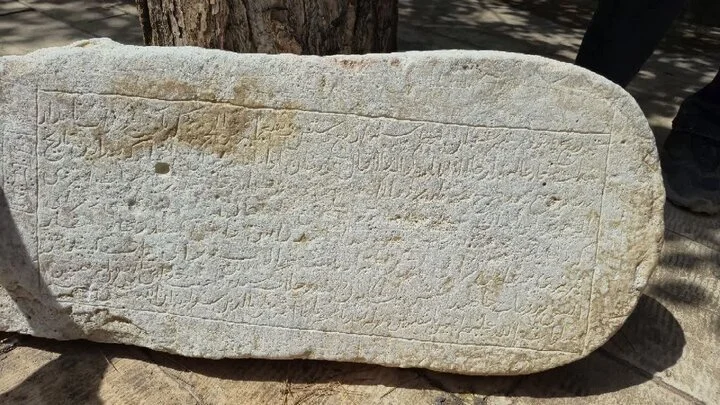
Ilkhanid-era stone inscription discovered in central Iran
TEHRAN – A stone inscription dating to the Ilkhanid period has been discovered during restoration work at the eastern entrance of the Jameh Mosque in Nimvar, a historic city in central Iran.
The white travertine stone measures approximately 85 by 34 centimeters and is 10 centimeters thick. It bears eight lines of carved writing, ISNA reported on Sunday.
Preliminary examinations suggest that the inscription may be a stone endowment deed, a local official said, adding that a definitive assessment of its content and exact nature will require further specialist studies by epigraphists and researchers.
The date recorded on the inscription is 764 AH, corresponding to 742 in the Iranian calendar, placing the artifact in the Ilkhanid period, the official said.
The inscription could provide researchers with further information about Nimvar's historical, cultural, religious and architectural development, the official added.
Nimvar is a city in Mahallat county of Markazi province. It is regarded as one of Iran's ancient settlements, with historical links to the Parthian and Sasanian periods. In antiquity, the city was also an important center of Zoroastrianism.
AM