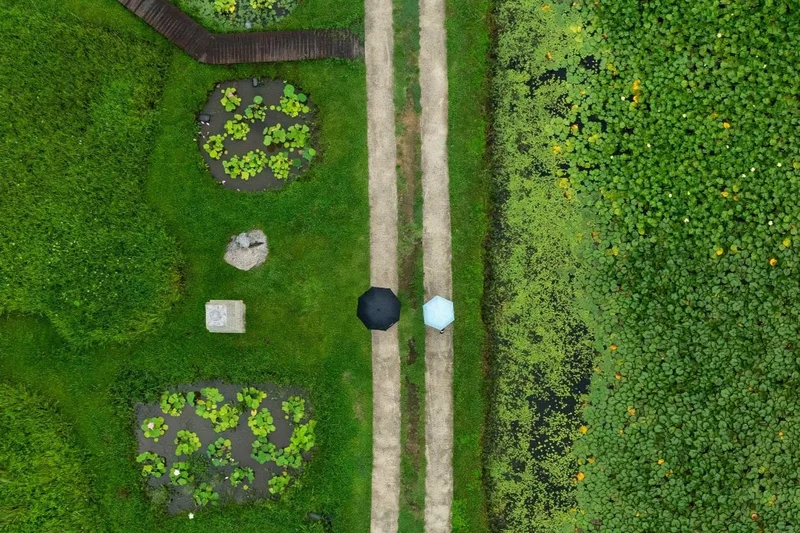
TAEAN, South Chungcheong Province — Along the windswept west coast of Korea, a unique botanical garden has spent over half a century proving that the best way to grow a forest is to leave it completely alone.
Founded in 1970, Chollipo Arboretum holds the historic distinction of being Korea’s first private arboretum. It was established by Carl Ferris Miller, a former U.S. Navy officer who naturalized as a Korean citizen under the name Min Pyong-gal. Miller passed away in 2002, but his foundational philosophy remains strictly intact at the arboretum, where human intervention is kept to an absolute minimum.
The garden’s beginning was notoriously difficult. It was planted on a barren, sandy shoreline constantly battered by harsh coastal winds and salty marine air. Instead of fighting these elements, the arboretum allowed the environment to naturally shape the landscape.
What makes this a cultural and ecological marvel is its radical policy against artificial pruning. In a region where traditional gardens often feature meticulously sculpted hedges and geometrically balanced trees, Chollipo strictly forbids the shaping of its flora.
Over the decades, Miller's deeply personal mission has flourished through international seed exchanges and passionate conservation into one of the most diverse botanical havens in Asia. Chollipo has dedicated itself to gathering and preserving rare, endangered and endemic species.
Spanning an impressive 600,000 square meters — equivalent to more than 80 international football fields combined — the arboretum has grown into a world-renowned ecological powerhouse. Within this vast maritime sanctuary, nature has been permitted to curate itself, resulting in an astonishing living collection of over 16,800 distinct plant varieties.
**Guardians of forest: Shared lifelong mission **
Choi Chang-ho, director of the Chollipo Arboretum Foundation, has spent over three decades safeguarding this coastal sanctuary. Having joined the arboretum in 1993, he worked side-by-side with Miller to cultivate the landscape until the founder's death in 2002.
Choi remembered Miller not just as a mentor, but as a man who possessed the rare gift of seeing plants as equal companions.
"In the mornings, he would walk past a tree, stroke it gently and ask, 'Did you sleep well?' After his mother passed away, he planted a mink-colored magnolia, named it the 'Mother Tree' and paid his respects to it every single day," he said during an interview with The Korea Times at the arboretum, July 16.
He said Miller's love of flora extended into the quiet hours, noting that one of his absolute favorite things to do was wandering the grounds at night. "Sometimes he cast the beam of a flashlight into the canopy just to witness how the forest transformed after dark. When storms rolled in, he would stand motionless beneath the gray skies for hours, completely captivated by the heavy raindrops falling against the leaves," Choi said.
Even today, Choi noted that walking through the arboretum often evokes vivid memories of the founder, as if the afterimage of Miller gazing at a particular tree still lingers in the landscape.
Choi said his own path to the arboretum began during his high school years at an agricultural school. "I found it utterly fascinating that if you broke off a branch and planted it in the ground, it grew roots. It felt as though a new living creature was being born right from my hands," he said. "Seeing those roots take hold gave me such a pure sense of joy that I naturally became drawn to grafting. I often call grafting 'surgery,' and because I had a knack for it, I leaned into this career."
Over the decades, Choi internalized Miller’s core philosophy of deep respect for nature.
"Miller always insisted that plants should be treated like humans, pouring immense care into everything he planted," Choi said. "He often told us to look after the trees rather than try to master them, reminding us that the plants — not us — are the true owners of this arboretum. That's why he strictly forbade anyone from cutting them."
According to Choi, Miller's reasoning was that a plant must be allowed to discover its true form, which is impossible if its branches are constantly pruned.
"Honoring his legacy, I always describe our arboretum as a 'living library of plants,'" Choi said. "Because the original forms are left perfectly intact, students of botany can come here and see exactly how a plant is naturally shaped. There is nowhere else in the country that allows plants to grow with this much freedom."
**From secret garden to national heritage **
For decades, this "secret garden" remained strictly closed to the general public, accessible only to members and experts for research and conservation. Following Miller’s death, the arboretum opened its gates to the public for the first time in 2009 to share the invaluable worth of unaltered nature with a wider audience.
Today, Chollipo Arboretum continues to serve as a quiet, powerful model for global ecological preservation, demonstrating that nature's own design is often the most resilient.
Underscoring this monumental legacy, a collection of 56 historical records documenting Miller’s 56-year journey transforming a barren wasteland into a world-class botanical sanctuary was designated as a National Registered Cultural Heritage last month. This collection, begun in 1962, includes land deeds, daily logs, plant collection and management records and international correspondence, marking the first time in Korea that arboretum-related archives have been recognized as national heritage.
The daily logs, which make up the largest portion of the archive, contain fascinating glimpses into the social landscape of the era. They include candid entries covering everything from the theft of flowers and the year’s first snowfall to a registered earthquake, and even an instance where the entire staff was placed on emergency standby following a report of a spy in the area. A selection of these captivating historical documents is currently on display at the Chollipo Arboretum’s Carl Ferris Miller Memorial Hall through October.
The arboretum is internationally celebrated for its world-class specialized collections, with unparalleled diversity in five signature plant groups: magnolias, camellias, holly plants, maples, and hibiscus flowers.
Chollipo Arboretum continues to serve as a quiet model for ecological preservation, demonstrating that nature's own design is often the most resilient. Walking through the gardens is like flipping through a living encyclopedia where every plant is treated with the dignity of an autonomous living being.