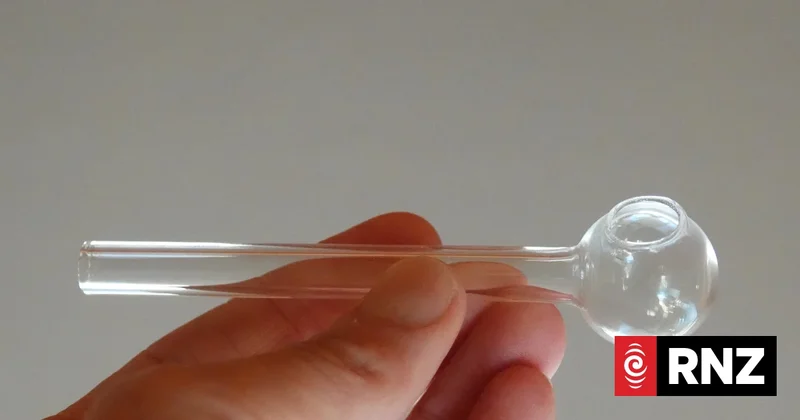
A newly released briefing paper has highlighted a lack of awareness among police, retailers and the public about a widely-flouted law banning the sale of meth pipes.
Importing and selling meth utensils has been illegal since 2014, but roughly two out of three vape stores, $2 shops and dairies in the Far North stocked the banned pipes when visited by an RNZ "secret shopper" last month.
In many cases the pipes were displayed openly on the counter, sometimes next to children's novelty items.
Police have previously told RNZ that selling meth pipes was not specifically prohibited, citing a section of the law that dealt with possession only.
However, a briefing paper prepared for Health Minister Simeon Brown made it clear the importation, supply and sale of methamphetamine utensils was prohibited under a separate section of the Misuse of Drugs Act.
The maximum penalty was three months' jail or a fine of $1000 for an individual or $5000 for a business.
Police have since told RNZ it was a matter of priorities - they had been focusing on the supply of the drug itself, but would now consider responding more proactively to the sale of meth pipes.
The ministerial briefing paper was released earlier this week following RNZ enquiries.
The paper's authors said improving compliance with the law "is likely to require raising awareness of the existing prohibition with police, retailers and the public".
The authors suggested Brown speak to Police Minister Mark Mitchell "about the extent to which the law is understood and enforced by police".
The Health Ministry could also publish information on its website and social media platforms to inform people of the ban and remind shop owners of their legal obligations.
They also suggested amending the Misuse of Drugs Act to make it clearer, or reviewing the penalties for selling drug utensils.
The authors said they were aware some retailers claimed the utensils were water pipes, ornaments or vases, and could therefore be sold legally.
That had not been tested in court but was unlikely to succeed because the ban was based on the physical features of the pipe, not on claims of what it was used for.
The paper's authors also said enforcing the law could have some negative health effects.
If users were unable to access glass pipes they could resort to riskier methods of ingesting the drug, for example by smoking it in pipes improvised from tin foil or broken lightbulbs, or injecting it.
However, it was likely some of the meth pipes currently for sale were of low quality and liable to shatter when heated, also causing harm.
The authors said those risks could be mitigated by allowing some utensils to be made available in a "harm-reduction context", much as needle exchanges already provided clean needles to injectable drug users.
That, however, would require a law change.
A police spokesman said staff responded to methamphetamine supply every day at an international, national and local level, as well as taking a strong enforcement role and supporting community resilience.
"Our response to methamphetamine users and possession of drugs has been more focused on a health-based response and preventing future harm by supporting users to find the help they need," the spokesman said.
Responding to the sale of methamphetamine pipes had not been prioritised.
"Instead, we have focused primarily on the supply of the drug itself [and] on large scale international and domestic supply chains."
Police and partner agencies had identified those supply chains and seized tonnes of methamphetamine and other drugs.
The spokesman said police would revisit their prioritisation and "consider opportunities to respond more proactively to the sale of meth pipes".
Confusion over whether or not the sale of meth pipes is illegal appears to stem from the way the law is written.
The Misuse of Drugs Act 1975 makes it an offence to be in possession of a meth pipe only if it is actually used for smoking meth. The so-called "primary legislation" makes no mention of selling or importing.
However, the Misuse of Drugs (Prohibited Utensils) Notice, first issued in 2014 and updated in 2020, makes it illegal to import or sell cannabis bongs, hash pipes and meth pipes.
The notice spells out the utensils' physical characteristics, rather than relying on claims about what they are intended for.
Customs has enforced the notice for a number of years.
The agency told RNZ it had seized 37,000 drug utensils in 2025 and more than 31,000 so far this year.