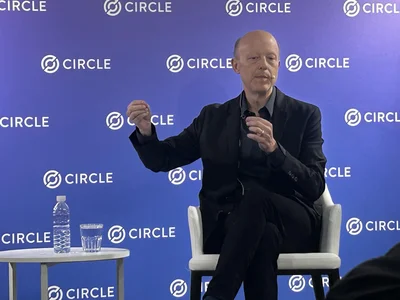
Circle CEO Jeremy Allaire speaks during a press conference in Seoul's Gangnam District, Monday. Korea Times photo by Lee Hyo-jin
Circle CEO Jeremy Allaire said Monday the U.S. stablecoin firm has no plans to issue a Korean won-based stablecoin, instead signaling a strategy focused on supporting local banks and fintech firms as they develop their own digital currencies.
"I don't believe Circle would issue a Korean won stablecoin," Allaire said during a press conference in Seoul, when asked about the possibility, noting that such efforts would likely be led by a consortium of Korean banks, fintechs and digital asset companies.
"However, we have built some of the most important and successful technology in the world for stablecoin operations that can be used to make them work across these blockchain networks," he added.
"So we may find ways to partner with Korean won issuers, and to be supportive of these emerging consortiums as they look to build Korean digital currencies."
Circle is the issuer of USDC, one of the world's largest stablecoins, which is pegged to the U.S. dollar.
Allaire's visit to Seoul comes as the New York-based firm steps up efforts to expand partnerships in Korea.
The CEO said the company is open to collaborations with Korea in cross-border payments through its payments network, Circle Payments Network (CPN), which settles transactions on blockchain using stablecoins.
Earlier in the day, he held back-to-back meetings with commercial banks, including KB Kookmin Bank, Shinhan Bank and Hana Bank, as well as cryptocurrency exchanges.
Circle signed a memorandum of understanding with Bithumb to explore cooperation in digital asset infrastructure and stablecoin technology. The firm also reached a similar agreement with Dunamu, operator of the Upbit exchange, aimed at fostering innovation in Korea’s digital asset market.
Allaire described Korea as a "highly attractive" market, citing its advaced technology, active participation in digital assets and strong rule of law.
"The Korean market is a very technologically advanced market. The population of Korea has already shown a strong interest in crypto and other digital assets, and so having a high propensity around that is very important," he said. "Also, I think it's a country with a strong rule of law which is very important."
He also told reporters he is "paying very close attention to the proposed laws" regarding digital assets in Korea, which could lay the groundwork for overseas companies.
The National Assembly and financial authorities are currently discussing details of the Digital Asset Basic Act, widely referred to as the second phase of virtual asset legislation. The bill outlines the legal definition and regulatory framework for the digital asset industry.
"With these laws, if they create a way for a company like Circle to come in, operate and be regulated here, that would be very welcome," the CEO said. "We've seen that in other major countries, like Hong Kong, where we're stepping up operations, as well as Singapore, Japan, the UAE and Europe."