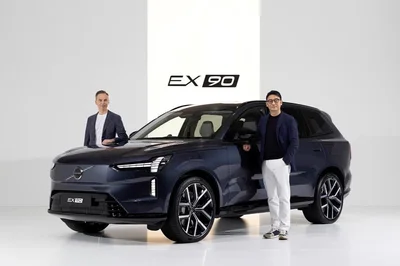
Volvo Car Korea CEO Lee Yoon-mo, right, poses with the carmaker's EX90 all-electric SUV at Inspire Entertainment Resort on Incheon’s Yeongjong Island, April 1. Courtesy of Volvo Car Korea
Tesla and BYD have emerged as the biggest disruptors in Korea’s imported car market, posing threats to established players — particularly to Volvo and Audi — two mid-tier premium carmakers that have recently lost their spots to the two rapidly growing electric vehicle (EV) makers, according to data and industry officials, Monday.
Tesla topped the list in the imported car sales between January and March by selling 20,964 EVs, according to data from the Korea Automobile Importers and Distributors Association. BMW Korea followed the list with 19,368 and Mercedes-Benz Korea came in third with 15,862 cars sold.
Of particular note is the rapid ascent of BYD Korea, which ranked fourth by selling 3,968 EVs during the same period. Volvo Car Korea and Audi Korea followed the list with auto sales of 3,628 and 3,138, respectively, in the first quarter.
BYD Korea is further tightening is presence here with a series of its price-competitive EV lineups, including the Atto 3 compact SUV, the high-performance Sealion 7 SUV and the Dolphin hatchback.
Volvo Car Korea and Audi Korea — which have long cemented their upper mid-tier position in the imported car market — ended up losing their market spot to the Chinese EV maker, only a year after BYD Korea made its market debut in January 2025.
Industry officials said there is still room for the two premium carmakers to win back their glory and surpass sales from BYD Korea, once their new strategic models make decent success here.
Audi Korea CEO Steve Cloete speaks during a press conference in Seoul, Jan. 15. Courtesy of Audi Korea
Audi Korea pins its hopes on revving up its sales with the upcoming launch of the fully redesigned A6 flagship sedan. The German carmaker is also scheduled to launch the third-generation Q3 compact SUV this year.
Volvo Car Korea is also stepping up efforts to maintain its recent sales momentum — initiated by a strong promotional campaign for its EX30 all-electric SUV. The carmaker recently cut the price for the compact electric SUV by up to 7.61 million won ($5,111) here in response to BYD’s emerging presence and Tesla’s aggressive discount for its Model Y SUV.
The EX30 has since drawn strong responses from customers by securing 2,000 orders within just two weeks of the discount announcement. The carmaker has also launched its EX90 premium electric SUV here, aiming to attract more customers seeking large luxury electric SUVs.
“For now, Tesla’s price-competitive Model Y is enjoying unmatched popularity particularly from consumers in their 20s and 30s, making it difficult for such legacy automakers to reclaim their rankings in the short run,” an official from the auto industry said.
“However, there is ample room for changes in the rankings, once new models from the traditional premium brands gain traction and the so-called Model Y boom fades.”