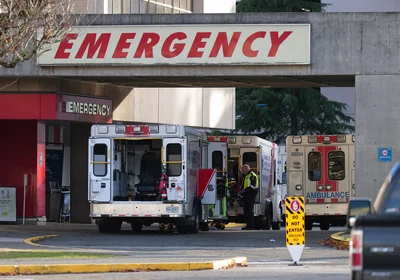

B.C. Health Minister Josie Osborne defended her government’s roll-back of decriminalization and the prescribed alternatives program.DARRYL DYCK/The Canadian Press
B.C. health officials marked the tenth anniversary of the province’s toxic-drug public health emergency by reflecting on profound human loss, some life-saving gains and policies that were undone by political blowback.
At a roundtable discussion in Victoria on Monday, Provincial Health Officer Bonnie Henry said she was disappointed that the province walked back some of her top recommendations, noting that there was “absolutely” political pressure.
Former provincial health officer Perry Kendall declared the emergency on April 14, 2016, in response to a surge in overdose deaths, driven by the growing presence of illicit fentanyl. The declaration allowed for better data sharing in response planning and supported a ministerial order authorizing the rapid expansion of overdose prevention services.
The decade since saw a major expansion of harm reduction services such as drug checking and take-home naloxone programs, alongside buildouts of detox, recovery and youth services. The province has also trialled – and walked back – more contentious efforts such as decriminalizing personal drug possession and prescribing alternatives to illicit drugs. It has dismissed ideas such as regulated heroin sales and otherwise expanding access to regulated drugs without prescriptions and committed to “strengthening” involuntary treatment.
Opinion: What has three years of decriminalization of drug possession yielded in B.C.?
Meanwhile, the illicit drug supply continued to evolve, with fentanyl supplanting the domestic supply of heroin. Newer additives such as benzodiazepines and tranquilizers have further complicated overdose response and recovery.
Since January, 2016, close to 19,000 people have died from illicit drugs in B.C. – enough to fill Vancouver’s Rogers Arena.
Decriminalizing personal drug possession was misunderstood by some as drug legalization, Dr. Henry said. And, prescribed alternatives to illicit drugs – also called safer supply – have been shown to benefit those at high risk of overdose.
“There are many benefits, but it takes time to measure these. And the milieu that we were in, we didn’t have the time to do that in an effective way,” Dr. Henry said.
“I don’t abandon hope on these. I think we need to regroup and relook at how we understand the principles behind these, and how we implement them in a way that is safer and addresses people’s very real concerns about public safety issues as well.”
Bernie Pauly, a scientist with the Canadian Institute for Substance Use Research, spoke to failures of implementation as a result of moral panic and misinformation. Drug decriminalization, which was widely blamed for public disorder, was hampered by a lack of public education, appropriate housing and wraparound supports such as mental health and trauma services, she said.
“I encourage the public to refuse the calls of those who capitalize on drug-related stigma for mostly political gains,” Dr. Pauly said.
B.C. ending its drug decriminalization pilot program
Health Minister Josie Osborne defended her government’s roll-back of decriminalization and the prescribed alternatives program.She said she was grateful the province was able to trial them, but that it also had to be responsive to public concerns, such as the diversion of prescribed alternatives to unintended recipients.
The province will review both programs to inform future decisions, she said.
“It is clear there is more work to do around reducing stigma, around opening up conversation, around needing to have a more nuanced conversation, like we are having today, about something that is very complex and requires a comprehensive approach,” Ms. Osborne said.
Nel Wieman, chief medical officer at the First Nations Health Authority, said a generation of people have been lost to toxic drugs and noted the disproportionate number of First Nations people who have died. Still, she is optimistic the public health emergency can be turned around.
“When I look back on the last 10 years, we still choose to be hopeful that things will get better,” she said at Monday’s roundtable. “What other choice do we have?”
Claire Rattee, the B.C. Conservative critic for Mental Health and Addictions, said the NDP government has been making the wrong choices for a decade.
By championing safe supply and decriminalization, the NDP has supported “ideological projects” that have hurt, not helped, Ms. Rattee said.
It’s unclear what the path forward is, she said.
“They have not replaced it with any kind of strategy on how we are actually going to get ourselves out of this crisis.”
Independent MLA Elenore Sturko, a vocal critic of the government’s drug policy, said the province’s projected $13.3-billion deficit gives her little confidence that Premier David Eby’s government can fund needed supports.
With a report from The Canadian Press